Artificial green walls have become one of the fastest-growing categories in commercial interior design. The global market reached roughly $1.0 to $1.5 billion in 2024 and is projected to hit $2.5 billion by 2033, expanding at about 9% annually (Verified Market Reports). For architects, designers, and facility managers weighing their options, the data points toward artificial systems: costs run 80 to 90% lower than living walls, maintenance drops to near zero, and the roughly 290,000 gallons of water a comparable living wall consumes over a decade never enters the equation.
At International Greenscapes, we’ve spent over four decades working with design teams on commercial botanical projects across hospitality, healthcare, corporate, and retail sectors. One of the clearest trends we’ve seen in recent years is the shift from standalone green walls to layered botanical environments, where vertical greenery and sculptural architectural trees work together to create spaces that feel genuinely immersive. Through our three specialized brands, PLANTWORKS®, NATUREMAKER®, and TREESCAPES®, we’ve built that kind of integrated approach into thousands of commercial projects nationwide.
This article covers the market data, the business case, the fire safety compliance framework, and the practical considerations involved in specifying large-scale artificial green walls for commercial spaces.
Why the Commercial Green Wall Market Is Growing at 9% Annually
Several forces are driving this growth simultaneously. The broader artificial plants and flowers market was valued at $3.09 billion in 2024, with commercial applications accounting for more than 58% of revenue (Grand View Research). That means hotels, corporate offices, retail centers, and restaurants are the primary buyers, not residential consumers.
North America leads the global market, capturing 29 to 38% of revenue depending on the research source. The U.S. vertical garden construction market alone is forecast to reach $608 million by 2030.
The key drivers include:
- Urbanization and space constraints pushing design vertical rather than horizontal
- Biophilic design mainstreaming in corporate wellness and tenant attraction programs
- Zero-maintenance appeal for facility managers dealing with tight operational budgets
- Building certification programs like WELL and LEED rewarding nature-integrated interiors
The result is that what was recently a design differentiator has become a baseline expectation. Commercial spaces without meaningful biophilic elements are increasingly at a disadvantage in tenant attraction, guest satisfaction, and brand perception.
The Business Case: Productivity, Wellness, and Revenue
The argument for green walls and botanical design in commercial spaces is no longer theoretical. Decades of research have produced specific, replicated numbers that tie nature exposure to human performance.
How Biophilic Design Affects Workplace Productivity
The Human Spaces Report (Interface, 2015), surveying 7,600 office workers across 16 countries, found that employees in environments with natural elements reported 6% higher productivity, 15% greater creativity, and 15% improved well-being. A separate study by Nieuwenhuis et al. at Cardiff University (2014) demonstrated a 15% productivity jump over three months in offices enriched with plants.
Terrapin Bright Green’s influential report, The Economics of Biophilia, puts those numbers in financial context. Because 90.3% of a typical office’s operating costs are salary-related (versus just 0.8% for energy), even small productivity improvements translate into outsized returns. A 6% productivity gain for a 1,000-person company could mean roughly $3.9 million in additional annual profits.
Green Walls in Hotels, Healthcare, and Retail
In hospitality, the data is particularly compelling. The Human Spaces 2.0 study found that biophilic hotel lobbies generated 36% longer dwell times than conventional ones. Research published in the Cornell Hospitality Quarterly (Suess et al., 2024) found that biophilic spaces attract approximately 35% more guests, with green walls and dense indoor landscaping ranking as the highest-utility attributes for guest restoration.
Roger Ulrich’s foundational 1984 study in Science found that surgery patients with nature views had 8.5% shorter hospital stays and required fewer pain medications. Terrapin Bright Green extrapolated this nationally, estimating $93 million in annual healthcare savings if nature views were standard in surgical recovery rooms.
In retail, research has documented that shoppers are willing to pay 15 to 25% more in greener settings (Wolf, 2005), and the ING Bank headquarters in Amsterdam saw absenteeism decline 15% after a biophilic redesign (Romm & Browning, 1994).
Living Green Walls vs. Artificial: Cost, Weight, and Maintenance
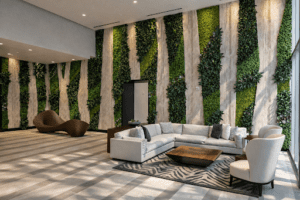
The total cost of ownership gap between living and artificial green walls is substantial, and it widens as labor and water costs rise. Here’s how the two compare across the factors that matter most to specifiers:
Factor | Living Green Wall | Artificial Green Wall |
Cost per sq ft | $95–$265 | $10–$25 |
Annual maintenance | 10–12% of original cost | Near zero |
Water use (107 sq ft/year) | ~29,000 gallons | 0 |
Saturated weight | 5–65 lbs/sq ft | 1–3 lbs/sq ft |
Annual plant replacement | 15–30% | 0% |
Specialized staff needed | Yes (horticulturists) | No |
Supplemental lighting | 12–15 hrs/day | None |
Pest management | Regular treatment | None |
Water damage risk | Irrigation leaks, mold | None |
Typical lifespan | 5–10 years (major replanting) | 10+ years |
Water consumption deserves a closer look. A 107-square-foot living wall consumes roughly 29,000 gallons annually with partial recycling, or up to 53,000 gallons without recirculation (Oquendo-Di Cosola et al., 2020, Journal of Environmental Management). Over a decade, that totals 290,000 to 530,000 gallons that an artificial wall simply never uses.
Weight is a structural concern that gets overlooked in early design phases. Living walls saturated with water and substrate weigh 5 to 65 pounds per square foot depending on system depth. Artificial panels weigh 1 to 3 pounds. That difference can eliminate the need for structural reinforcement entirely, which simplifies retrofits in existing commercial buildings.
Living walls also carry operational risk. Irrigation system failures can cause sections to brown out within days. Copper plumbing corrodes when exposed to fertilizer, causing plant toxicity and clogged emitters within two years. Mold growth on damp substrates is a recognized insurance concern. And paradoxically, living walls that dry out from irrigation failure become significantly more flammable, a fire safety liability that artificial IFR-rated walls avoid.
Fire Safety Compliance: NFPA 701, ASTM E84, and the IBC
Fire safety is a non-negotiable specification requirement for artificial green walls in commercial interiors. Three overlapping standards govern compliance, and understanding how they interact is essential for specifiers.
NFPA 701 (Standard Methods of Fire Tests for Flame Propagation of Textiles and Films) is the primary test standard referenced in building codes for decorative vegetation. Test Method 1 applies to lightweight artificial greenery (under 700 g/m²), requiring no more than 40% average mass loss, afterflame time of 2.0 seconds or less, and char length not exceeding 6.5 inches. Test Method 2 applies to heavier materials with stricter specimen requirements.
ASTM E84 (also published as UL 723) measures surface burning characteristics. Commercial green walls mounted to walls function as interior finishes under this standard. Class A certification requires a Flame Spread Index of 0 to 25 and a Smoke Developed Index of 0 to 450.
IBC Section 807.4 brings these standards into enforceable code, requiring all artificial decorative vegetation to meet NFPA 701 flame propagation criteria. Assembly spaces (Group A) restrict compliant decorative materials to 10% or less of wall and ceiling area, expandable to 75% with sprinklers in auditoriums.
Why IFR Materials Matter
The distinction between Inherently Fire Retardant (IFR) and topically treated products is critical. IFR materials have fire retardant chemicals blended into the raw polymer during manufacturing. The protection cannot wash off, dissipate, or leave residue, and it maintains consistent fire performance throughout the product’s lifespan. Topical treatments, applied by spraying or dipping, degrade over time and produce inconsistent coverage.
The historical reason these standards exist traces back to the 1942 Cocoanut Grove nightclub fire in Boston, where flammable artificial palm trees contributed to a fire that killed 492 people. That tragedy directly catalyzed the framework for decorative material regulation that persists today.
At International Greenscapes, all of our indoor green walls feature proprietary UltraLeaf-IFR® foliage, a commercial-grade, laboratory-tested material with inherent fire retardancy that meets ASTM E84 Class A, NFPA 701, and California Title 19 standards. The material blackens and self-extinguishes when a flame source is removed but does not sustain fire or contribute to flame spread.
How Green Walls and Architectural Trees Create Layered Environments
The most significant shift in commercial biophilic design right now is the move from isolated green walls to integrated botanical environments. Rather than adding a single accent wall, design teams are pairing vertical greenery with sculptural statement trees to create layered spaces with real depth.
This is something we see constantly in our own work. NATUREMAKER®, the original creator of the hand-sculpted steel-core tree since 1983, provides statement pieces that anchor a space architecturally, while PLANTWORKS® and TREESCAPES® provide the surrounding vertical greenery, understory, and canopy elements engineered for durability and realism.
At CATCH Las Vegas inside ARIA Resort & Casino, our PLANTWORKS® team built out an immersive environment that includes custom olive trees rising from booth centers, full-height green walls, an overhead floral ceiling, and a signature 80-foot floral tunnel entry with integrated fountains. Every element works together so the space reads as a single cohesive environment.
At the Three Arts Club Café at RH Chicago, TREESCAPES® fabricated Mediterranean olive trees engineered with inherently fire retardant materials to complement the historic 1914 building’s soaring glass atrium. The trees soften the grand architectural elements with organic form and gentle foliage, creating an atmosphere that feels like a courtyard garden.
The Datran Center in Miami is a good example of how this approach works in corporate settings. PLANTWORKS® and TREESCAPES® worked together on a comprehensive biophilic design strategy that spans ground-level and mezzanine lobbies, featuring trailing green walls, balcony-edge greenery, and architectural-grade fabricated trees that add scale and organic contrast throughout the 10,000-square-foot atrium.
The formula that works across these projects: green walls provide the backdrop and texture, while trees provide vertical structure and focal points. The combination reads as a cohesive environment rather than a collection of decorative additions.
Green Walls Across Commercial Sectors
Large-scale green wall projects have become signature design elements across virtually every commercial category.
Hospitality and restaurants are leading the trend. Feature trees now serve as architectural anchors alongside green walls, adding structure, height, and drama without seasonal change. In restaurant design, trees and green walls together create memorable moments, guide guests through the space, and highlight key areas like the host station or bar. We’ve seen this firsthand in projects ranging from the Forum Shops at Caesars Palace to SUSHISAMBA’s iconic Tree Bar.
Corporate offices increasingly treat biophilic design as tenant attraction and retention infrastructure. Green walls in lobbies, collaboration spaces, and break areas contribute to the kind of environment that helps reduce absenteeism. The American Society of Interior Designers’ headquarters achieved a 19% improvement in absenteeism and 16% improvement in presenteeism post-renovation, with first-year financial returns estimated at $694,000.
Healthcare facilities use green walls therapeutically. Hospitals with green elements have reported measurable reductions in patient painkiller use and stress levels. Our NATUREMAKER® brand has placed sculptural trees in healthcare settings including Bellin Health and Surgery Center and the Richard and Lois Nicotra Heart Institute, where the botanical art contributes to healing environments.
Airports feature some of the most dramatic green wall and tree projects in the world, from Singapore Changi’s 1,000-foot vertical green tapestry to Philadelphia International and San Diego International, where our own NATUREMAKER® trees anchor terminal spaces with regional character.
LEED, WELL, and Sustainability Considerations
The sustainability comparison between living and artificial green walls is more nuanced than it first appears.
On operational resource consumption, artificial walls win clearly. Eliminating 290,000+ gallons of water consumption over a decade is significant on its own. Living walls also require regular fertilization and pesticide applications, with runoff contributing to nutrient loading in drainage systems.
On carbon footprint, the numbers are closer than expected. Lifecycle assessment data from Perini et al. (2017) and Salah & Romanova (2021) estimates that over 10 years, a 10 m² living wall produces roughly 965 kg of CO₂ before sequestration offsets, while an equivalent artificial wall produces approximately 340 kg. When optimistic carbon sequestration estimates are applied to the living wall, the net figures are near parity.
On building certifications, living walls hold a direct advantage for LEED credits across multiple categories, including Sustainable Sites, Water Efficiency, and Indoor Environmental Quality. Artificial walls are not directly eligible for most LEED credits, though they may contribute under Materials & Resources (recycled content, particularly relevant for our steel-core trees that use 75% recycled steel) or Innovation categories.
The WELL Building Standard v2 favors living elements in specific prescriptive requirements, but its emphasis on occupant experience means that high-quality artificial greenery delivering visual biophilic connection can still support a broader biophilic design strategy. At International Greenscapes, we’ve seen many projects earn WELL and LEED recognition while incorporating our artificial green walls and botanical elements as part of a comprehensive approach.
What to Look for When Specifying Commercial Green Walls
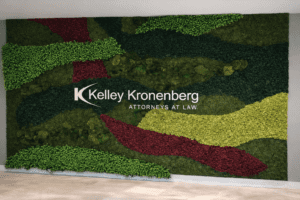
If you’re evaluating artificial green wall manufacturers for a commercial project, there are several things worth paying attention to beyond the product catalog.
Fire safety certification. Every panel should be IFR-rated, not topically treated. Ask for NFPA 701 and ASTM E84 Class A test documentation. If a manufacturer can’t provide independent lab reports, that’s a red flag.
Custom design capability. Commercial projects rarely fit off-the-shelf panel layouts. The manufacturer should be able to custom-design walls to exact dimensions and integrate with architectural features, lighting, signage, and water features.
Foliage variety and realism. A range of foliage types (boxwood, moss, ivy, fern, tropical) allows designers to create texture and depth rather than flat, uniform surfaces. The best manufacturers offer mixed-species panels that read as natural rather than repetitive.
Integration with other botanical elements. Green walls achieve their full impact when paired with complementary trees, planters, and overhead greenery. Working with a manufacturer that handles both vertical greenery and architectural trees simplifies coordination and ensures visual cohesion.
Track record at scale. Large-scale commercial projects have complexities that smaller residential jobs don’t. Code compliance, structural coordination, logistics, and tight construction timelines all require experience. Ask for references from comparable projects in your sector.
Frequently Asked Questions
How much do large-scale artificial green walls cost for commercial projects?
Artificial green wall panels typically cost $10 to $25 per square foot, depending on foliage type, panel complexity, and custom design requirements. By comparison, living walls run $95 to $265 per square foot before ongoing maintenance. Over a ten-year period, a 107-square-foot living wall costs an estimated $24,000 to $43,000 including maintenance, versus $4,300 to $8,200 for an artificial equivalent.
Do artificial green walls meet fire codes for commercial buildings?
Yes, when manufactured with Inherently Fire Retardant (IFR) materials. IFR-rated artificial green walls meet NFPA 701 (flame propagation), ASTM E84 Class A (flame spread and smoke development), and IBC Section 807.4 requirements for decorative vegetation in commercial interiors. The key is specifying IFR-rated panels rather than topically treated alternatives, which degrade over time.
Can artificial green walls contribute to LEED or WELL certification?
Artificial walls are not directly eligible for most LEED credits that specifically require living plant material. However, they may contribute under Materials & Resources categories (recycled content) and Innovation credits. Under the WELL Building Standard, artificial greenery can support broader biophilic design strategies even if it doesn’t satisfy specific prescriptive plant requirements. Many commercial projects successfully incorporate artificial green walls alongside other sustainability measures to achieve certification goals.
How long do commercial artificial green walls last?
Premium commercial-grade artificial green walls typically last 10 or more years with minimal upkeep, primarily occasional dusting by existing janitorial staff. This compares favorably with living walls, which often require major replanting every 5 to 10 years and experience annual plant replacement rates of 15 to 30%.
International Greenscapes has been building botanical environments for commercial spaces since 1983. Through our three specialized brands, PLANTWORKS®, NATUREMAKER®, and TREESCAPES®, we work with architects, designers, and developers to create spaces where green walls and architectural trees work together as cohesive, immersive environments. If you’re planning a project that involves large-scale green walls, statement trees, or both, reach out to our team for a complimentary design consultation.