The most commonly specified artificial trees for commercial projects are palm trees, olive trees, ficus trees, birch trees, steel-core sculptural trees, natural wood tree trunks, preserved trees, bamboo, topiaries, outdoor-rated trees, cherry blossoms, and banyans. The right choice depends on the environment, fire code requirements, traffic levels, and the visual effect you’re trying to achieve.
The global artificial plants market is valued between $1 billion and $3.3 billion, depending on scope, growing at roughly 5-7% annually through 2032. Commercial applications account for more than 58% of all sales. Today’s commercial-grade trees range from mass-produced replica ficus trees to museum-quality, hand-sculpted steel-core specimens that take months or years to complete.
At International Greenscapes, we’ve been fabricating and assembling artificial trees for commercial projects since 1983 through our three specialized brands: NATUREMAKER®, PLANTWORKS®, and TREESCAPES®. With over 20,000 completed projects across hotels, casinos, airports, restaurants, and retail spaces, we’ve seen the industry transform from a niche category into a core component of commercial architecture.
This guide breaks down the 12 most commonly specified artificial tree types for commercial projects, the biophilic design research driving adoption, the fire safety requirements you need to know, and how to match the right tree to your space.
Why commercial projects are shifting to artificial trees
The business case for commercial artificial trees comes down to two converging forces: the biophilic design movement is creating demand for greenery in spaces where living plants can’t survive, and the total cost of ownership makes artificial trees the more practical choice for most commercial square footage.
The biophilic design case
Biophilic design, rooted in Edward O. Wilson’s 1984 biophilia hypothesis, has moved from academic theory to measurable commercial strategy. The Human Spaces Global Report, which surveyed 7,600 office workers across 16 countries, found that workers in environments with natural elements reported 6% higher productivity, 15% higher creativity, and 15% greater well-being. A third of respondents said office design affects their employment decisions.
Terrapin Bright Green’s Economics of Biophilia report quantified the financial side: integrating nature views in office space can save over $2,000 per employee per year, and buildings with biophilic design features command 7-8% rental premiums.
In healthcare, Roger Ulrich’s foundational study showed patients with nature views recovered nearly a full day faster and used 22% less pain medication. In retail, customers in biophilic settings perceive merchandise as worth prices up to 25% higher. Hotel guests spend 36% more in lobbies with nature displays.
The challenge is that most of the spaces where these benefits are needed, such as windowless corridors, casino gaming floors, underground retail, and hospital rooms, are exactly where living plants can’t thrive. That’s where high-quality artificial trees become essential infrastructure.
The cost comparison
The economics of artificial versus live trees in commercial settings are straightforward when you look at five-year total cost of ownership.
| Factor | Live Trees | Artificial Trees |
|---|---|---|
| 5-year cost per plant | ~$650 (including maintenance) | ~$175 (one-time purchase + minimal cleaning) |
| Monthly maintenance | $125 to $600+ (professional service contracts) | None required |
| Watering | Daily to weekly | None |
| Light requirements | Adequate natural or supplemental lighting | None |
| Allergen risk | Pollen, mold, soil-borne allergens | Completely allergen-free |
| Appearance consistency | Seasonal changes, wilting, browning | Consistent year-round |
| Indoor lifespan | Weeks to years (species dependent) | Decades with quality commercial products |
| Specialized staff | Required (weekly or biweekly visits) | Not needed |
Major hotel brands report approximately 75% cost reduction over five-year periods after switching from live to artificial plants. The most significant practical advantage is placement flexibility: artificial trees can go in windowless corridors, ceiling installations, temperature-controlled environments, and high-traffic areas where live plants would be destroyed within weeks.
The industry best practice, and one we advocate at International Greenscapes, is a hybrid approach. Live plants at ground level where conditions support them, capturing air quality benefits. Artificial trees in challenging locations where living specimens would fail. This strategy satisfies both the WELL Building Standard and LEED certification requirements.
12 types of artificial trees used in commercial projects
Artificial palm trees
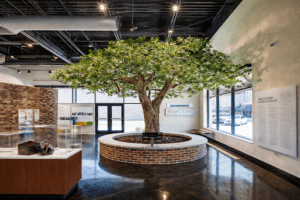
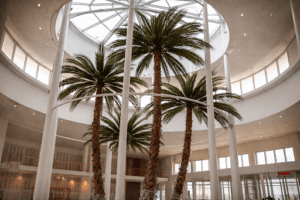
Palms are the workhorse of resort, casino, and tropical-themed commercial design. Species range from royal palms and coconut palms to fan palms, date palms, and areca palms. Commercial sizes go from tabletop specimens to custom fabrications exceeding 45 feet.
Construction quality varies significantly across the market. At the commercial grade level, real palm bark is mounted piece by piece onto a rust-resistant steel core, with fronds made from weatherproof poly resins containing UV inhibitors infused during the molding process. Bendable steel or aluminum cores inside fronds allow natural sway in wind and return to position.
There’s also a distinction worth understanding: preserved palm trees versus fully fabricated palms. Preserved palms use real harvested palm fronds treated with a glycerin-based solution that replaces internal sap, maintaining the natural cellular structure, translucency, and texture of the living plant. Our TREESCAPES® division specializes in preserved palms, which often look better than fully synthetic alternatives, particularly when backlit. The tradeoff is that preserved palms are best suited for indoor and covered outdoor environments. Fully fabricated palms with UV-inhibited foliage are the better choice for direct sun exposure.
Palm trees are commonly specified for hotel lobbies, casino gaming floors, resort pool decks, cruise ship atriums, and airport terminals. Our TREESCAPES® team created custom-fabricated date palms for The Palm Court at RH San Francisco, where they rise beneath a glass-enclosed atrium, and has provided preserved Phoenix dactylifera date palms for The Forum Shops at Caesars Palace in Las Vegas.
Artificial olive trees
Olive trees bring Mediterranean elegance to restaurants, luxury retail, and hotel lobbies. Their silvery-green foliage, twisted trunks, and gnarled bark make them distinctive focal pieces that work in settings from casual to ultra-high-end.
Mediterranean olives are our number one best-selling species at International Greenscapes, and for good reason. The gnarly trunks and expansive canopies create visual drama that few other species can match. The best commercial olive trees use hand-selected natural olive wood trunks paired with artificial foliage, giving you authentic bark texture with zero maintenance.
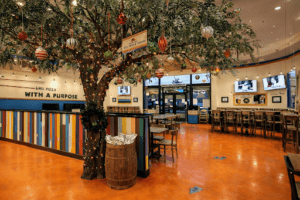
Commercial sizes typically range from 4 to 22 feet. We’ve fabricated custom olive trees for CATCH Las Vegas at ARIA Resort & Casino, where olive trees rise from the center of round booths, and for the Three Arts Club Café at RH Chicago, where they sit within a soaring glass atrium. A custom 14.5-foot olive tree crafted from a real olive trunk was also featured on HGTV’s Sin City Rehab.
Artificial ficus trees
The ficus, particularly the Benjamina or Weeping Fig, is the single most popular artificial tree for office and commercial spaces worldwide. Its dense, lush canopy and clean architectural silhouette adapt to modern, tropical, traditional, and specialty design themes.
Ficus trees work across corporate lobbies, healthcare facilities, co-working spaces, and restaurants. They’re available from 3-foot tabletop sizes to 16+ feet, with inherently fire-retardant (IFR) foliage meeting NFPA 701 standards and UV-resistant versions for near-window placement.
Our PLANTWORKS® division created two custom 16-foot ficus trees for Café Carmellini at The Fifth Avenue Hotel in New York City, and natural-trunk ficus trees with pink blossoms for Flight Club in Washington, D.C. TREESCAPES® has also fabricated grand ficus trees for Toca Madera in Las Vegas, where they serve as focal points throughout the restaurant with realistic bark textures and lush canopies.
Artificial birch trees
Birch trees are prized for their iconic white peeling bark, making them instantly recognizable in modern and Scandinavian-inspired commercial design. Real natural birch trunks are often used for maximum realism, paired with artificial foliage in green or autumn tones.
Our NATUREMAKER® division created a soaring 36-foot birch tree as the anchor piece at the Walton Family Whole Health & Fitness campus in Bentonville, Arkansas, a wellness campus for Walmart associates. We’ve also assembled birch trees at The Bow in Calgary’s 42nd-floor sky lobby and the Richard and Lois Nicotra Heart Institute in New York.
Customizable heights range from 6 to 26 feet, with inherently fire-retardant polyester foliage where chemicals are fused at the molecular level, providing permanent protection that won’t wash off or degrade over time.
Artificial bamboo
Bamboo serves dual purposes as both greenery and functional space divider in Asian-themed restaurants, spas, wellness centers, and modern offices. Dense foliage creates effective privacy screening without fully dividing spaces or blocking light.
Available in multiple stalk configurations (3-stalk through 8-stalk), subspecies include black bamboo, japonica, and timber bamboo. Natural bamboo trunks provide authenticity, while UV-resistant versions work for outdoor patios and formal entryways. Heights reach up to 40 feet for custom commercial fabrications, with fire-retardant options for code compliance.
Artificial topiaries
Topiaries communicate formality and prestige at building entrances, retail storefronts, and hotel exteriors. Shapes include ball/globe (single, double, or triple), spiral, cone/pyramid, teardrop, and rectangular column forms. Boxwood is the dominant species, with cedar and bay leaf alternatives.
Outdoor versions use UV-resistant PVC and polyblend materials with multi-year fade warranties. Sizes range from 12-inch tabletop globes to 15+ foot custom fabrications. The perfect symmetry and consistency of artificial topiaries, something that’s impossible to maintain with live specimens, makes them especially valuable where year-round visual consistency matters.
Our TREESCAPES® division created custom outdoor topiaries and colorful floral arrangements for the Peppermill Resort Spa Casino in Reno, fabricated to withstand the region’s climate with UV-rated exterior materials.
Preserved trees
Preserved trees occupy a unique niche: they are real plant material sustainably harvested and treated with glycerin-based solutions to maintain their natural appearance indefinitely without water, light, or maintenance.
The preservation process takes approximately two weeks for absorption plus two to three weeks of drying. Glycerin replaces internal sap, and the process makes leaves inherently fire retardant (not topically treated), meeting the strictest commercial fire codes. Preserved palm trees are the most popular type, used in restaurants, hotels, casinos, and airports since the early 1990s.
The key limitation is that preserved trees are indoor-only. They cannot withstand temperatures below 50°F (10°C) or humidity above 80%. Fronds maintain appearance for 6 to 8 years before replacement is needed.
Steel-core sculptural trees
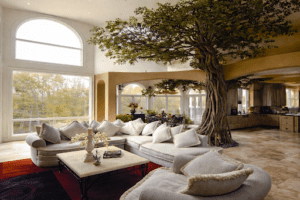
Steel-core trees represent the highest tier of commercial artificial tree craftsmanship: one-of-a-kind, hand-sculpted pieces built on engineered steel substructures. NATUREMAKER®, founded in 1983, originated this category.
The process involves welding steel frameworks using 75% recycled steel, applying a proprietary bark medium wet to the steel structure, then hand-carving, hand-painting, and scenically aging each tree to achieve 87% botanical accuracy. A team of artisans, designers, welders, and craftspeople creates each piece at our facilities in San Marcos, California, and Las Vegas, Nevada.
What makes steel-core trees unique for architects is their ability to integrate building systems. The steel substructure can accommodate lighting, A/V equipment, sprinkler systems, surveillance cameras, HVAC ductwork, and millwork. Column-clad configurations can conceal structural support pillars, transforming a utilitarian necessity into a biophilic feature.
Notable steel-core projects include a 24-foot public art sculpture on NYC’s High Line, a walk-through sequoia at Fresno Yosemite International Airport, a 25-foot oak at The Met Gala, and interactive banyans at the Golisano Children’s Museum in Naples, Florida.
Natural wood trunk trees
These hybrid trees use real harvested wood for trunks with maintenance-free artificial foliage, delivering exceptional realism where close-up inspection is expected. Real bark texture, color variations, and natural imperfections are impossible to replicate synthetically, making natural-trunk trees ideal for high-end restaurants, hotel lobbies, and luxury retail.
Our PLANTWORKS® division makes this a core offering, using hand-selected myrtle, dragonwood, and birch wood trunks. Each trunk is fumigated to meet international import standards and supported internally by PVC pipe set in concrete. Heights typically range from 6 to 16 feet, making them suitable for standard ceiling heights.
PLANTWORKS® natural-trunk trees are featured at Stubborn Seed (a Michelin-starred restaurant at Resorts World Las Vegas), Amaya at The Cosmopolitan Las Vegas, and multiple JOEY Restaurants locations.
Outdoor-rated artificial trees
Outdoor trees require fundamentally different materials than indoor trees. Silk is strictly indoor-only; outdoor trees use polyethylene, PVC, and polyblend plastics with UV inhibitors infused during manufacturing. The distinction between “outdoor-safe” (suitable for covered patios) and “UV-resistant” (rated for direct sunlight) is important to understand before specifying.
Weather-resistant features for commercial outdoor trees include rust-resistant steel cores, stainless steel hardware for salt-air environments, and weighted bases for wind stability. Our TREESCAPES® team engineers outdoor trees with UltraLeaf-X® UV-inhibited foliage designed for prolonged direct sun exposure, with colorfast guarantees.
JOEY Restaurants in Newport Beach features a custom outdoor olive tree with UV-inhibited foliage and hand-painted trunk, assembled overnight into a recessed mounting base concealed in the patio floor.
Cherry blossom trees
Cherry blossom trees are popular for events, seasonal retail displays, and Asian-themed restaurants. Available in soft pink, deep fuchsia, and white, they use steel frames with fiber-reinforced plastic (FRP) trunk coatings and silk or polyurethane flowers. Fire-retardant versions are available for commercial venues, and interchangeable branches allow seasonal transitions.
Our TREESCAPES® division created cherry blossom trees for Okura Robata & Sushi Bar in La Quinta, California and a cherry column-clad tree for COCINA 35 at Liberty Station in San Diego.
Banyan and specialty trees
Banyans, with their dramatic aerial root systems, are used for large-scale immersive environments. TREESCAPES® created a weather-resistant exterior banyan for the San Diego Zoo Amphitheater, and NATUREMAKER® has assembled interactive banyan trees at the Golisano Children’s Museum and CityPlace West Palm Beach.
Other commercially relevant species include magnolia (luxury hospitality and retail), Japanese maple (zen spaces and outdoor landscapes), bougainvillea (Mediterranean and resort themes), and fiddle leaf fig (contemporary offices and boutique retail).
How to match tree types to commercial settings
Choosing the right artificial tree for a commercial project depends on the environment, traffic patterns, code requirements, and the visual effect you’re trying to achieve. Here’s how the most common commercial settings typically map to tree types.
Commercial Setting | Best-Suited Tree Types | Key Considerations |
Hotel lobbies | Palms, ficus, large statement trees, olive | Scale to match atrium heights; fire-rated materials required |
Restaurants | Olive, cherry blossom, oak, ficus | Thematic consistency; column-clad options for space efficiency |
Corporate offices | Ficus, fiddle leaf fig, birch | Clean architectural silhouettes; WELL Building Standard compliance |
Resorts and pools | Coconut palms, date palms, fan palms | UV-resistant outdoor-rated materials; salt-air resistant hardware |
Healthcare facilities | Ficus, small palms, calming species | Allergen-free; must pass inspection standards; IFR fire compliance |
Retail and malls | Topiaries, seasonal cherry blossoms, ficus | High-traffic durability; seasonal display adaptability |
Airports | Preserved palms, large ficus, statement trees | Fire-rated; ADA compliant; seismic engineering require |
Casinos | Preserved palms, steel-core trees, column-clad | Fire compliance is strict; integrated lighting and A/V capabilities |
Spas and zen spaces | Bamboo, Japanese maple | Privacy screening function; calming visual profile |
Fire safety compliance for commercial artificial trees
Fire safety is non-negotiable for any artificial tree going into a commercial space. Less than 1% of all artificial plants on the market meet NFPA 701 standards, so this is an area where the choice of manufacturer matters significantly.
NFPA 701 and IBC Section 807.4
NFPA 701 (“Standard Methods of Fire Tests for Flame Propagation of Textiles and Films”) is the primary fire safety standard governing artificial plants in commercial settings. It evaluates vertical flame propagation, after-flame time, char length, and flaming drips through both small-scale (Method 1) and large-scale (Method 2) testing.
The International Building Code (IBC) Section 807.4 specifically addresses artificial decorative vegetation. Requirements include:
- All artificial vegetation in commercial spaces must meet NFPA 701 Test Method 1 or 2
- Compliance must be documented and certified by the manufacturer
- Wall coverage cannot exceed 30% of wall area
- Freestanding vegetation in non-sprinklered buildings is limited to 3 feet maximum height
- Unlisted electrical wiring on artificial vegetation is prohibited
Inherently fire retardant vs. topical treatments
There are two approaches to fire compliance, and the difference matters.
Inherently Fire Retardant (IFR) technology integrates fire-retardant chemicals during manufacturing at the molecular level. It will not wash off, dissipate, or leave residue, providing lifetime protection. Quality IFR products achieve an ASTM E84 Class A rating with flame spread indices well below the Class A threshold of 25.
Topical surface treatments, applied post-manufacturing by spraying, are less durable. They typically retain efficacy for about 2 years and are not recommended for permanent commercial projects.
At International Greenscapes, all of our products are available with inherently fire-retardant materials, meeting or exceeding ASTM E84 Class A, NFPA 701, and California Title 19 standards. We provide stamped certifications for fire marshal review and maintain complete compliance documentation for every project.
Engineering considerations for large-scale artificial trees
Large commercial artificial trees, particularly those exceeding 20 feet, are genuine engineering projects. If you’re planning an architectural-scale tree, here’s what your team should be thinking about early in the design process.
Structural and seismic requirements
Major fabricators consult with architects at the beginning of the building design process so structural supports and footings can be incorporated from the outset. Steel-core trees conform to architectural, structural, fire, and seismic specifications, meeting or exceeding applicable building codes. Trees intended for public spaces are designed to be ADA compliant.
The fabrication and assembly process
Construction follows a systematic sequence: steel frameworks are welded to form the skeleton, with connection points for main and secondary branches. A sculptural bark medium (typically fiberglass resin) is applied over the steel core, then hand-carved and hand-painted with natural imperfections including knots, burls, and growth patterns.
For shipping, each tree is dismantled into labeled, numbered, and color-coded components using telescoping connections and invisible joints. Trees do not need to be brought through roofs or require unconstructed walls for assembly on-site.
Maximum sizes for custom commercial trees reach 40-50+ feet tall with canopy spreads of 24 feet or more. NATUREMAKER®’s Tree of Tenere at Burning Man measured 40 x 40 feet and was engineered to support climbers.
Sustainability credentials
Sustainability is increasingly a factor in commercial specification decisions. Quality commercial trees are fabricated from 75% recycled steel with 50-75% recyclable component parts, use low-VOC materials meeting RoHS guidelines, and can contribute to LEED Green Building certification credits across water efficiency, materials reuse, and recycled content categories.
How to evaluate artificial tree quality before you buy
Not all commercial artificial trees are created equal. Here are the factors that separate commercial-grade products from consumer-grade alternatives.
Materials and construction. Look for steel-core or engineered polymer cores rather than plastic tubing. For natural-trunk trees, ask whether real wood is used and how it’s preserved and supported internally. For foliage, ask specifically about inherently fire-retardant (IFR) treatment versus topical spray.
Botanical accuracy. The best commercial trees replicate natural growth habits, branch architecture, bark texture, and leaf arrangement patterns. At International Greenscapes, we target 87% botanical accuracy, replicating specific phyllotaxy (leaf arrangement) patterns and authentic bark textures hand-carved from molds taken from real specimens.
Code compliance documentation. Any manufacturer serving the commercial market should be able to provide ASTM E84, NFPA 701, and California Title 19 certifications on request. If they can’t produce documentation, that’s a red flag.
Customization capability. Commercial projects rarely benefit from off-the-shelf solutions. The ability to customize heights, canopy density, trunk configuration, foliage color, and architectural integration (column cladding, wall mounting, lighting integration) is what separates commercial fabricators from retail suppliers.
Track record. Ask for project references in similar environments. A manufacturer with thousands of hospitality, healthcare, or airport projects will understand the code requirements, traffic demands, and assembly logistics that a consumer-focused company simply won’t.
Getting started with your commercial tree project
Selecting the right artificial trees for a commercial project involves balancing aesthetics, code compliance, budget, and long-term performance. The species type, construction method, and fire safety certification all need to align with your specific space and requirements.
If you’re in the planning or design phase of a commercial project and want to discuss tree options, our team provides complimentary consultations, including species selection guidance, preliminary renderings, and engineering documentation for your project team. Reach out to start the conversation.