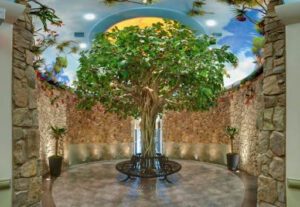
Every artificial tree placed in a U.S. commercial building must pass NFPA 701 flame propagation testing before a fire marshal will approve it. Depending on the state and occupancy type, additional standards like ASTM E84, California Title 19, and the International Fire Code (IFC) may also apply. Large trees in seismic zones need professional structural engineering as well. The regulatory framework is layered, but it exists for a clear reason: fires involving non-compliant decorative vegetation have killed hundreds of people in documented incidents spanning the last eight decades.
At International Greenscapes, we’ve worked through this compliance process on over 30,000 commercial projects across casinos, airports, hospitals, hotels, restaurants, and retail environments. Every product we fabricate uses inherently fire-retardant (IFR) materials that meet ASTM E84 Class A, NFPA 701, and California Title 19 standards. Below, we’ll walk through each layer of the regulatory framework, so you know exactly what to expect when specifying artificial trees for a commercial project.
Why Fire Ratings Matter for Artificial Vegetation
The fire safety standards governing artificial trees exist because of real tragedies. The 1942 Cocoanut Grove nightclub fire in Boston killed 492 people when flames spread along decorative palm fronds to a fabric-covered ceiling. That single event became the foundation of the NFPA Life Safety Code and led directly to laws banning flammable decorations in public establishments.
More recently, in April 2023, a restaurant fire in Madrid killed three people and injured 12 when a waiter’s flambeed dish ignited artificial plants decorating the ceiling and columns. UK fire services investigated afterward and found that artificial decorations they tested from similar restaurants caught fire rapidly, despite claims of being fire-retardant. And in January 2025, a fire in an artificial flower shop in Karachi, Pakistan, killed 79 people when synthetic materials ignited and spread, collapsing the building.
These aren’t abstract risks. They’re the reason fire marshals require documentation before approving any artificial vegetation in a commercial space.
NFPA 701: The Baseline Standard for Artificial Trees
NFPA 701, Standard Methods of Fire Tests for Flame Propagation of Textiles and Films, is the single most important fire test for artificial decorative vegetation in commercial buildings. Published by the National Fire Protection Association and originating in 1938, the current 2023 edition formally added artificial decorative vegetation to its scope for the first time.
The standard evaluates whether materials will propagate flame, produce dangerous flaming droplets, or self-extinguish after ignition. It does not measure fire resistance (how long a material blocks fire passage), but rather flame behavior under controlled ignition.
Test Method 1 vs. Test Method 2
NFPA 701 contains two distinct test methods. Because artificial vegetation is classified as a decorative material rather than a fabric, Test Method 2 (TM2) is the appropriate test for most commercial artificial tree products. The IFC explicitly requires artificial decorative vegetation to meet the flame propagation performance criteria of TM1 or TM2, as appropriate.
| Criterion | TM1 (under 700 g/m²) | TM2 (over 700 g/m²) |
|---|---|---|
| Ignition time | 45 seconds | 70 sec (folded) / 120 sec (flat) |
| Mass loss limit | Less than 40% average | N/A |
| Char length limit | N/A | Less than 1,050 mm folded / less than 435 mm flat |
| Afterflame limit | Less than 2.0 sec (drips) | Less than 2.0 sec (all specimens) |
| Flaming drip limit | Less than 2.0 sec average | Less than 2.0 sec |
An alternative compliance path allows testing per NFPA 289 using a 20 kW ignition source, with a maximum permissible heat release rate of 100 kW.
ASTM E84: Surface Burning Classifications
ASTM E84, also called the Steiner Tunnel Test, is the primary standard the International Building Code (IBC) uses to regulate interior wall and ceiling finishes. The test apparatus is a 24-foot steel tunnel where specimens are mounted face down and exposed to 89 kW gas burners for 10 minutes. Two indices are measured against calibration references of red oak (100/100) and cement board (0/0).
| Classification | Flame Spread Index (FSI) | Smoke Developed Index (SDI) | Typical Application |
|---|---|---|---|
| Class A (Class I) | 0–25 | 0–450 | Exit stairways, corridors, high-occupancy spaces |
| Class B (Class II) | 26–75 | 0–450 | General commercial corridors, residential |
| Class C (Class III) | 76–200 | 0–450 | Limited applications, rooms with sprinklers |
A Class A rating does not mean a material won’t burn. It means the material resists flame spread and limits smoke production better than Class B or C materials.
When Does ASTM E84 Apply to Artificial Trees?
ASTM E84 primarily governs materials applied to building surfaces (walls and ceilings) rather than freestanding decorative elements. Freestanding artificial trees in a lobby are regulated primarily under NFPA 701 via IFC Section 807.4. However, when artificial vegetation is attached to walls as a green wall covering more than 10% of wall area, it may be classified as interior finish under IBC Section 803 and require ASTM E84 testing.
This is why some manufacturers obtain both NFPA 701 and ASTM E84 certifications. All materials used in our NATUREMAKER® steel-core sculptural trees, for instance, are fire-retardant and conform to the maximum ASTM E84 flame/smoke rating. Our TREESCAPES® and PLANTWORKS® product lines use UltraLeaf-IFR® foliage certified to NFPA 701, ASTM E84 Class A, and California Title 19.
California Title 19: The Nation’s Strictest Standard
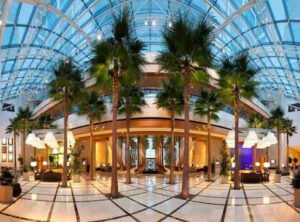
California Code of Regulations, Title 19, Division 1, Chapter 8 establishes fire safety requirements that do not accept NFPA 701 testing as a substitute. Products that pass NFPA 701 must undergo separate California Title 19 testing at an Office of the State Fire Marshal (OSFM)-approved laboratory and be registered with the OSFM before being placed in California.
What Makes Title 19 Different
The testing protocol under Section 1237 is distinctive. The small-scale test exposes a 2.5″ x 10″ specimen to a 4.5-inch oxidizing flame for just 1 second (compared to NFPA 701 TM1’s 45-second exposure), but requires testing in three conditions: original state, after accelerated weathering, and after water extraction. This durability requirement is the key differentiator. It ensures treatments remain effective over time, not just on the day of initial testing.
Pass criteria require afterflame of less than 2 seconds, average char length of less than 3.5 inches, and maximum char length of less than 6 inches.
California Title 19 is considered the most stringent for several reasons:
- The OSFM maintains its own mandatory registration system. Materials must carry an OSFM-issued seal with a unique registration number.
- Only OSFM-approved laboratories may perform testing.
- The state requires separate registration of flame-retardant chemicals, companies that apply them, and the treated or inherently non-flammable materials themselves.
- The OSFM directly addresses artificial decorative vegetation in Section 3.08 and requires compliance with Chapter 8’s flame propagation criteria.
If you’re specifying artificial trees for a project in California, your manufacturer needs to provide California Title 19 registration documentation in addition to NFPA 701 test reports. These are two separate testing regimes, and neither substitutes for the other.
IBC and IFC: How Building Codes Regulate Artificial Plants
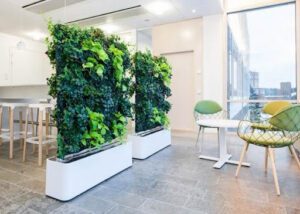
The International Building Code and International Fire Code work in tandem. The IBC governs construction requirements, while the IFC governs ongoing fire prevention in operations.
IFC Section 807.4: The Key Provision
IFC Section 807.4 is the most important code provision governing artificial plants in commercial buildings. It requires all artificial decorative vegetation to meet NFPA 701 TM1 or TM2 criteria, with compliance documented and certified by the manufacturer in an approved manner. Test reports must be furnished to the fire code official upon request.
The 2021 IFC also added Section 319, which requires outdoor artificial combustible vegetation exceeding 6 feet in height that is permanently placed within 5 feet of a building or on a roof to comply with NFPA 701 as well. IFC Section 807.4.2 prohibits unlisted electrical wiring and lighting on artificial vegetation and bans all electrical elements on all-metal artificial trees.
Occupancy-Specific Coverage Limits
IBC Section 806 limits how much combustible decorative material can be applied to walls or ceilings. Materials covering 10% or more of the wall or ceiling area are reclassified as interior finish under Section 803 and must meet ASTM E84 requirements.
| Occupancy Group | Max Combustible Decorative Coverage | Exceptions |
|---|---|---|
| A (Assembly) | 10% of wall/ceiling | 75% in auditoriums with sprinklers |
| B (Business) | 10% of wall/ceiling | Unlimited suspended fabric partitions |
| E (Educational) | 10% wall/ceiling; 20% corridor; 50% classroom | None |
| I (Institutional) | 10% or prohibited depending on condition | Sprinklered areas with NFPA 701 compliance |
| M (Mercantile) | 10% of wall/ceiling | Unlimited suspended fabric partitions |
| R-1 (Hotels) | 10% of wall/ceiling | None |
| R-2 (Dormitories) | 10% of wall/ceiling | 50% within dwelling units with sprinklers |
Group I-3 detention facilities are the most restrictive, generally prohibiting combustible decorations entirely. Group I-2 healthcare facilities prohibit combustible decorations in non-sprinklered areas unless they meet NFPA 701 or exhibit a heat release below 100 kW.
For projects in sprinklered Group I-2, R-2, R-3, and R-4 occupancies in California, an exception permits untested artificial vegetation only if freestanding items do not exceed 3 feet in any dimension, wall-mounted items cover no more than 30% of the wall area, and door decorations do not exceed 50% of the door surface.
Inherently Fire-Retardant (IFR) Materials vs. Topical Spray Treatments
The choice between inherently fire-retardant (IFR) materials and topical fire-retardant treatments is the most consequential decision when specifying artificial vegetation for commercial use. Both can pass NFPA 701 at the time of testing. The difference is what happens afterward.
How IFR Works
IFR materials achieve flame resistance through their fundamental chemistry. Fire-retardant agents are introduced into the polymer structure during fiber manufacturing or extrusion. The fire retardancy is a permanent part of the molecular architecture. It cannot be washed out, worn away, or separated from the material.
At International Greenscapes, our UltraLeaf-IFR® foliage uses this approach. Fire-retardant chemicals are mixed directly into the liquid resin or polyethylene before foliage is molded, creating molecular bonds that make fire protection integral and permanent.
Why Topical Treatments Fall Short for Permanent Projects
Topical treatments are chemical coatings applied to the surface of finished materials through spraying, dipping, or padding. Most flame-retardant sprays are water-soluble and dissipate through cleaning, exposure to humidity, UV degradation, physical abrasion, and dust accumulation. Topical treatments are typically certified for only one year, with most lasting 1-5 years before requiring re-application.
The National Fire Sprinkler Association (NFSA) has stated bluntly that it is impossible to make a combustible material non-combustible by applying an after-market chemical treatment. The IFC reinforces this distinction: Section 807 requires that fire-retardant coatings in existing buildings be maintained to retain effectiveness under service conditions. That’s a maintenance obligation that applies exclusively to topically treated products.
| Factor | IFR Materials | Topical Spray Treatments |
|---|---|---|
| Duration of protection | Permanent (life of product) | 1–5 years, then re-application needed |
| Certification frequency | One-time | Annual or per re-application |
| Affected by cleaning/humidity | No | Yes, water-soluble agents degrade |
| Documentation burden | Single certification package | Ongoing re-certification required |
| NYC requirements | One-time certification only | Must be applied by C-15 Certificate of Fitness holder |
| California tagging | OSFM seal (permanent) | Must include re-treatment labeling |
For any permanent commercial project, IFR materials eliminate ongoing re-treatment expenses, reduce documentation burden to a one-time certification, and provide consistent protection throughout the product’s service life.
Structural Safety: Seismic Engineering for Large Artificial Trees
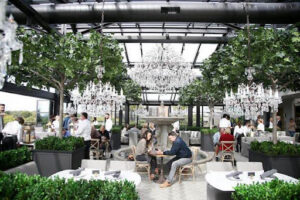
Fire compliance is only part of the picture. A permanently placed artificial tree in a commercial building is classified as an architectural nonstructural component under ASCE 7 (Minimum Design Loads and Associated Criteria for Buildings and Other Structures). It must comply with seismic and wind load provisions.
When Seismic Engineering Is Required
The IBC assigns buildings to Seismic Design Categories (SDC) A through F based on spectral response acceleration, risk category, and soil conditions. In SDC A and B, nonstructural components are generally exempt from seismic design. In SDC C through F, which encompasses most of California, the Pacific Northwest, Alaska, Hawaii, parts of Utah, and the New Madrid Seismic Zone, large artificial trees require engineered seismic anchorage.
The exemption threshold is components weighing less than 400 pounds mounted no more than 4 feet above the floor with flexible connections, or items weighing less than 20 pounds on walls or ceilings. Most monumental commercial artificial trees exceed 400 pounds, putting them firmly in the engineered-anchorage category.
What the Engineering Involves
The horizontal seismic design force is calculated per ASCE 7 Section 13.3.1. For a 2,000-pound artificial tree in a San Francisco high-rise lobby (with a design spectral response acceleration of approximately 1.2), the horizontal design force could exceed 960 pounds. That requires substantial base plates and anchoring.
Post-placed anchors in concrete must be seismically prequalified per ACI 355.2 (mechanical) or ACI 355.4 (adhesive) in SDC C through F. For trees suspended over occupied spaces, the rigging industry standard demands a safety factor of 5:1. Structural calculations and stamped drawings from a licensed Professional Engineer are required in most jurisdictions for any attachment to building structural elements.
This is one of the areas where working with an experienced manufacturer matters most. At International Greenscapes, our engineering exceeds applicable building and seismic codes, verified by independent testing. We provide professional engineering stamps, seismic compliance documentation, wind load calculations for outdoor placements, and foundation and anchoring specifications. For projects like the 25-foot column-clad sequoias at Fresno Yosemite International Airport or the monumental trees in Las Vegas casino environments, this structural engineering is built into the design process from day one.
Documentation Your Fire Marshal Will Need
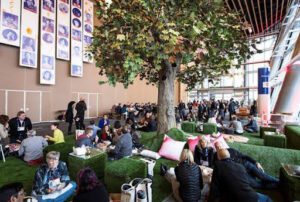
Fire marshals verify compliance through document review, visual inspection of tags and labels, and field testing in accordance with NFPA 705. Here’s what you should expect to provide:
- Independent laboratory test reports from accredited facilities (such as Underwriters Laboratories, Intertek, or Southwest Research Institute) confirming NFPA 701 and/or ASTM E84 results
- Certificates of flame resistance specifying the testing standard, results, laboratory name, test date, and product identification
- Manufacturer certification statements documenting compliance with applicable codes
- Compliance tags affixed to each decorative element, indicating whether the material is inherently fire-retardant, has been provided with current fire-retardant treatment, or is otherwise compliant with NFPA 701
- For California projects: OSFM seal of registration with unique number, identification of registered chemical used or registered fabric, and the applicator’s registration number with date of treatment
The consequences of non-compliance are significant. Fines range from $100 to $2,500 per violation (escalating daily) and may include building closure orders and misdemeanor criminal charges. In Los Angeles, violations carry fines up to $1,000 or imprisonment up to 6 months per day of violation. The civil liability exposure is even greater. The Station nightclub fire in 2003 generated $176 million in civil settlements, and the 1980 MGM Grand fire in Las Vegas produced $140 million in compensatory damages.
We provide stamped certifications and independent laboratory testing reports with every project to ensure smooth permitting and occupancy approvals. When a fire marshal asks for documentation, our clients have it ready.
How to Specify Fire-Rated Artificial Trees for Your Next Project
When evaluating manufacturers for a commercial artificial tree project, these are the questions that matter:
- Does the manufacturer use inherently fire-retardant (IFR) materials, or topical spray treatments? IFR provides permanent protection and simplifies long-term compliance. Topical treatments require ongoing re-application and re-certification.
- Can they provide NFPA 701 TM2, ASTM E84 Class A, and California Title 19 documentation? If you’re working in California or on a federal project, you’ll need all three. Even outside California, having ASTM E84 alongside NFPA 701 demonstrates comprehensive compliance.
- Do they provide structural engineering for seismic zones? For any tree over 400 pounds in SDC C through F, you need PE-stamped calculations and prequalified anchors. Ask whether engineering is included in the project scope or treated as an add-on.
- Can they provide stamped certifications for fire marshal review? The documentation package should be ready before the fire marshal shows up, not assembled after the fact.
International Greenscapes has been fabricating fire-rated artificial trees for commercial environments since 1983, with products in nearly every Las Vegas casino, at major airports, in Restoration Hardware galleries, and at landmark venues like the Metropolitan Museum of Art. If you’re planning a project that requires code-compliant artificial vegetation, reach out to our team to discuss your specifications and compliance requirements.