
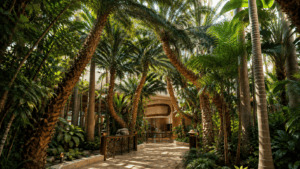
A preserved palm’s price starts with fabrication, and our published fabrication figure for a custom commercial tree between 12 and 20 feet is $3,500 to $15,000 and up per tree. That figure comes from our own cost guide, where it covers custom commercial trees in that size class rather than preserved palms on their own. It is still the closest published figure to work from, because 12 to 20 feet is also the standard height range for our preserved palms. Start your budget line there.
Where a palm lands inside that band depends on how it is specified. More height, a fuller crown, and custom trunk work all push toward the top of it. The low end of the band belongs to the size class as a whole, and to fully fabricated construction in particular, rather than to a preserved palm, so a preserved palm sits above the bottom of that band. Fabrication is only part of the total. Engineering, shipping, on-site assembly, and certification add another 30 to 50 percent of the fabrication figure. Inherently fire-retardant materials add 10 to 25 percent of the fabrication figure when you specify them. Both of those percentages are calculated on fabrication, so they do not stack on top of each other. Five specifications decide where your palm lands inside the fabrication band: trunk height, palm species, canopy fullness, quantity, and custom trunk work.
At International Greenscapes, our TREESCAPES® line fabricates preserved palms in the USA and assembles them on-site with our own crews. We have more than 20,000 completed projects behind us. We don’t publish a minimum project size. Our commercial projects are measured in thousands to hundreds of thousands of dollars, and the count and the size of the palms are what put a given project at one end of that range or the other.
Why preserved palm prices are quoted instead of listed
We cannot price a palm until the specification is settled. Every project we quote is priced from six things: complexity of design, engineering requirements, materials specified, size and scale, timeline requirements, and assembly and shipping logistics. Change any one of them and the price changes, which is why preserved palms are not sold off a price list.
Four of those six are largely set by your drawings and your schedule: design complexity, materials, size and scale, and timeline. Engineering and logistics tend to follow from those four. So the specification you give a fabricator is what sets the price, and settling it early is the part you control.
What appears on a preserved palm quote besides the palm
Fabrication is the base, and the other costs on the quote are quoted as percentages of it. Engineering, shipping, on-site assembly, and certification together add 30 to 50 percent of the fabrication figure. Our guide to what custom artificial trees cost for commercial projects breaks those layers down across the full range of tree sizes we build. That 30-to-50-percent layer covers four things.
Crating and freight. Coordinated delivery to your site is inside our scope, so freight appears as a line on our quote rather than a separate bill that arrives later. We price freight from your site access. A dock that cannot take the unload, an inside delivery, or a redelivery to a site that is not ready all add fees beyond a standard dock-to-dock rate. A longer palm also needs a longer crate, and length raises the rate on its own.
On-site assembly. Our own crews travel to your site and assemble the pre-fabricated components in place.
Engineering documentation and anchoring. We provide stamped engineering calculations, fire safety certifications, material testing reports, and structural compliance documentation, and we design for seismic loads. Secure anchoring to structural elements is part of our assembly scope.
Post-assembly support. Maintenance guidance and touch-up kits come with the project.
What we handle, and what stays with your general contractor
These two lists are paid for out of different budgets, so check them against your own cost breakdown. Our scope of work covers:
- Coordinated delivery to your location
- Professional on-site assembly of all components
- Secure anchoring to structural elements
- Finishing work to hide seams and joints
- Final canopy dressing and detail work
- A quality verification walkthrough
- Site cleanup and waste removal
The following stays with your team or your general contractor, and needs a budget line somewhere else:
- General contracting and full-scope project installation
- Site preparation
- Structural work such as foundations and steel
- Permit submission. We provide the documentation your permit set needs, and your team or general contractor submits it
- Coordination of the other trades on the job site
The specifications that move a preserved palm’s price
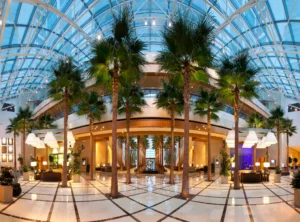
Five specifications account for most of the difference between one palm’s price and another’s. We don’t publish a dollar figure for any single one of them, so for each one, here is the direction it pushes the price and what you need to decide.
Trunk height
Height affects the price more than any other specification, and it hits three parts of the quote at once: the material in the trunk, the engineering and anchoring the finished piece needs, and the freight. Standard preserved palms run 12 to 20 feet in height, and we build custom trunk heights above that for larger architectural volumes. Settle height first. Then check the height you picked against your finished ceiling, and against the doors, elevators, and dock you will move the crate through, because anchoring and delivery costs both follow from it.
Palm species
We offer Queen Palms, Coconut Palms, Date Palms, Phoenix Palms, Areca Palms, and custom palm varieties. The fronds are real palm fronds harvested from sustainable plantations, so the species you specify determines what we source. Name the species in your quote request, or describe the look you want and let us suggest one. Changing species later can mean sourcing different fronds, which may add time to the schedule and change the price.
Frond count and canopy fullness
Frond count and fullness are both customizable, so you decide how full the crown is. A fuller crown generally takes more preserved frond material and more hand assembly than a lighter crown on the same trunk, which is typically why fullness affects the price. Tell us the viewing distance when you request a quote. Someone standing directly under a palm notices individual fronds and any gaps in the crown, and someone looking at the same palm high in an atrium does not. Specify fullness to the distance people will view it from, because extra fullness on a palm nobody stands under is detail no one will see.
Quantity
More palms means more material, more freight, and more assembly time, so the total rises with the count. The decision here is when you settle that count. Our three-month minimum lead time runs from design approval, so palms added after approval begin their own schedule. Give us the full count up front, including palms planned for later phases, and the whole job gets priced and scheduled together.
Custom trunk work
A trunk built above the 12-to-20-foot standard range, or built to match a specific detail in your drawings, takes more design time and more fabrication than a standard trunk, so it raises the price. If your drawings show anything unusual about the trunk, include it in the quote request. A trunk detail that comes up after your budget is set becomes a change order.
How much does fire-retardant specification add to the cost?
Fire safety compliance adds 10 to 25 percent to the fabrication figure. All TREESCAPES® preserved palms are available with inherently fire-retardant (IFR) materials that are NFPA 701 compliant, ASTM E84 Class A rated, and California Title 19 certified. The fire protection is molecularly bonded into the material, so it cannot wash off or degrade over time.
Two things about this matter for your budget. First, inherently fire-retardant material is an option rather than a default. If you do not specify it, it is not in your quote. Second, we do not decide which certification your project needs. Building and fire codes are adopted and enforced locally, so the requirement on your project is whatever your local fire code official says it is. Ask them which certification they want to see before you request a quote.
What a budget line for one preserved palm looks like
Here is the arithmetic worked through on a hypothetical palm, so the percentages have a dollar figure to work from. This is an example rather than a quote. Say you are specifying one preserved Queen Palm at 16 feet for a hotel lobby, with inherently fire-retardant materials, delivered and assembled by our crews. Start with the published fabrication band, then add each layer as a percentage of it.
| Quote line | If fabrication lands at the bottom of the band | If fabrication lands at the top |
|---|---|---|
| Fabrication, one commercial tree 12 to 20 feet | $3,500 | $15,000 |
| Engineering, shipping, on-site assembly, certification (30 to 50 percent of fabrication) | $1,050 to $1,750 | $4,500 to $7,500 |
| Inherently fire-retardant materials (10 to 25 percent of fabrication) | $350 to $875 | $1,500 to $3,750 |
| Budget line for one palm | $4,900 to $6,125 | $21,000 to $26,250 |
Source: International Greenscapes cost analysis
Those figures come with two limits worth noting in your budget. The published band ends at $15,000 and up, so it has no stated maximum, and a palm above 20 feet or with heavy custom trunk work can come in higher than the right-hand column. At the other end, the low column starts from the bottom of the size class band, which is below where a preserved palm starts, so read it as a floor for the size class rather than as a preserved palm price. Next to the figure in your budget, note the specification it assumes: the height, the species, the canopy, and whether fire-retardant material is included. Then anyone who asks what the line covers has the answer.
Preserved palms vs. fully fabricated palms: cost and fitness for the space
The deciding factor is exposure, meaning how much sun and open weather the palm will actually sit in.
| Feature | Preserved palms (TREESCAPES®) | Fully fabricated palms |
|---|---|---|
| Material | Real palm fronds, preserved and sealed for long-term durability | Custom-fabricated synthetic materials |
| Best suited to | Interiors and covered outdoor areas: lobbies, atriums, casino floors, restaurants, covered dining | Full outdoor exposure, extreme weather, and spaces needing maximum UV resistance |
| Appearance | Natural cellular structure, authentic translucency when backlit, genuine tactile feel, organic variation from piece to piece | Engineered for durability and realism, and consistent across a large run |
| Durability notes | Best in stable indoor conditions. Tell us if the space is humid | Built for high-traffic areas, wide temperature swings, and salt air or coastal sites |
Both can be specified with inherently fire-retardant materials, so fire code is not what decides between them. Both are quoted from the same six factors, and the published fabrication band is a size-class reference that covers custom commercial trees of either construction. That is not a statement that the two cost the same, because which construction you choose is itself a price factor. Size is the largest driver on either one, and a fully fabricated palm then carries the engineering its location demands, including its core structure, wind and seismic load engineering, and UV-inhibited materials. If the palm will sit in full sun and open weather, specify fully fabricated palms. For interiors and covered outdoor areas, preserved palms are the better fit, and the fronds are genuine palm.
What preserved palms cost against live palms over the life of the project

If you have to defend this line to an owner or a finance team, this is the comparison to use. Beyond the palms themselves, a live palm program in a commercial interior carries three costs, and the figures here are our own. It needs an irrigation system, which can run $50,000 or more. It needs specialized grow lighting, at $20,000 or more. And it needs an annual horticultural maintenance contract at $10,000 or more, every year, for as long as the plants are in the building. Preserved palms eliminate all three.
Most of our commercial projects break even against living plants within three to five years, then provide ongoing savings for decades after that. The irrigation, the lighting, and the maintenance contract sit in an operating budget year after year, while a preserved palm is a one-time capital line.
Palm tree column wraps as a second option to price
If your drawings already have structural columns where you want the look of a palm, ask about palm tree column wraps. They are modular, fire-retardant wraps that turn a structural column you already have into a palm trunk. The column is already standing and already carrying the load, so a wrap is cladding on an existing structure rather than a tree that has to hold itself up. That does not take the technical work off the project: wrap projects still come with structural engineering calculations and code compliance documentation, and assembly still includes secure anchoring.
We don’t publish a wrap price. Put both on the same quote request: freestanding palms where you need the full tree, and wraps where an existing column can carry the look. That is how you find out how the two compare on your own drawings.
How long do preserved palms last, and what do they cost to maintain?
Preserved palms are built to last decades with minimal maintenance. The longest-running proof point we have comes from another of our lines: a NATUREMAKER® tree still looked as good as the day it was built after two full decades of continuous use, a little dustier and otherwise unchanged. Maintenance after assembly is dusting. There is no irrigation to run, no feeding, no pest control, and no plant replacement cycle, which is why the ongoing cost line is so small next to a live program.
Two conditions do matter, and both are worth settling before you commit to a location. Humidity is the first. Preserved foliage kept in humid conditions can weep solution from the leaves, and those oily droplets can stain wood surfaces and textiles underneath. If you are looking at an open pool deck, a spa, or a humid enclosed courtyard, tell us during design, because fully fabricated palms are usually the better specification in those spaces. Direct sun is the second. Where a space needs maximum UV resistance we specify fully fabricated palms, so flag a glass wall that gets hours of direct sun early.
How long is the lead time for preserved palms?
Our minimum lead time is approximately three months from design approval to delivery. The three months start at design approval, not at your first phone call, so add your own review cycles on top of them. For most projects three months fits comfortably inside a construction schedule when we are engaged early. Complex or monumental projects can require longer.
A compressed schedule can also raise the price, and we don’t publish a rush figure. Timeline is one of the six things every project is quoted from, and what is possible on a compressed schedule depends on what is already in production, so the answer comes out of a conversation about your date rather than a published rate. If your opening is in six weeks, contact us anyway. We work with clients on compressed timelines to find solutions, and high-profile projects may be prioritized in our production queue depending on what is already in fabrication. Plan around the three-month minimum from design approval, and tell us your delivery date in the first conversation, because the later a palm package enters the construction schedule, the fewer options we have.
Why do two quotes for the same palm come back at different numbers?
There are usually three reasons, and you can check all three yourself.
First, the specifications are not actually the same. One quote may assume a 14-foot trunk with a lighter canopy while the other assumes 18 feet with a full crown. The rendering can look identical while the two palms take different amounts of material and labor to build.
Second, the inherently fire-retardant material is an option. If one quote includes it and the other does not, the two prices are for different products.
Third, the scope is not the same. Check each quote for crating and freight, on-site assembly, secure anchoring, finishing and seaming, canopy dressing, the quality verification walkthrough, site cleanup, and the stamped engineering documentation. A quote that stops at fabrication will always look cheaper than a quote that carries the project through to a finished, anchored, inspected palm.
Line up the specifications and the scope side by side before you compare the totals. If they do not match, the two numbers are not comparable.
What to bring to your quote request
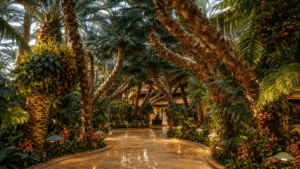
Every item here is something we would otherwise have to ask you for. Each one you leave open is a place the price can move after you have budgeted.
- The species you want, or the look you are after if you are open on species
- Trunk height, and whether you need anything above the 12 to 20 foot standard range
- Frond fullness, and the distance people will view the palms from
- Quantity, including palms planned for later phases
- Whether you need inherently fire-retardant materials, and which certification your local fire code official requires
- Where the palms go, and whether they will see high humidity, direct sun, or open weather
- Your delivery date, counted back from design approval
- Site access details: dock height, whether a liftgate is needed, door and elevator clearances, and who receives the freight
- Your CAD drawings, if you have them
With those in hand, our proposal comes back with the complete scope of work, specifications for each element, materials and finishes, the production timeline, the delivery and assembly schedule, and a total investment breakdown.
If you are pricing preserved palms for a hotel lobby, a casino floor, a resort, an airport concourse, or a corporate atrium, send us what you have, even if it is only a rendering and a date. Our preserved palm trees page lists the palm species we offer and the standard height range, so you can check your drawings against them first. Then reach out. We will tell you what is still missing and price the palm you have described.