Yes, UV resistant artificial trees can hold up outdoors, as long as the UV protection is built into the materials and the tree is engineered for the weather at its site. Trees that fade, turn chalky, or crack in the sun usually rely on a UV coating sprayed onto the surface, or they have no real UV protection at all. At International Greenscapes, we build artificial trees for outdoor commercial projects, from the grand entrance of the Peppermill Resort Spa Casino in Reno to the patio at JOEY Newport Beach. Our TREESCAPES® team has completed more than 20,000 projects.
An outdoor tree at a resort entrance or on a pool deck is a statement piece, so it has to keep its color and stay anchored in high wind through every season. An “outdoor” or “UV resistant” label on its own doesn’t tell you whether a tree will keep its color or stay anchored in high wind. Before you specify outdoor trees, ask the manufacturer where the UV protection sits, how the tree is engineered for wind, and how its core and hardware resist rust.
What Does “UV Resistant” Mean on an Artificial Tree?
On an artificial tree, “UV resistant” means the materials contain ingredients that slow down the damage sunlight does to color and to the synthetic material itself. Sunlight includes ultraviolet (UV) light, and UV light breaks down the long molecules that give synthetic leaves and finishes their strength. The damaged surface then reacts with oxygen and moisture in the air. You see the results as faded color, a chalky white film on the surface, and material that turns brittle and cracks. Outdoor PVC pipe that has turned yellow and chalky is a common example of what sunlight does to synthetic materials.
Manufacturers slow this damage with UV stabilizers. UV stabilizers can be mixed into the material while it’s being made, so the protection runs all the way through. The same stabilizers can also go into a coating applied over the surface. Where the protection sits makes a big difference outdoors, because a surface coating wears away, while protection inside the material doesn’t need reapplying.
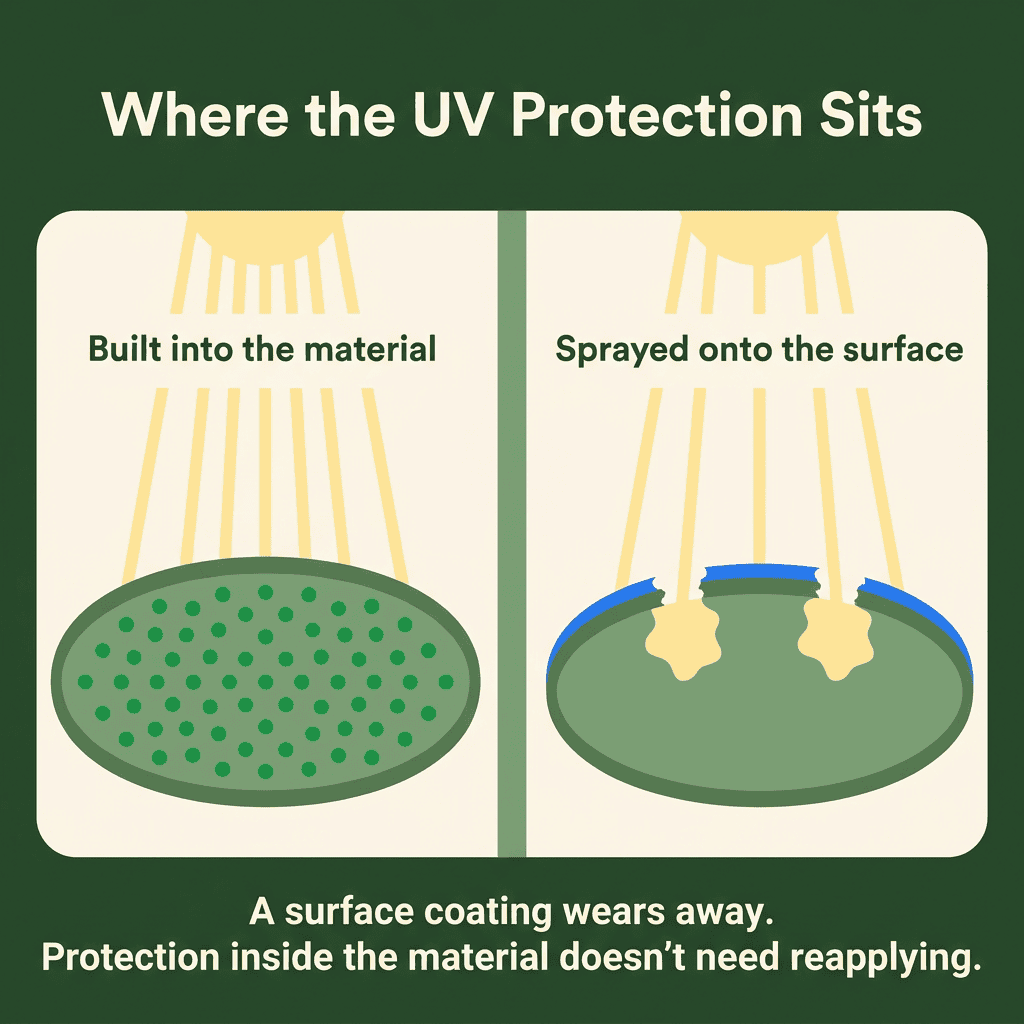
Our outdoor foliage uses built-in protection. Our TREESCAPES® fully fabricated trees use UltraLeaf-X® / UVI, our ultraviolet inhibited (UVI) foliage for exterior use.
UltraLeaf-X® UltraViolet Inhibiting (“UVI”) Foliage is an artificial product designed for exterior and interior projects. This artificial plant material is constructed to resist fading and sun damage. International Greenscapes is a pioneer in the manufacture and sale of artificial, commercial-grade, Ultraviolet Inhibited (“UVI”) horticultural products. Ultraviolet Inhibited UltraLeaf-X® Foliage is manufactured with a proprietary chemical solution that is impregnated into the fibers of the foliage. This chemical directly inhibits the damage caused by the sun’s ultraviolet rays. Our exclusive UltraLeaf-X® UVI Foliage was independently laboratory tested and exposed to over 2,000 hours of UV light (equivalent to years of ordinary exposure) with zero product degradation noted. International Greenscapes confidently offers the longest Color-Fade Warranty in the industry.
The foliage on an outdoor artificial tree generally has built-in UV inhibitors, a sprayed-on UV coating, or no UV protection at all.
| UV protection type | How it works | How it holds up outdoors |
|---|---|---|
| Built-in UV inhibitors | UV stabilizers are mixed into the material when the leaves are made, so the protection runs all the way through. | Built-in UV inhibitors keep protecting the color and strength of the leaves without reapplying, which makes them the right choice for full sun. |
| Sprayed-on UV coating | A clear finish containing UV stabilizers is applied over the surface of the leaves. | A sprayed-on UV coating wears away with sun exposure, so it needs regular inspection and reapplying. A coating that isn’t maintained starts to peel. |
| No UV protection | Nothing in the leaves or on their surface slows the damage sunlight causes. | Foliage with no UV protection fades, turns chalky, and becomes brittle in the sun, so it should be used only indoors. |
The trunk of an outdoor tree needs a different kind of protection than the foliage. For example, the handcrafted Mediterranean olive tree our TREESCAPES® team made for the patio at JOEY Newport Beach has UV-inhibited foliage, but its trunk is hand-painted. A painted trunk relies on its finish to hold its color outdoors, so that finish has to be made to resist fading and weather. On our fully fabricated outdoor trees, we use colorfast exterior finishes that resist fading, along with weather-resistant sealants. Because a trunk finish sits on the surface, small worn spots may need touch-up paint over time.
UV Resistant vs. Outdoor Safe vs. Weather Resistant
Each of these common labels covers only part of what an outdoor commercial tree needs. “UV resistant” usually means the maker added some kind of UV protection. The label doesn’t say whether that protection is built into the material or sprayed onto the surface, or whether it covers the trunk finish as well as the leaves. “Outdoor safe” usually means the product can get wet without being damaged. It often says nothing about how the color holds up in strong sun. “Weather resistant” usually refers to rain and temperature changes. It rarely tells you whether the tree is engineered for wind or rated for salt air. Before you rely on any of these labels, ask the manufacturer what the label means for the specific tree you’re considering.
Does UV Resistant Spray Work?
A UV resistant spray can slow fading for a while, but its protection wears off and has to be reapplied. The ingredients in a UV coating that block sunlight get used up as the sun hits them, much like sunscreen on skin. For that reason, UV protective finishes need regular inspection and reapplying, and more often where the sun is harsh or the surface gets heavy wear. A coating that isn’t kept up starts to peel. On a large commercial tree, reapplying means reaching every leaf and branch on a regular schedule, and any area that gets missed is left unprotected. UV protection built into the material doesn’t depend on anyone reapplying it.
How Long Do Outdoor Artificial Trees Last?
We design our outdoor trees to last for decades when their materials and engineering match the site. For any outdoor artificial tree, how long it lasts depends on where its UV protection sits, how strong the sun is at your site, where the tree is placed, the weather it faces, and how well it’s cared for. Placement matters even within one property. A tree under a covered walkway or cabana gets much less direct sun than a tree in the middle of an open pool deck. Wind, moisture, and salt air add wear of their own. Your spec should call for wind load engineering to handle wind and a corrosion-resistant core and hardware to handle moisture and salt air. Care makes a difference too, because regular cleaning and inspection help you catch small problems, like a worn spot on the bark finish, while they’re easy to touch up.
Not every tree sold for outdoor use is built for open sun, and that includes some of our own lines.
| Our product line | Where it can go |
|---|---|
| TREESCAPES® fully fabricated trees | Open sun, including sites with extreme temperature swings or salt air |
| NATUREMAKER® steel-core trees | Outdoor and interior projects, including resort pool decks, rooftop terraces, and outdoor shopping districts |
| TREESCAPES® preserved palms | Covered outdoor spaces, such as a covered pool deck, and interiors, but not full sun. Preserved palms are made from real palm material. |
| PLANTWORKS® natural-trunk trees | Interior only |
At the Peppermill Resort Spa Casino in Reno, Nevada, our TREESCAPES® team fabricated the Italian cypress, sculpted spheres, and floral arrangements at the grand entrance from exterior materials made to resist UV damage and withstand the Reno climate. At the San Diego Zoo, we fabricated a weather-resistant banyan tree for the amphitheater.
How Do Wind, Rain, Cold, and Salt Air Affect Outdoor Artificial Trees?
Sunlight is what fades an outdoor tree, but the tree also has to handle wind, rain, cold, and, near the coast, salt air.
| Weather factor | What it does to an outdoor tree |
|---|---|
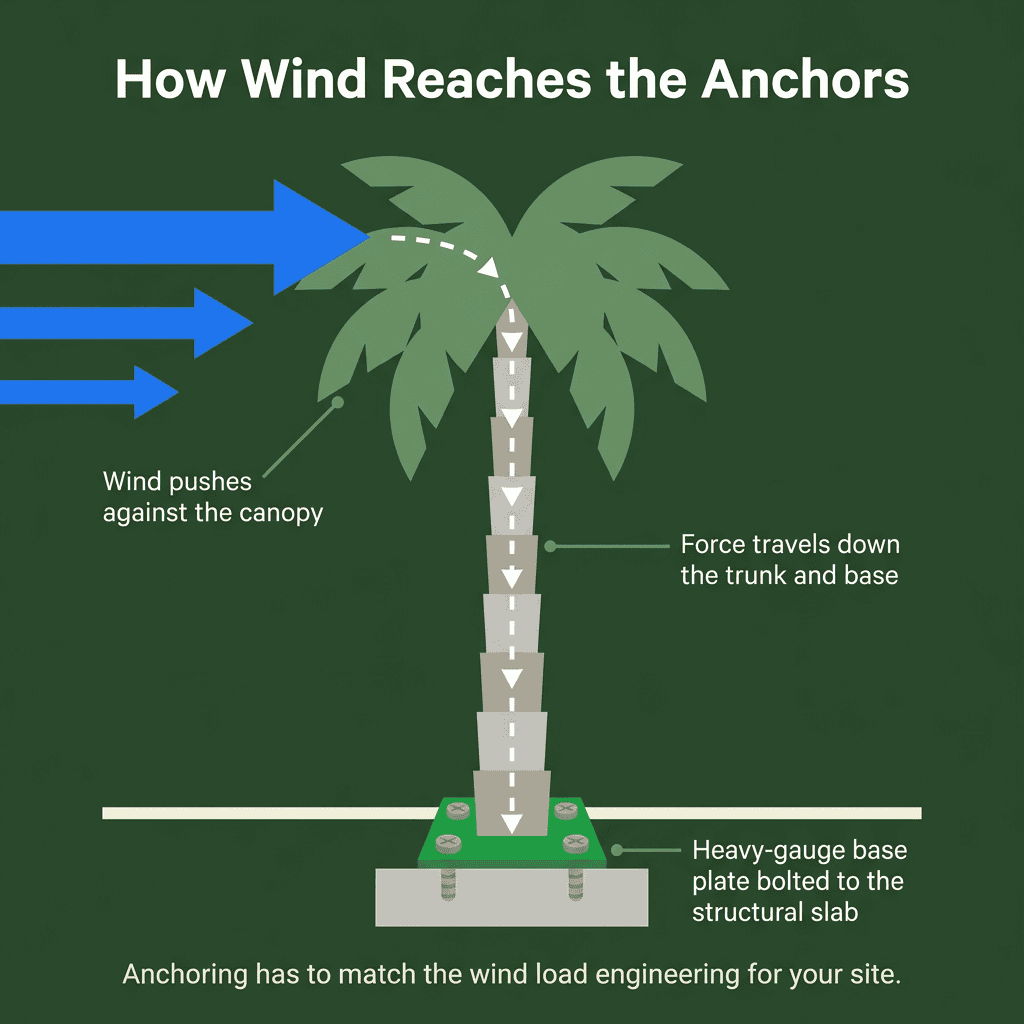
| Wind | Wind pushes against the canopy and puts force on the trunk, base, and anchors, which makes wind the main structural concern for a tall tree. |
| Rain and humidity | Moisture adds to the surface damage sunlight causes, because the sun-damaged surface reacts with water and oxygen in the air. Humidity also helps rust form on steel. |
| Cold | Cold makes many synthetic materials stiffer and more likely to crack under strain. The temperature where this happens is different for each material, so ask the manufacturer how the tree’s materials handle the coldest temperatures at your site. |
| Salt air | Salt and humidity speed up rust on steel cores and hardware. On the coast, galvanized steel exposed to regular salt winds rusts much sooner than galvanized steel sheltered from them. A tree on an exposed oceanfront terrace faces more corrosion than one in a sheltered courtyard. Warm coastal climates are also harder on galvanized steel than cooler ones. |
What Should You Ask a Manufacturer Before Specifying Outdoor Artificial Trees?
Ask a manufacturer for specific answers about materials, engineering, and support before you write outdoor trees into a spec. Ask each question about the exact product line you’re considering, because lines from the same manufacturer can be rated very differently for sun.
- Is the UV protection built into the foliage, and how is the trunk finish protected? Protection built into the leaves doesn’t need reapplying, so it’s the kind to ask for. The trunk sits in the same sun as the leaves, so ask what protects its finish from fading and what upkeep that finish needs.
- What weathering test results can you share? Labs can speed up sun and moisture exposure to show how a material will fade and weaken over time. Ask for results on the exact foliage and finishes going into your project.
- What does your outdoor warranty cover? The warranty shows what the manufacturer will guarantee for outdoor use, so ask whether it covers color and structure for exterior projects. Get the terms in writing.
- Will you provide wind load engineering for my site? US building codes require buildings and other structures to be designed for the wind loads at their location, so a tall outdoor tree should come with wind load calculations for your site. Our in-house engineers provide wind load calculations and engineering documentation for outdoor projects.
- What is the core made of, and how are the core and hardware protected from rust? Salt air and humidity speed up rust on steel, so a coastal or poolside project needs a corrosion-resistant core and hardware. Standard sun-exposure testing leaves out salt water, so a manufacturer’s UV test results don’t answer this question. Ask what protects the steel and whether that protection is rated for your site’s exposure.
- How will the tree be anchored? Anchoring is what holds a tall tree in place in high wind, so it has to match the wind load engineering. As part of our on-site assembly, we anchor trees with heavy-gauge base plates bolted to the structural slab. The slab or foundation itself is your contractor’s work.
- Can you provide a fire rating? If your local code requires one for the location, ask for the rating on the exact foliage and finishes being specified.
- What maintenance plan comes with the tree? Your staff will care for the tree once it’s in place, so ask what cleaning guidance, touch-up supplies, and repair support the manufacturer provides.
How Do You Keep Outdoor Artificial Trees From Fading?
The right placement and routine care help an outdoor tree keep its color and finish.
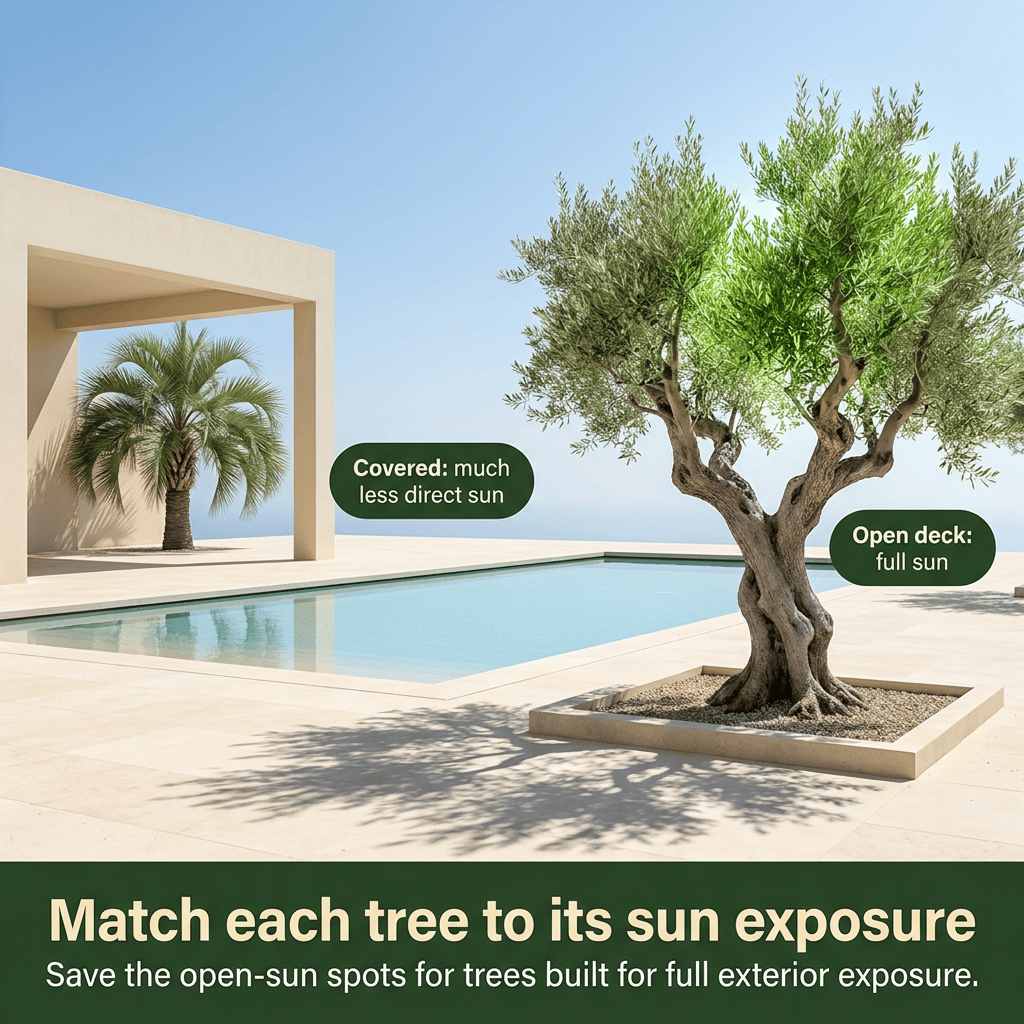
- Match each tree to its sun exposure. Keep trees rated only for covered spaces, such as preserved palms, under a roof or canopy. Save the open-sun spots for trees built for full exterior exposure.
- Clean the tree gently. Occasional dusting with compressed air keeps the foliage clean. Use the cleaning products the manufacturer recommends, because the right product depends on the finish. We give our clients cleaning product recommendations for their trees.
- Include the tree in your regular property inspections. Check the foliage and trunk for faded patches, a chalky surface, cracks, or rust on exposed hardware. These are the early signs of sun and weather damage, and they’re easier to fix when you catch them early.
- Touch up small wear right away. Minor wear on the bark finish can be repaired with touch-up paint. We provide touch-up kits for bark repairs, and our team offers repair services for anything larger.
Visit a Showroom Before You Specify
Before you write outdoor trees into a spec, we’d be glad to have you visit one of our showrooms. In person, you can see and touch our foliage and trunk finishes and compare our product lines side by side. Our Las Vegas showroom displays products from all three of our brands, NATUREMAKER®, PLANTWORKS®, and TREESCAPES®. Las Vegas walk-ins are welcome Monday through Friday, 8:00 AM to 4:00 PM. Our San Marcos, California, and Miami showrooms are open by appointment. You can see our trees online first, contact our team, or call us at 760-631-6789 to talk through the sun, wind, and weather at your site.