
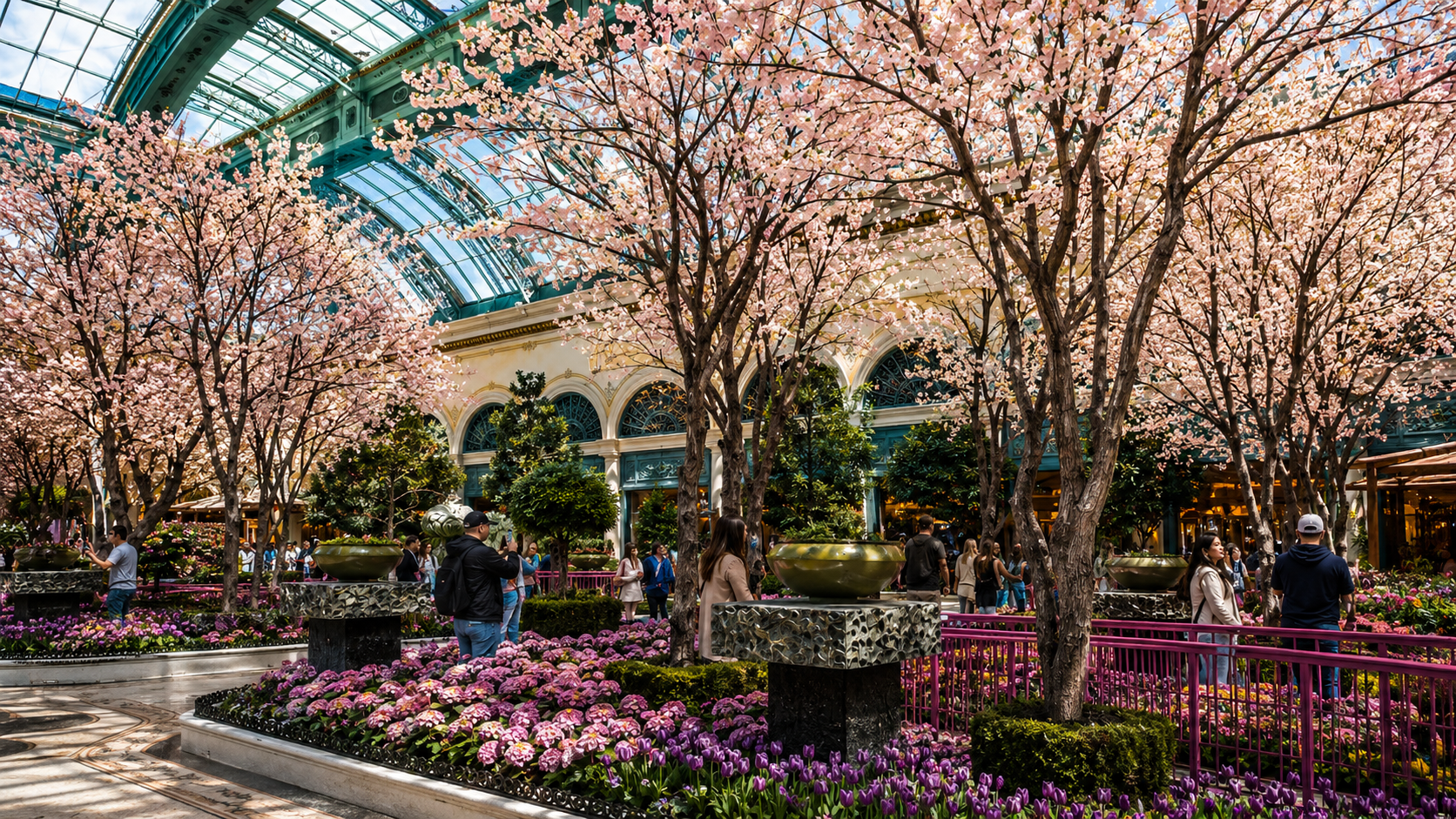
A casino gaming floor is one of the most demanding interiors a designer will ever specify a tree into. It runs 24 hours a day, sees relentless foot traffic, offers little or no usable daylight in its deepest zones, and sits under some of the strictest public-assembly fire codes in the country. Those conditions are exactly why artificial trees belong in casinos as permanent architectural elements rather than seasonal dressing. A well-made artificial tree holds its form and color for decades, needs no light or water to survive, and can be built to carry documented fire performance into a permit review. The two things that separate a casino-grade tree from an off-the-shelf one are documented fire performance and real structural engineering.
At International Greenscapes, casinos are the environment we know best. We have contributed trees to nearly every major casino on the Las Vegas Strip, the most competitive hospitality market in the world and one with the strictest safety codes, and we have been fabricating and assembling commercial trees since 1983 across three brands. Getting artificial trees for a casino right means handling the fire code, engineering each tree for its location, and matching the right tree to the right part of the property.
Why casinos use artificial trees
Casinos have always been built to hold a guest’s attention, and for much of their history that meant floor plans that minimized clocks, windows, and other cues to the outside world. Design thinking has shifted toward more legible, comfortable environments that use natural cues to make guests feel good in the space, a change documented in recent casino design research. Trees are part of that shift, softening a vast gaming floor, marking wayfinding, and bringing a sense of nature into rooms where people spend hours.
The problem is that the parts of a casino that most need greenery are the parts where living trees struggle the most. A gaming floor with a deep floorplate has little usable daylight, and light is not a nice-to-have for a living plant. All plants need light to photosynthesize, and without enough of it their energy reserves run down and they decline, as horticulture extension guidance explains. Keeping a live tree alive on a windowless gaming floor means supplemental grow lighting, irrigation, feeding, pruning, and pest control, indefinitely. An artificial tree removes that dependency. It looks the same on day one as it does decades later, and it goes exactly where the design calls for it, daylight or not.
We want to be straight about one thing, because architects appreciate the honesty and it is the right way to specify. Where a space has real daylight, irrigation, and a maintenance budget, living trees can deliver genuine biophilic benefit, and exposure to real nature is well supported in the research on restorative environments. Artificial trees earn their place in the locations where living ones cannot realistically survive or perform, and in the applications where scale, consistency, and code documentation matter most. They only work, though, when they look convincingly real. Our NATUREMAKER® trees are hand-sculpted to be 87% botanically accurate, close enough that guests read them as real from across the floor and up close.
Fire and life-safety codes for casino trees
Fire and life safety is the single biggest reason casino trees are a specialized product, and it is where most off-the-shelf trees fail a project. Under the current model building code, casino gaming areas are classified as assembly occupancies, the same category as other spaces where large numbers of people gather. That classification raises the bar on how interior materials, including artificial vegetation, are expected to behave in a fire. It also means fire documentation is a real procurement issue, not a premium extra.
What ASTM E84 and NFPA 701 actually cover
ASTM E84 and NFPA 701 come up constantly on casino projects, and they are not the same thing. A certificate for one is not a certificate for the other.
NFPA 701 is a flame-propagation test for textiles and films. The fire code names it as a compliance path specifically for artificial decorative vegetation, which is the category a freestanding artificial tree usually falls under, with an alternative path through NFPA 289. ASTM E84 is a different test. It measures the surface-burning behavior of building materials such as wall and ceiling finishes, and it reports a flame-spread index and a smoke-developed index. Under the building code, a Class A interior finish means a flame-spread index of 0 to 25 and a smoke-developed index of 0 to 450, the strictest of the three interior-finish classes. Both standards are relevant to casino work, but they answer different questions, and “Class A” is not another name for NFPA 701 compliance.
What inherently fire-retardant means
There is no such thing as a fireproof tree, and any supplier who uses that word should give you pause. The honest and code-accurate terms are fire-retardant and fire-resistant. Suppliers differ in how the fire protection gets into the material.
Topical fire-retardant sprays sit on the surface of the foliage, and they can wear, wash off, or degrade over time, which is why some jurisdictions have limited how they can be relied on. Our foliage is inherently fire-retardant instead. The fire-retardant chemistry is mixed into the resin before the leaf is molded, so the protection is bonded into the material and does not wash off or wear away over the life of the piece. We offer inherently fire-retardant materials across our product lines, available ASTM E84 Class A rated and NFPA 701 compliant, and we also carry California Title 19 documentation for the most demanding jurisdictions. Just as important, we provide stamped certifications and independent laboratory reports that a fire marshal can review during permitting.
Questions to ask a casino tree supplier about fire
A familiar acronym on a sales sheet is not the same as evidence that the tree in your lobby will pass review. The useful questions are specific. What exact material or assembly was tested? To what standard? By what laboratory? And does that report cover the product as it will actually be fabricated and delivered, not just a sample of raw foliage? A generic foliage report does not automatically establish how a finished tree behaves once the foliage is combined with a trunk, a coating, and a mounting method.
Placement is part of compliance too. The fire code prohibits decorative materials from blocking exits or interfering with the operation of sprinklers and fire-alarm equipment, so a large tree has to be positioned and detailed with those clearances in mind. That is another reason casino trees are an engineering conversation, not a catalog order.
Engineering a casino tree as a permanent architectural element
Once a tree gets large enough, the authorities stop treating it as decor and start treating it as part of the building. Clark County’s guidance for unusual interior features draws a practical line. An item a person can carry in is likely to stay classified as decorative material, while a feature that takes a crew to bring in and assemble may be expected to use materials appropriate to the base building and to come with a documented engineering analysis. Large features can trigger case-by-case review of anchorage, proximity to sprinklers, concealed combustible voids, and fire behavior, often accompanied by a fire-protection report prepared or reviewed by a registered design professional. In assembly spaces, Clark County fire prevention also expects a flame certificate for decorative items to be part of the submittal, which is a strong argument for locking down fire documentation before procurement rather than after fabrication.
That permanence starts with the structure inside the tree. Our NATUREMAKER® statement trees are built around a welded steel armature, using 75% recycled steel, fabricated by certified welders and shipped in flanged sections for clean on-site assembly. The point of the steel is structural, not promotional. A welded armature carries the weight of a tall sculptural tree, holds it upright permanently, and lets it anchor into the building instead of leaning against it. We work directly with architects and design teams, integrate with your drawings, coordinate with the other trades, and produce the engineering documentation a building department needs. Custom trees carry a minimum lead time of about three months from design approval, and the design consultation itself is complimentary.
Matching tree type to casino zone
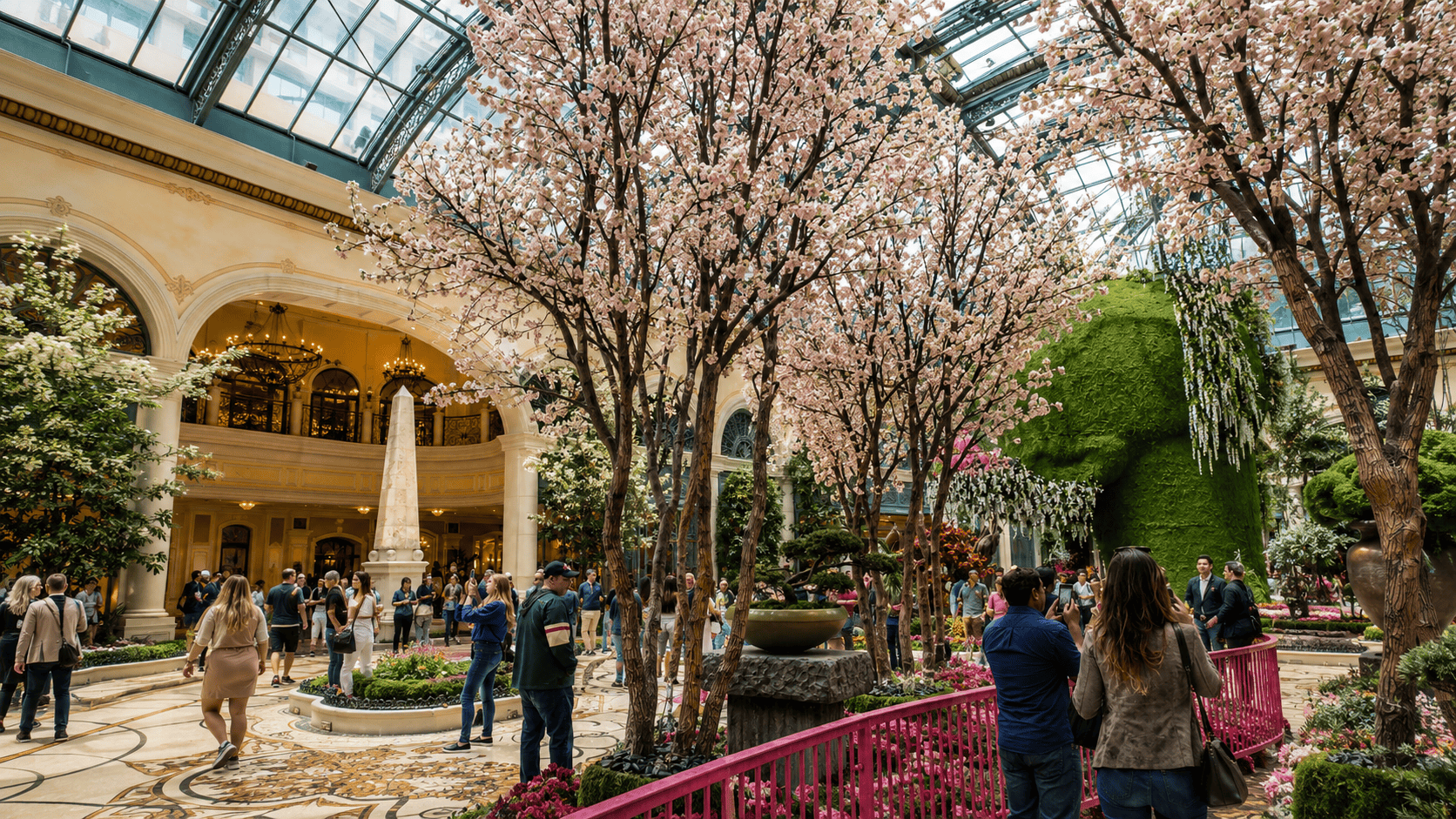
There is no universal industry rulebook that assigns a species to a room, so treat what follows as how we approach casino projects after four decades of them, not as a code requirement. We match the tree to the demands and the sightlines of the zone it will live in.
Statement trees for casino lobbies and atriums
Lobbies and atriums are where a single tree can define the whole arrival experience, so this is the home of the sculptural steel-core statement tree. At Summer House at Durango Station in Las Vegas, we built a 16-foot Arbutus Marina tree with a 12-foot canopy as a biophilic centerpiece, working with Rockwell Group. A tree at that scale reads as the anchor of the room, which is exactly what a lobby wants and what a steel armature makes possible. More steel-core statement trees at this scale appear in our NATUREMAKER® featured projects.
Palm trees for gaming floors and pool decks
Palms carry the resort feeling across gaming floors, entrances, and pool decks, and they come in two constructions worth understanding. Preserved palms use real palm material treated for long interior life, which gives you genuine natural texture. Fully fabricated palms are engineered from the ground up, which gives you more control over shape, scale, and consistency across a large order, along with test documentation for the built assembly. Neither is universally better. The right choice depends on the natural material content you want, the exposure and traffic of the location, replaceability, and the fire and durability documentation the project needs. Our TREESCAPES® brand, drawing on more than 20,000 projects, builds both. At The Forum Shops at Caesars Palace, preserved Phoenix date palms and Mediterranean olive trees complete the Roman streetscape inside a casino-connected retail environment.
Pool decks and covered outdoor areas add sun exposure to the equation. For those, ask for foliage engineered and tested for solar exposure rather than a generic “UV resistant” label. Our UltraLeaf-X® ultraviolet-inhibited foliage bonds UV stabilizers into the material to resist fading, and we back exterior work with a colorfast guarantee. The right question is always whether the weathering evidence covers the exact exterior material being supplied.
Olive and ficus trees for casino lounges and dining
Lounges and dining rooms inside a casino call for trees with a softer, more organic presence, which is where sculpted Mediterranean olive and ficus trees do their best work. At CATCH inside ARIA Resort and Casino, our PLANTWORKS® team built custom sculptural olive trees that rise straight out of the booths. At Vanderpump a Paris inside Paris Las Vegas, we fabricated Mediterranean olive trees in a range of shapes and sizes to fill the room. And at SUSHISAMBA at the Grand Canal Shoppes inside The Venetian, we built a custom orange Banyan tree canopy stretching over a 125-foot bar. Each of these sits inside a Las Vegas gaming property, and each brought a tree into a room where a living one would have struggled to survive.
What artificial casino trees cost to own
Artificial trees are a significant upfront investment, and they are best judged over the full life of the piece, because that is where the ongoing savings add up. A living tree on a casino floor keeps costing money for as long as it lives, through grow-light energy, water, feeding, pruning, pest control, and eventual replacement. An artificial tree carries none of those recurring horticultural costs. It is not truly zero-maintenance, and we would not claim that. It still benefits from occasional dusting, inspection, and the rare component repair, for which we supply touch-up and cleaning kits. It eliminates the routine biological care that never ends with a live tree.
That distinction matters more now that operating costs are rising across hospitality. In a survey released in March 2026, the American Hotel and Lodging Association reported that most hoteliers cited rising costs for supplies and labor as top financial pressures, with about half pointing to energy costs and more than half describing their properties as understaffed. Anything that permanently removes a recurring maintenance line while keeping the design intact is worth a serious look in that environment. Rather than quote a one-size savings percentage, we build a project-specific comparison for owners that puts the installed capital cost against the real annual cost of keeping the equivalent living trees alive. Most commercial projects reach break-even against the cost of live plants well within the first few years, and then the savings continue.
Our trees are also built to hold their appearance for decades. A restaurant once contacted us about relocating a NATUREMAKER® tree that had been in place for 20 years, and the photos showed it looking as good as the day it was assembled, just a little dusty. That is the kind of service life a permanent architectural element should deliver.
Common questions about artificial trees for casinos
Do artificial trees have to meet fire codes on a casino floor?
Yes. Casino gaming areas are assembly occupancies, so artificial trees are held to the fire code’s requirements for artificial decorative vegetation, typically through NFPA 701 or an equivalent path, with documentation the fire marshal can review.
Are artificial casino trees fireproof?
No. No tree is fireproof, and the accurate term is inherently fire-retardant. Our foliage has the fire-retardant chemistry molded into the material so the protection does not wash off or wear away, and it is available ASTM E84 Class A rated and NFPA 701 compliant.
Can artificial trees be used outdoors on a casino pool deck?
Yes, with the right materials. Exterior trees should use ultraviolet-inhibited foliage engineered and tested for sun exposure. Our UltraLeaf-X® foliage is built for that, and we ask that the weathering evidence match the exact material being supplied.
How much maintenance do artificial casino trees need?
Very little. They need no watering, feeding, pruning, or pest control. Routine care is limited to occasional dusting and inspection, with the odd component touch-up over the years.
Who makes artificial trees for casinos?
International Greenscapes has been fabricating and assembling commercial trees since 1983 and has contributed trees to nearly every major casino on the Las Vegas Strip. We work through three brands, NATUREMAKER®, PLANTWORKS®, and TREESCAPES®, with over 100 years of combined experience among them.
Talk to us about your casino project
If you are specifying trees for a casino or resort, we would like to help you get the design and the documentation right from the start. We collaborate with your architects and designers, engineer each tree for its exact location and code requirements, and provide the stamped certifications your permit review will ask for. The fastest way to understand the difference is to put your hands on one, so we invite you to visit our Las Vegas showroom, or our showrooms in San Diego and Miami. To start a conversation about your project, contact our team or call 760-631-6789.