

Artificial Trees and Plants for universities solve a problem living plants cannot: they bring convincing greenery into libraries, atriums, student unions, and other high-traffic campus spaces that lack the light, irrigation, or maintenance budget to keep real plants alive. For a facilities director or campus planner, the appeal is concrete. Commercial-grade botanical art delivers the wellbeing and aesthetic value of a planted space, meets the fire codes that govern public-assembly buildings, holds up under constant student traffic, and removes the recurring cost of watering, lighting, and replacing live material. At International Greenscapes, the parent company of NATUREMAKER®, PLANTWORKS®, and TREESCAPES®, we have spent more than 40 years building exactly these kinds of pieces, including a 30-foot interactive Live Oak that anchors a museum learning space and 22 to 30-foot birch trees in the sky gardens of a Foster + Partners tower, engineered to meet the building’s seismic requirements.
This guide is written for the people who specify greenery on a campus: facilities and capital projects teams, campus architects, and interior designers. It covers where artificial greenery makes sense, what separates a commercial solution from a catalog product, how fire code applies, what a campus piece costs to own over time, and how the process works.
Why universities are adding greenery to interior spaces
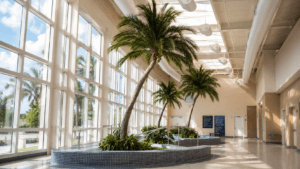
Colleges are putting more thought into how their buildings feel, and greenery is part of that. The research on plants and people in interior environments is broad and consistent. A widely cited University of Michigan study found that memory and attention performance improved by about 20% after participants spent time interacting with nature, whether on a walk through a natural setting or simply viewing images of one. Separate Texas A&M research found that people generated more ideas and solved problems more creatively in spaces that included plants than in spaces without them. Beyond cognition, multiple field studies tie visible greenery to lower perceived stress, better mood, and higher satisfaction with a space.
For a university, those effects matter in concrete ways. Libraries and study spaces are where students spend long, demanding hours. Student unions, dining commons, and residence hall lobbies shape how a campus feels to prospective students and their families on a tour. A well-designed interior with greenery reads as cared-for and intentional, which is the impression a recruitment-conscious institution wants to make.
The problem is that the spaces where greenery would help most are usually the hardest places to keep a plant alive.
Why living plants struggle in campus buildings
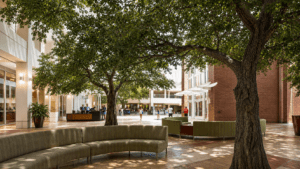
Most campus interiors are hostile to living plants for reasons that have nothing to do with how well they are maintained.
- Low light. Library stacks, interior reading rooms, and windowless study areas do not provide enough natural light for most foliage to survive. Supplemental grow lighting is an added capital and energy cost.
- Aggressive HVAC. Atriums and large lobbies run dry, conditioned air that stresses live plants and speeds their decline.
- No irrigation infrastructure. Many buildings, especially older ones and renovated spaces, have no practical way to water plants in the locations where they would have the most impact.
- Height that cannot be maintained. A statement tree in a multi-story rotunda or atrium is effectively unreachable. Pruning, watering, and pest treatment at that scale require lifts and shutdowns.
- The maintenance burden lands on facilities. Every living interior landscape becomes a standing line item and a standing task for a team that is already stretched.
This is why so many campus greenery projects either never happen or quietly die within a year or two. Artificial botanical art removes every one of those constraints.
The campus spaces best suited to artificial greenery
Artificial greenery is the right call in any space where realism and durability matter and live plants are impractical. On a typical campus, that includes:
- Library reading rooms and stacks, where low light rules out living plants but greenery softens long study sessions
- Student unions, where a focal piece anchors a high-traffic social hub
- Atriums and rotundas, where height makes maintenance unrealistic and a statement tree defines the volume
- Recreation centers, where greenery supports a wellness atmosphere in a humid, demanding environment
- Dining commons, where foliage and trees add warmth without dropping leaves or attracting pests near food service
- Residence hall lobbies, where a welcoming first impression matters and traffic is constant
- Administrative reception and admissions, where the space represents the institution to visitors
- Wellness and quiet rooms, where a calm, natural setting is the entire point
What separates commercial botanical art from retail and classroom plants
Search for artificial trees and plants, and most of what surfaces is built for a single desk or classroom: small, mass-produced, and not engineered for anything. A piece specified for a public university building is a different category of product. Four things separate the two.
| Factor | Retail or Classroom Product | Commercial Botanical Art |
|---|---|---|
| Realism | Generic molded foliage, repeated shapes | Hand-sculpted, 87% botanically accurate, modeled from real specimens |
| Structure | Lightweight, freestanding, small | Engineered steel-core armature for large statement pieces |
| Fire Compliance | Typically none | Inherently fire-retardant materials with documented certification |
| Durability | Degrades with handling and sun | Built for decades of 24/7 high-traffic use |
NATUREMAKER® originated the sculpted steel-core tree in 1983. Our pieces are hand-sculpted by artisans and fabricated by certified welders at US facilities in San Marcos, California; Las Vegas, Nevada; and Miami, Florida. The botanical accuracy is what makes a piece read as real from a few feet away. The steel core is what lets a tree stand 30 or 40 feet tall in an atrium and carry integrated lighting, A/V, or sprinkler routing inside the structure.
Fire code and safety in public-assembly campus buildings
University buildings that hold large numbers of people are public-assembly occupancies, and the materials inside them are regulated. This is the most common reason a catalog product cannot be used in a campus project: it carries no fire documentation.
Commercial botanical art is built from inherently fire-retardant materials and can be certified to the standards that govern these spaces:
- ASTM E84 Class A for flame spread and smoke development, the relevant standard for finishes in public-assembly buildings
- NFPA 701 for fire-retardant textiles
- California Title 19 and the federal SIN-494-4 flammability code where applicable
We provide stamped documentation for each project so the general contractor or owner can include it in the permit submission to the fire marshal and building department. The brand supplies the supporting certification; the GC or institution manages the permit itself. Engineered steel-core pieces also come with stamped engineering calculations and are designed to meet International Building Code seismic categories, which matters for any tall piece.
One terminology note worth understanding as a buyer: a credible vendor describes materials as inherently fire-retardant, never “fireproof.” No material is truly fireproof, and the distinction is one of accuracy and liability.
Total cost of ownership for a campus

The number that matters to a facilities or capital projects team is not the purchase price. It is the cost over the life of the space.
A living interior landscape carries recurring costs that never stop. Commercial interior plant maintenance contracts commonly start above $100 per month for a basic program and run $200 to $600 or more per month for full-service packages, and that is before the cost of supplemental lighting, horticultural staff time, pest control, and ongoing plant replacement. Those costs recur every year the building is open.
Artificial botanical art is a one-time project. After assembly, ongoing care is occasional dusting. In our experience, a custom artificial piece breaks even against the all-in recurring cost of a comparable living interior landscape in roughly three to five years, then continues delivering the same visual impact for decades with no recurring spend. For a building expected to operate for 30 or more years, the long-run difference is substantial.
| Cost Factor | Living Interior Landscape | Artificial Botanical Art |
|---|---|---|
| Up-front cost | Lower to moderate | Higher, custom-quoted |
| Watering and irrigation | Ongoing | None |
| Supplemental lighting | Often required | None |
| Horticultural staff or service contract | Ongoing | None |
| Pest control | Ongoing | None |
| Plant replacement | Recurring | None |
| Typical break-even point | n/a | Roughly 3 to 5 years |
| Appearance over time | Declines without constant care | Maintained for decades |
How a campus project works
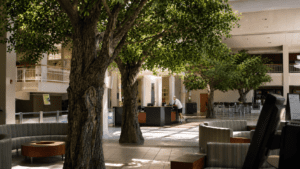
A campus piece is custom-designed to the building, not pulled from a catalog. The process fits university construction and renovation timelines when the design team engages early.
- Design. We work from the building’s architecture, the species and scale you want, and the role the piece plays in the space. A sketch, photo, or set of drawings is enough to start.
- Engineering and fabrication. For steel-core pieces, the structure is engineered with stamped calculations, then fabricated and hand-sculpted at our US facilities.
- Coordinated delivery. Large pieces are built in sections and shipped for coordinated delivery to the site.
- On-site assembly. Our crews handle assembly on-site and integrate the piece with the building.
Minimum lead time runs about three months from design approval, which fits comfortably within typical campus construction and renovation schedules when we are brought in during design rather than after the building is finished. The most reliable campus projects start the conversation with the fabricator at the same time as the architect.
Proof points from education and learning environments
The strongest evidence for this audience is the work itself. A few projects map directly to campus needs.
- Interactive learning projects. At the Golisano Children’s Museum of Naples, Florida, we built a monumental two-story walk-through Banyan that children climb, with integrated educational signage and exhibits. At the Bishop Museum of Science and Nature in Bradenton, Florida, a 30-foot Live Oak anchors the interactive “Backyard Universe” learning space, complete with a built-in treehouse and integrated science exhibits. For the Michigan DNR’s Outdoor Adventure Center in Detroit, we built a fully interactive 40-foot Oak with a spiral walkway and lookout platforms in a high-traffic public facility. More examples are on the NATUREMAKER® featured projects page.
- Engineering at height. At The Bow in Calgary, a Foster + Partners skyscraper, we placed 22 to 30-foot birch trees in multi-story sky gardens, engineered to meet the building’s seismic and structural requirements. That same structural capability is what allows a statement tree to stand safely in a tall campus atrium.
- Calm, clean environments. At the Richard and Lois Nicotra Heart Institute on Staten Island, we built a birch grove for a clinical setting with strict cleanliness needs, the kind of calming, low-maintenance greenery that transfers directly to campus wellness and quiet spaces.
Common questions about artificial trees and plants for universities
Do artificial trees and plants meet fire code for campus buildings?
Yes, when they are commercial-grade. Pieces built from inherently fire-retardant materials can be certified to ASTM E84 Class A and NFPA 701, and a serious vendor provides stamped documentation to support the permit submission for a public-assembly building.
How long do commercial artificial trees last?
They are built to hold their appearance for decades. We have NATUREMAKER® trees still performing beautifully 20 years after the original assembly.
How much maintenance do they require?
Occasional dusting. There is no watering, no specialized lighting, no pest control, and no plant replacement, which is the core advantage for a facilities team managing a tight budget.
Can a large tree work in a multi-story atrium?
Yes. Engineered steel-core trees are built on welded steel armatures with stamped calculations and can reach well over 30 feet while carrying integrated lighting and building systems inside the structure.
Bringing greenery to your campus
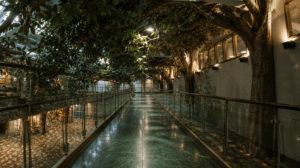
If your library, student union, atrium, or wellness space needs greenery that lives where real plants cannot, we can help you design it. At International Greenscapes, our team across NATUREMAKER®, PLANTWORKS®, and TREESCAPES® designs, fabricates, and assembles custom botanical art for campus environments at any scale, whether you need a single statement tree or a fully realized interior. To talk through your space and your timeline, contact our team to start the conversation.
You can also learn more about our artificial plants and artificial trees for commercial spaces, our custom green walls for vertical campus surfaces and where large-scale green walls work alongside architectural trees, and how project costs work in our guide to custom artificial tree costs for commercial projects.