A commercial artificial hedge is judged on four things a retail privacy panel almost never documents: fire-test evidence tied to the exact product and how it is mounted, weathering data reported as retained properties rather than exposure hours, an attachment designed for the real substrate and the real wind and seismic loads, and a warranty that covers the labor and access needed to honor it. Leaf shape, color, and density are preference. Those four decide whether a hedge passes inspection and still looks right years later.
At International Greenscapes, our brands have been fabricating and assembling commercial botanical work since 1983, and TREESCAPES® alone accounts for more than 20,000 projects. That work includes the sculpted boxwood topiary at CATCH inside ARIA Resort & Casino, an 18-foot piece 15 feet across, built from more than 300 panels and weighing over 1,000 pounds. The hard conversations we have with design teams are almost never about how a hedge looks. They are about documentation, attachment, and exposure, and they tend to arrive months later in the schedule than they should. This guide is the order we work through them.
What Counts as a Commercial Artificial Hedge
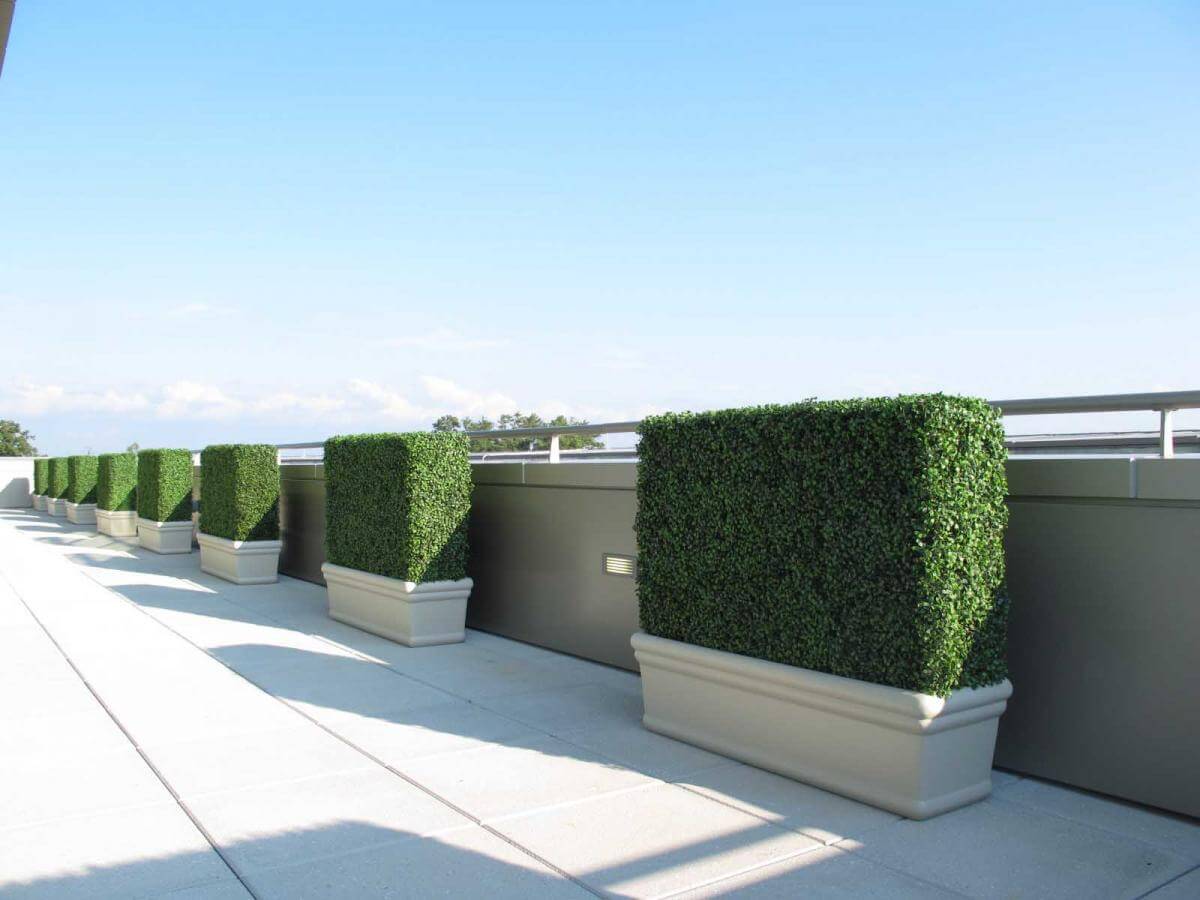
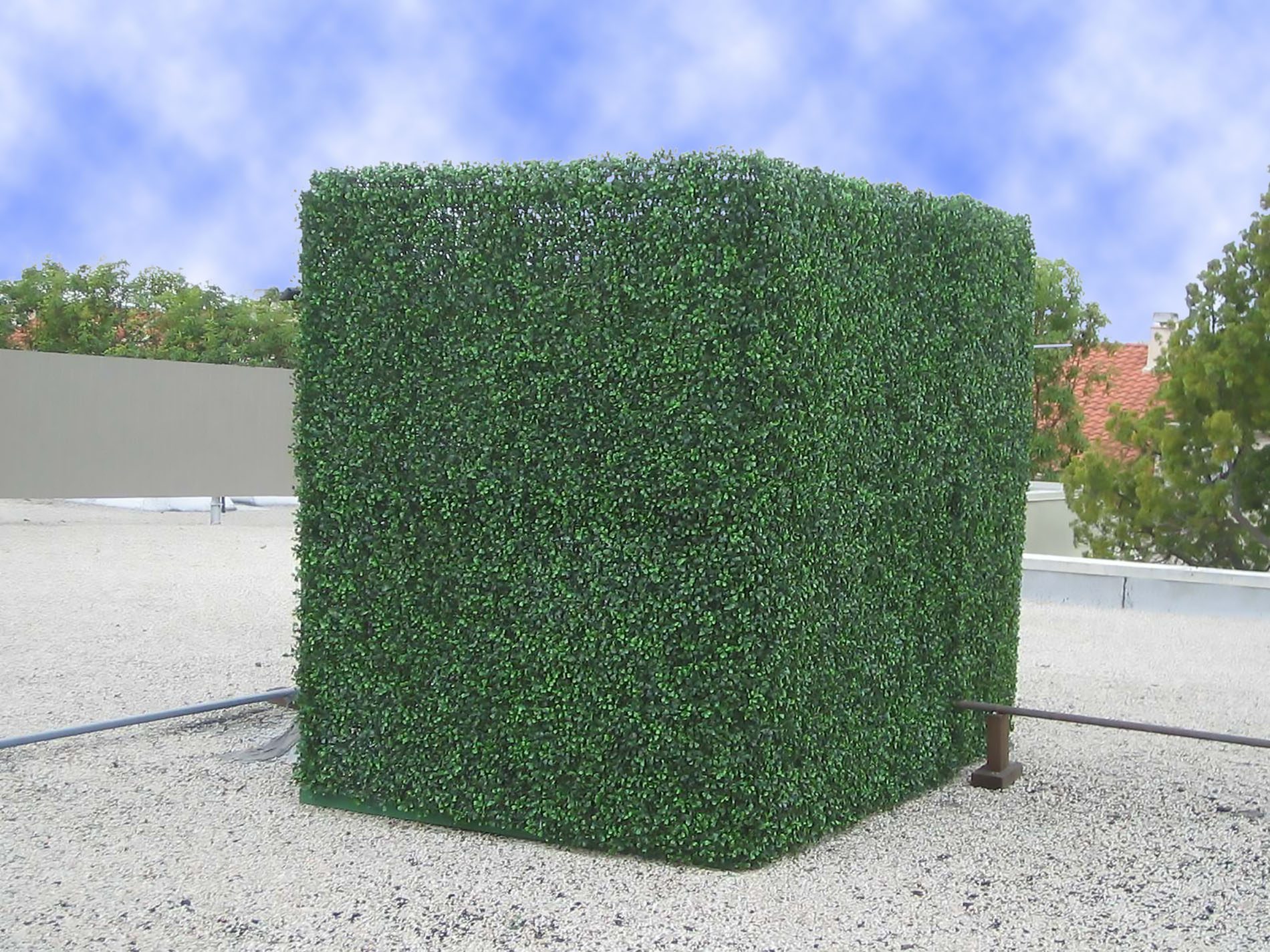
Artificial hedging in a commercial project is a manufactured architectural element used for screening, privacy, and space definition. Landscaping and fencing are different trades with different rules. The forms hedging takes:
- Boxwood hedges and screens
- Low hedge borders that define an edge without blocking a view
- Privacy screens and dividers
- Topiary forms, including spheres, cones, and spirals
- Custom sculpted shapes built to a drawing
- Planter-integrated units and freestanding assemblies
Our sculpted hedges and topiaries are a PLANTWORKS® product line, built to any height, width, or depth in straight, curved, or geometric configurations. These are commissioned pieces rather than catalog items. A sculpted hedge is assembled by hand, with foliage layered to break up the flatness that gives cheaper product away, which is why a specifier who has only ever seen a boxwood mat on a warehouse shelf tends to change their mind after handling one.
PLANTWORKS® was established in Las Vegas in 1987 and built its reputation on green walls and sculpted hedges in casino resorts. That history says something useful about the category. Hospitality drove commercial hedging long before it reached corporate and retail interiors, and hospitality is where the fire and durability requirements bite hardest.
Hedges and wall-mounted foliage systems overlap at the edges. What settles the difference for specification purposes is how the authority having jurisdiction classifies the finished element, because that determines which fire standard applies. We cover that below, and our custom green walls page covers the vertical systems in more detail.
Where Commercial Artificial Hedges Are Used
Hedging earns its place when the job is to divide, screen, or soften without building a wall. The applications we see most:
- Pool decks and resort perimeters
- Restaurant patio dividers and outdoor dining separation
- Retail perimeter softening and storefront edges
- Event and function space definition
- Rooftop terraces and podium gardens
- Hotel and casino zoning, including queue and lounge boundaries
- Corporate office collaboration areas and workstation screening
The design problem underneath most of these is the same. You need a boundary that reads as a boundary without killing the sightline that makes the space feel open. At Élephante Scottsdale, we placed foliage in custom-built planters to define dining zones while keeping visibility and flow intact. That brief is harder than it sounds. Too tall and the room fragments. Too short and the zones never register. At Datran Center in Miami, greenery had to work across both vertical and horizontal sightlines in a 10,000 square foot atrium under a 40-foot ceiling without closing off views through the space.
Retail Panels Versus Commercial-Grade Hedging
Stock product is not automatically the wrong answer. Fire and structural codes are performance based, and a stock modular panel can serve a commercial project perfectly well if that exact product carries acceptable fire documentation, appropriate weathering data, a designed attachment system, and a warranty with teeth. What separates the tiers is documented suitability, which has nothing to do with the label on the box.
Where the tiers actually diverge:
| Decision point | Typical retail or marketplace panel | Commercial-grade specification |
|---|---|---|
| Fire evidence | A logo or a one-line claim, often unattached to any report | Full independent laboratory report naming the standard, edition, laboratory, report number, test date, specimen construction, and mounting method |
| Standard applied | “Fire rated,” unspecified | NFPA 701 for artificial decorative vegetation, plus ASTM E84 data where the assembly may be reviewed as interior finish |
| Polymer identity | “Synthetic” | Named polymer, resin formulation, and stabilizer package |
| UV evidence | “UV protected” or a bare hour count | Named weathering cycle with lamp type, irradiance, temperature, moisture, intervals, and measured retained color and mechanical properties |
| Attachment | Zip ties, clips, generic hardware | Engineered load path documented to the substrate, with anchor type, embedment, spacing, and edge distance |
| Wind and seismic | Not addressed | Project wind loads and, where applicable, seismic design for permanently attached nonstructural components |
| Warranty | Material replacement, buyer absorbs everything else | Defined failure thresholds, plus labor, access, freight, and a remedy when foliage is discontinued |
| Documentation for the AHJ | None | Certificates traceable to the supplied product, plus shop drawings showing proximity to exits, sprinklers, detectors, and heat sources |
The commercial consequence is that the cheap number and the expensive number are measuring different scopes. A retail panel price leaves out engineering, frames, anchors, shop drawings, freight, site access, fire documentation, custom shaping, on-site assembly, and warranty risk. Those costs do not disappear. They come back as change orders.
Fire Code Requirements for Commercial Artificial Hedges
This section decides whether the product gets to stay in the building. Our published guide to fire-rated artificial trees and code compliance covers the standards in depth. What follows is the buying decision layered on top.
Which fire standard applies to your project?
NFPA 701 and ASTM E84 measure different behaviors and are not interchangeable. The International Fire Code addresses artificial decorative vegetation directly. IFC §807.4.1 requires it to meet the flame propagation performance criteria of NFPA 701 Test Method 1 or Test Method 2 as appropriate, with compliance documented and certified by the manufacturer in an approved manner. The current published edition of NFPA 701 is the 2023 edition.
A dense, wall-mounted hedge system may instead be reviewed as an interior wall or ceiling finish depending on how it is mounted, which brings ASTM E84 into the picture. Both can apply to the same project. Which one governs is a question for the AHJ, and it belongs at the front of the process rather than the day the crates arrive. A Michigan Bureau of Fire Services bulletin puts it plainly: the two referenced tests “are not equal to each other.”
So do not accept an E84 certificate in place of NFPA 701 documentation, or the reverse, until you know how your AHJ will classify the finished element.
What “Class A” means, and what it does not
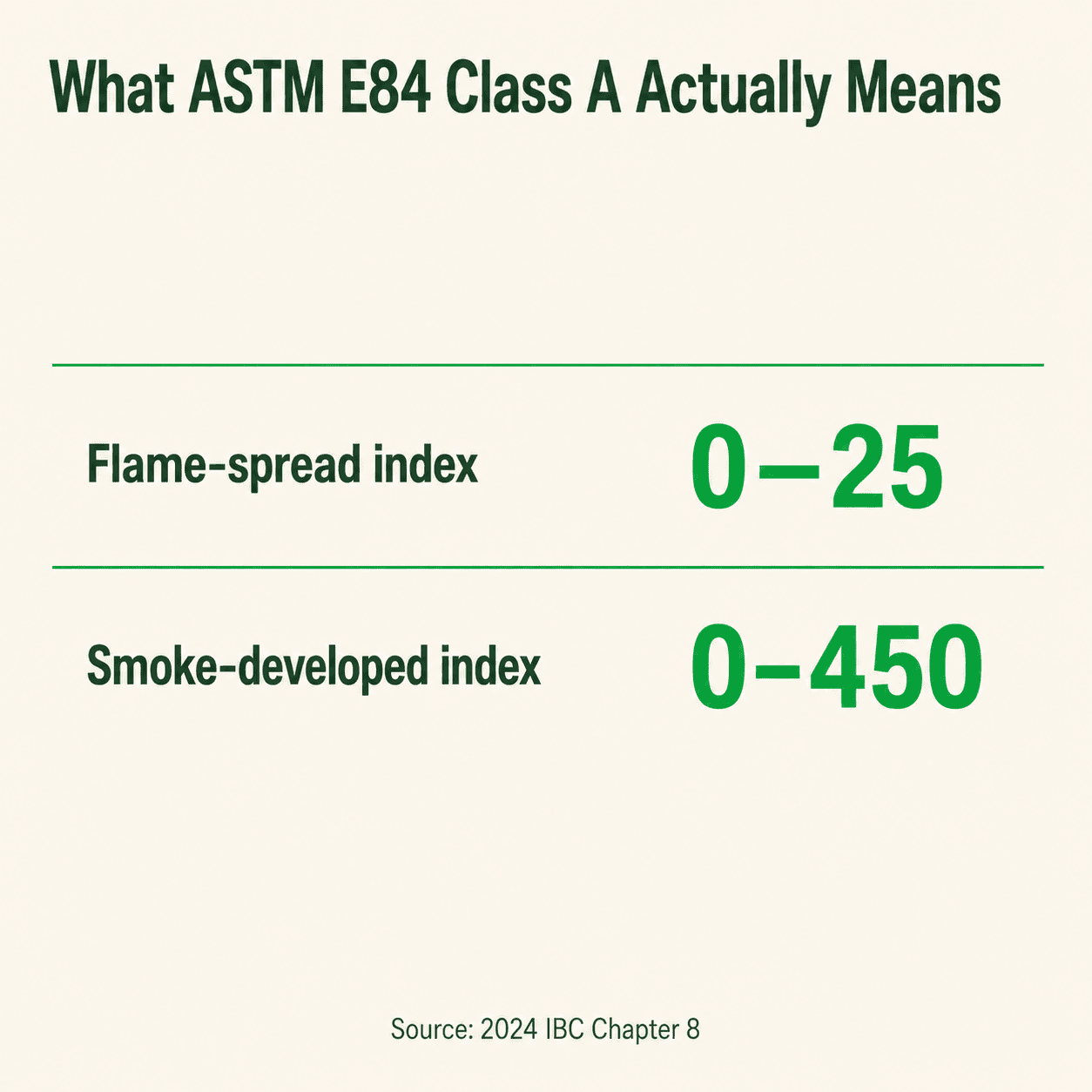
Class A is a building-code classification applied to E84 results, not a separate ASTM product certification. Under the IBC interior finish provisions, Class A corresponds to a flame-spread index of 0 to 25 and a smoke-developed index of 0 to 450. A report giving only a flame-spread number, or a certificate that says nothing beyond “Class A,” omits half the classification and cannot be reviewed properly.
ASTM is candid about the limits of its own test. E84 is a comparative surface-burning test using a nominal specimen roughly 24 feet long by 20 inches wide under a ten-minute controlled fire exposure. ASTM states there is not necessarily a relationship between the two indices, warns that supporting materials can lower the measured flame-spread index, and cautions that products which melt, drip, or delaminate can produce low indices that do not correspond to materials staying in place. Hold onto that last point with polymer foliage, because the mounting and backing you actually build with can change the result.
The question to ask, then, is whether this construction, on this backing, with this mounting method, was the thing that got tested.
The exterior checkpoint most teams miss
The 2024 IFC added an explicit provision for permanently installed exterior artificial vegetation. Under IFC §321.1, artificial combustible vegetation exceeding 6 feet in height that is permanently installed outdoors within 5 feet of a building, or on a building roof, must comply with the artificial vegetation flammability provision, with an exception related to artificial decorative vegetation more than 30 feet from an exterior wall.
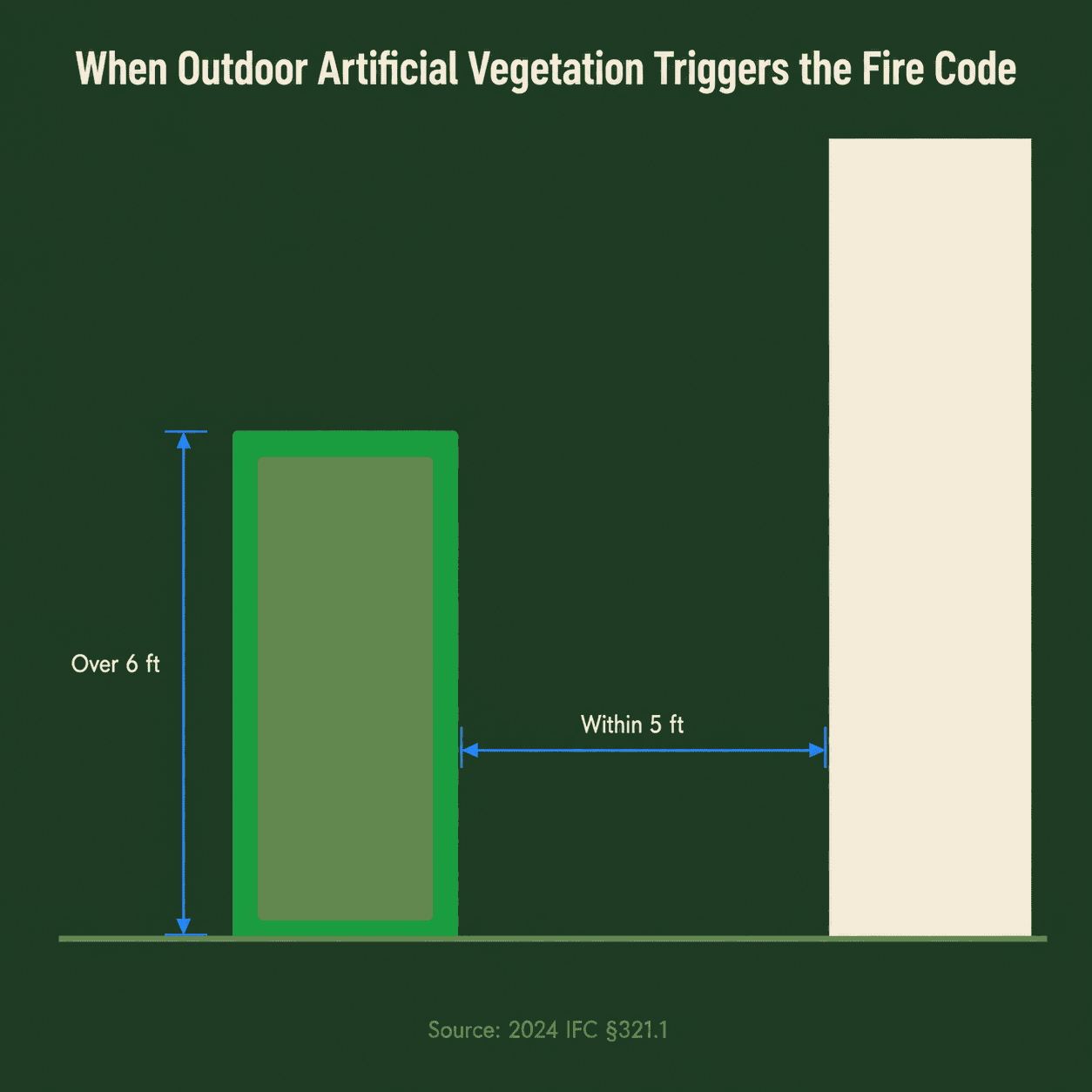
Read those thresholds as a floor rather than a permission slip. Smaller or more remote product is not automatically clear, because egress, rooftop use, wildland-urban-interface rules, exterior wall construction, and local amendments can all still apply. If your project has a roof terrace, a restaurant patio against the façade, a pool deck, or tall perimeter screening near a building, treat this as a separate checkpoint from the interior one.
California and other state registration frameworks
California Title 19 compliance means participation in a state approval, registration, and enforcement framework rather than a pass on one named fire test. The California Office of the State Fire Marshal issues registrations for approved flame-retardant chemicals, applicators, nonflammable materials, and treated fabrics, all of which are first subjected to laboratory testing. OSFM’s authority over decorative materials now extends to artificial plants.
A California submittal should identify exactly what is registered or listed: the chemical, the treated foliage or fabric, the nonflammable material, the applicator, or the finished product. “Title 19 certified” with no traceable registration number, product identification, and underlying test evidence will not survive review.
Inherent versus topical fire retardancy
There is a real difference here, and it deserves better than a slogan.
A topical flame-retardant treatment sits on the surface, where cleaning, water, abrasion, weather, and handling all reach it. The Michigan Bureau of Fire Services identifies applicator skill, washing, dry cleaning, exterior exposure, humidity, and the material’s own properties as factors affecting how long a treatment lasts, and notes that testing laboratories do not designate how often material must be retreated. Users are told to follow the manufacturer’s recommendation and keep approved laboratory test results on file.
An inherently fire-retardant formulation puts the chemistry into the resin before the foliage is molded, so there is no surface application to wear away. That is how our UltraLeaf-IFR® foliage is made, and it is why we can hand a facility a product with no retreatment schedule attached to it.
Here is the part suppliers tend to skip. “Inherently fire retardant” describes how a material is made. On its own it is not a code rating. The finished product still has to be tested, the report still has to match the construction you are buying, and the certification still has to survive whatever cleaning and field modification the project puts it through. We test, document, and provide stamped certifications and independent laboratory reports for fire marshals and building inspectors, and we would tell any buyer to demand exactly the same from everyone else on the bid list.
One last thing, said plainly. No product in this category is fireproof. Any supplier using that word is telling you something about their documentation.
UV and Weather Resistance in Outdoor Artificial Hedges
Exterior exposure is where a bad specification shows up slowest and costs the most. The failure is rarely dramatic. It is a hedge that has gone yellow-green on the south face by year three, while the north face still looks fine, which is somehow worse.
What sunlight does to polymer foliage
Polyethylene degrades under ultraviolet exposure through photo-oxidative reactions. Research archived by the U.S. National Library of Medicine links UV exposure in high-density polyethylene to declining elongation at failure and to molecular changes consistent with chain scission, with higher UV intensity and temperature accelerating the process. The associated NIST publication record covers the same work. In foliage, that reads as color change, gloss loss, chalking, cracking at leaf folds and stem connections, and eventually brittleness.
PVC takes a different path to a similar place. UV and heat can strip hydrogen chloride from the polymer, producing conjugated structures associated with yellowing and property loss.
The buying implication is simple. Ask what the foliage is made of, because “synthetic” tells you nothing about whether the relevant durability evidence concerns polyethylene, PVC, polyester, polyurethane, or a multilayer construction. Test data for one polymer family does not transfer to another.
Why exposure hours alone tell you nothing
Accelerated weathering standards define the apparatus and the exposure procedure. They do not establish a service-life claim. ASTM G154 covers fluorescent ultraviolet lamp exposure for nonmetallic materials, ASTM G155 covers xenon-arc exposure, and ASTM D4329 is the polymer-specific practice. None of them, by designation alone, is a result.
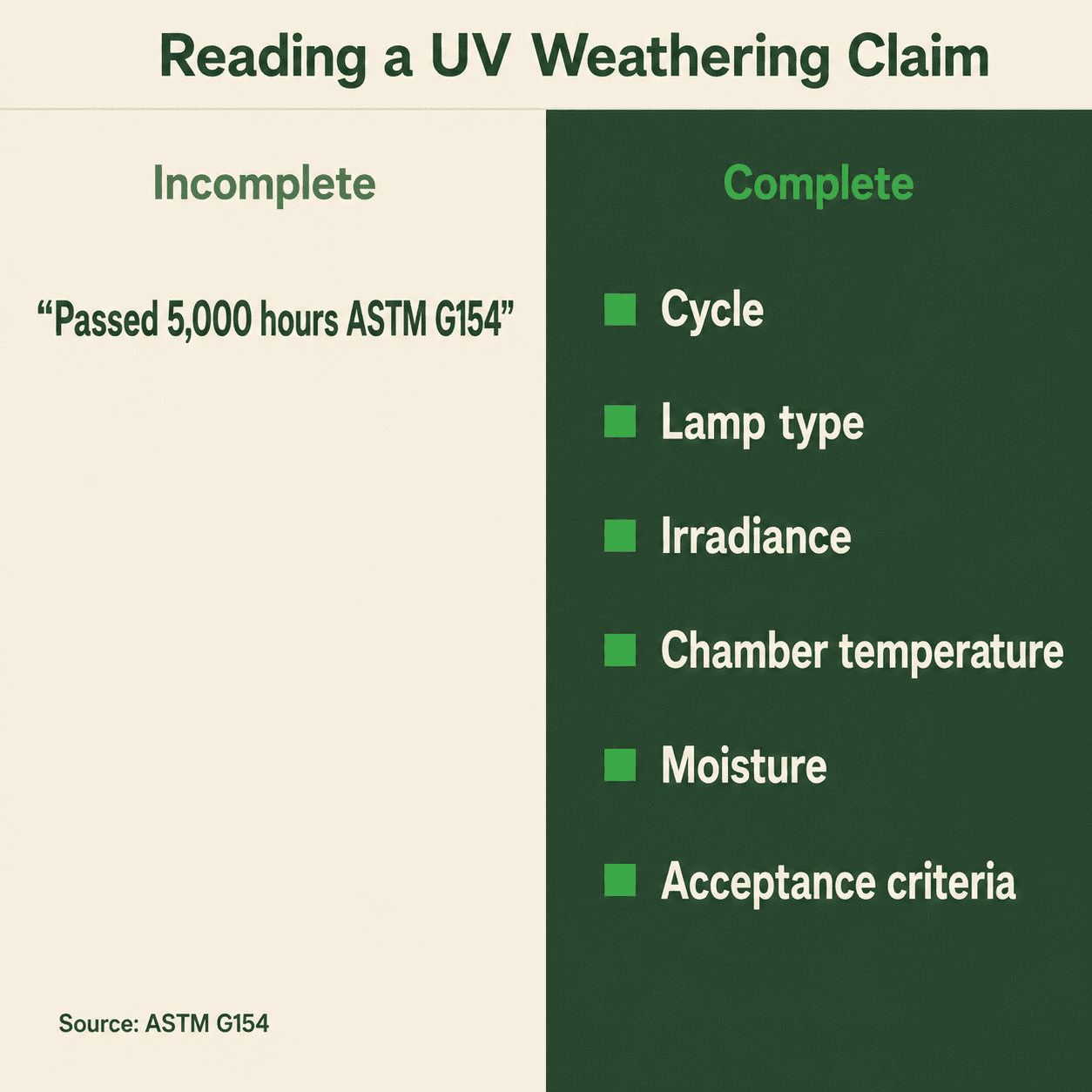
“Passed 5,000 hours ASTM G154” leaves out everything that makes the number mean anything. A complete claim states the cycle, lamp type, irradiance, black-panel or chamber temperature, condensation or spray, specimen orientation, inspection intervals, and the measured acceptance criteria. A product with more test hours can easily be the weaker product if it ran a milder cycle, used different lamps, included no moisture, or defined no acceptance threshold at all.
There is also no universal conversion from laboratory hours to outdoor years. Real weather combines variable sun angle, cloud cover, shade, surface temperature, pollution, salt deposition, rainfall, wind abrasion, freezing, biological deposits, and cleaning. A credible service-life claim needs correlation data from a comparable material and exposure environment, such as parallel natural-weathering panels in Arizona or Florida. Treat any five-, seven-, or ten-year promise as a supplier warranty or a project-specific commitment, never as a category fact.
How to write a color-fastness requirement that means something
Color-difference reporting only helps when the color space, formula, measurement conditions, reference, and tolerance are all defined. The current practice is ASTM D2244-25, which covers color-difference calculations using CIELAB, CIE94, CMC, DIN99o, and CIEDE2000, recommends CIEDE2000 for certain small differences, and states that purchaser and seller must agree on the permitted tolerance and the calculation procedure. It also notes that gloss, texture, lighting, and specimen proximity affect visual acceptability.
Which means “delta E below 3” explains nothing on its own. Below 3 by which formula? Measured how, against what reference, after which exposure? No universal pass/fail threshold exists for artificial foliage, so your specification has to set one.
A workable exterior performance requirement reads roughly like this: after a named weathering cycle at a stated duration, measured color change shall not exceed an agreed value using a stated formula, with retained tensile or flexural properties above a stated percentage of the original.
Compounded stabilizers versus surface coatings
Hindered amine light stabilizers slow photo-oxidation in polyolefins through radical-scavenging and regenerative mechanisms, and their effectiveness depends on chemistry, concentration, dispersion, pigments, other additives, processing, and the exposure environment. A stabilizer compounded into the resin distributes protection through the molded material. A surface coating concentrates it where the weather hits first, and can itself abrade away.
Our UltraLeaf-X® / UVI foliage bonds UV stabilizers into the resin formulation for that reason, and we add specialty coatings for salt air, coastal, and extreme-temperature conditions on top of it. We will also say the fair thing: the compounded-versus-coated distinction is chemically well founded, but it is not by itself proof of a fixed life advantage. Ask for comparative retained-property data rather than a description of the additive package.
Exterior work is where all of this gets tested for real. At Peppermill Resort Spa Casino in Reno, we custom fabricated outdoor topiary spheres in UV-rated exterior Polyblend materials chosen for that regional climate. At JOEY Newport Beach, the exterior patio work used UV-inhibited foliage anchored into a recessed mounting base concealed within the tiled patio, with assembly run during overnight hours to minimize disruption to the restaurant’s operations.
How Commercial Artificial Hedges Attach to a Building
A hedge is lightweight foliage, which makes it easy to assume it is somebody else’s problem structurally. Permanently attached exterior screening is subject to project wind loads, and permanently attached nonstructural components and their supports fall under seismic design provisions where the project is subject to them.
Wind demand on a screen is governed by exposed area, shape, location, pressure, support spacing, and load path. ASCE/SEI 7-22 is the current national consensus standard for minimum design loads. A foliage screen is partially porous, but porosity does not remove wind demand, because leaves and stems overlap, deform, foul with debris, and present different effective areas at different wind directions. No published universal porosity coefficient exists for artificial hedges, so the engineer selects the applicable method and documents the assumptions.
On the seismic side, IBC §1613.1 requires structures and portions of structures, including nonstructural components permanently attached to structures and their supports and attachments, to be designed to resist earthquake effects per the applicable ASCE 7 provisions. That reaches tall freestanding hedges, wall panels, frames, planter-integrated screens, and anything whose failure could obstruct egress or strike an occupant.
There is no industry-standard artificial hedge anchor detail, and nobody should sell you one. A commercial attachment design has to document:
- Finished system dead weight, dimensions, center of gravity, and projected area
- Foliage-panel-to-frame connections and frame member spacing
- The complete load path into the building structure
- Substrate type and condition: cast concrete, concrete masonry, brick, structural steel, wood framing, cold-formed steel framing, or nonstructural finish
- Anchor type, diameter, embedment, spacing, edge distance, allowable loads, corrosion resistance, and inspection
- Required blocking or supplemental framing
- Differential movement, thermal expansion, drainage, moisture trapping, and dissimilar-metal compatibility
- Wind and seismic reactions furnished to the engineer of record
- Access to replace foliage without dismantling the structural supports
A light product does not turn gypsum board, thin cladding, veneer, or unspecified studs into an acceptable structural substrate.
Planter integration changes the problem without removing it. Foliage and frame lift the wind resultant above the base, which creates overturning, sliding, racking, and local connection demands. A heavy planter is not automatically adequate ballast, particularly on roofs, terraces, and waterproofed decks, where floor loading, waterproofing penetrations, drainage, and whether the planter is fixed or movable all have to be verified. Approving a freestanding or planter-mounted exterior hedge from catalog dimensions and planter weight is how projects end up with a screen face down on the deck after the first real storm.
One terminology note that matters on site. We provide on-site assembly. We bring pre-fabricated components to your site, assemble them in place, anchor them securely, and finish the seams and canopy dressing. Full-scope installation, site preparation, structural work, and coordination of other trades sit with the general contractor. Getting that boundary into the contract documents early prevents the scope gap that otherwise surfaces in week two of assembly.
How Tall Should a Commercial Artificial Hedge Be?
Height is where a hedge specification most often goes wrong for reasons that have nothing to do with codes.
Screening height and zoning height are different problems. A screen has to interrupt a specific view from a specific eye level, so the requirement comes from what sits behind it and who is looking. A zoning element only has to signal a boundary, and it usually works better below seated eye level or well above standing eye level, so the room stays legible. The failure mode in between is a hedge tall enough to block the room and short enough to feel like a barricade.
Resolve these on the drawing rather than on site:
- What the hedge is screening, from which position, at what eye height
- Whether the element needs to read from both sides, which drives depth, backing visibility, and whether a single-sided panel will do
- Where terminations, corners, and returns land, since exposed panel edges and visible seams draw more complaints on a finished hedge than anything else
What to Ask a Supplier Before You Specify
Take this list into a supplier call. It is also the list we expect to be handed.
On fire:
- Which standard applies to this project, and has the AHJ confirmed the classification?
- Can you provide the full independent laboratory report rather than a certificate, with laboratory identity, report number, test date, standard and edition, and pass/fail criteria?
- Does the report cover the exact foliage, backing, support, adhesive, and coating we are buying?
- What specimen dimensions and mounting method were used, particularly for E84?
- Has the production product changed from the tested formulation?
- Do field cutting, adhesives, touch-up coatings, cleaning agents, or replacement foliage affect compliance?
- Where applicable, what is the California OSFM registration or listing?
On materials and exposure:
- What is the foliage polymer, and what is the stabilizer package?
- Is the UV stabilizer compounded into the resin or applied as a coating?
- What weathering cycle was run, at what irradiance and temperature, with what moisture, and what were the measured retained properties?
- What color-difference formula and tolerance do you warrant against?
On structure:
- Who is performing the attachment engineering, and is it delegated design?
- What wind and seismic reactions do we hand the engineer of record?
- What substrate and blocking do you require, and who provides it?
On the commercial terms:
- What does the warranty cover, for how long, and does it include labor, access, lifts, freight, and disposal?
- What are the measurable thresholds for excessive fading, cracking, embrittlement, leaf loss, delamination, and corrosion?
- What happens if the original foliage or color is discontinued?
- What is the attic stock plan, and what are the future color-match limitations?
One more question costs nothing. Ask to see and touch the product. We keep 15,000 square feet of display examples at our Las Vegas showroom, which takes walk-ins, and clients can review independent laboratory validation reports there while holding the sample those reports describe. Setting a hand-sculpted hedge next to a retail panel settles the quality argument faster than any specification sheet we could send you.
How Commercial Artificial Hedges Are Priced
No published industry benchmark exists for what commercial artificial hedging costs in place. We went looking for one. Construction-cost publishers, architectural associations, public bid tabulations, and trade associations do not isolate code-compliant artificial hedging as a repeatable cost-per-square-foot line item, and retail panel prices are no substitute because they omit engineering, frames, anchors, shop drawings, freight, access, fire documentation, custom shaping, on-site assembly, and warranty risk.
The category gets quoted several defensible ways: by square foot of finished coverage, by lineal foot at a stated height, by fabricated assembly, by planter-and-hedge unit, or as a lump-sum delivered and assembled scope. No single convention dominates. We quote each project on complexity of design, engineering requirements, materials specified, size and scale, timeline, and assembly and shipping logistics, and our design work, including renderings, samples, and iterations, carries no charge until an order is confirmed. Our guide to custom artificial tree costs for commercial projects walks through how the same drivers behave on the tree side.
With no benchmark to lean on, the burden falls on your bid comparison. Normalize at least these before the numbers mean anything:
| Line to normalize | Why it moves the number |
|---|---|
| Finished coverage and dimensions | Nominal module size is not finished coverage after overlap and trimming |
| Foliage type and density | Density drives material cost and how the hedge reads at close range |
| Fire and UV qualification | Testing the actual construction costs more than citing a generic certificate |
| Frame and attachment | An engineered load path is a different scope from clips and zip ties |
| Engineering and stamped documents | Delegated design and stamped calculations are real line items |
| Mockups and samples | Full-scale mockups on major work are common and rarely in a base bid |
| Freight, storage, site access, assembly, protection | Overnight or phased assembly in an operating venue changes labor cost |
| Taxes, permits, and inspections | Often excluded quietly |
| Warranty labor and replacement coverage | A material-only warranty leaves access and labor with the owner |
How to Specify Artificial Hedges and When to Decide
No universally accepted CSI MasterFormat section exists for commercial artificial hedges. Placement depends on scope. A team may put the product in a project-specific Division 12 Furnishings section and coordinate structural supports, anchors, blocking, electrical, waterproofing, or site elements in their respective divisions. Verify the section against your licensed MasterFormat edition and office master. The number matters less than keeping the scope out of a generic furnishings allowance, because a dedicated section is what lets you define performance, delegated design, mockups, fire and UV documentation, tolerances, assembly, maintenance, warranty, and closeout.
Beyond the fire, weathering, and structural evidence covered above, a submittal package worth approving adds shop drawings showing panelization, seams, terminations, corners, access panels, clearances, supports, and anchors, plus proximity to exits, sprinklers, detectors, luminaires, and heat sources. It should also include physical samples and a full-scale mockup on major work, a fabrication and assembly quality-control plan, cleaning instructions tied to the actual materials, material disclosures where sustainability requirements apply, and an attic stock plan noting future color-match limitations.
On timing, the decision has to land early enough to coordinate fire review, structure, electrical, waterproofing, ceilings, finish substrates, fabrication tolerances, and access. A large custom or exterior hedge selected during final furniture procurement arrives after blocking, structural steel, power, waterproofing, and fire-protection coordination have all closed. Final leaf selection can wait. Location, size, exposure, and attachment approach cannot.
| Project phase | What should be settled |
|---|---|
| Concept or schematic | Location, approximate size, occupancy, exposure, and whether the element is freestanding, planter integrated, wall mounted, or overhead |
| Design development | Code classification, fire criteria, structural design responsibility, substrate, exposure classification, seams, and mockup requirements |
| Construction documents | Performance specification, responsibility matrix, attachment criteria, submittal requirements, and coordination details |
| Preconstruction and early procurement | Validate test reports, start engineering and mockups before substrate construction |
| Closeout | Certificates, as-builts, O&M documents, warranty, and replacement inventory |
Lead time deserves the same skepticism as price. No independent benchmark exists for stock versus custom artificial botanical lead times, so treat any published range as a marketing number until proven otherwise. What actually controls the schedule is material availability, test-document review, custom color or foliage, shop drawings, engineering, mockup approval, frame fabrication, factory assembly, freight dimensions, site access, assembly sequencing, and AHJ review. Get a project-specific schedule in writing, and make sure documentation review sits inside it rather than being assumed instant.
Scope ownership varies by project too, so write it down. There is no industry default for whether artificial hedging sits with the general contractor, the millwork or specialty furnishings contractor, the landscape contractor, the owner’s procurement agent, or the botanical fabricator. At minimum, assign fire classification and AHJ communication, structural engineering and delegated design review, substrate and blocking and waterproofing, field dimension verification, delivery and hoisting and access, electrical and lighting integration, and warranty service.
How to Maintain Commercial Artificial Hedges
Artificial hedging removes a large and expensive category of work. It does not remove all of it, and we would rather set that expectation now than in year two.
What goes away permanently:
- Watering and irrigation systems, along with the water damage risk that comes with them
- Fertilizer, soil amendments, and growing medium
- Pruning and trimming
- Pest control and disease treatment
- Replacement of dead or dying specimens
- Specialized horticultural staff, grow lighting, and humidity control
What remains:
- Periodic visual inspection and low-abrasion dust removal, typically with compressed air
- Cleaning where the environment loads the foliage: kitchen grease, HVAC deposition, public contact, exterior pollution, salt, and bird activity
- Occasional repair, foliage replacement, and touch-up, for which we supply kits and replacement components
No published cleaning interval or universal safe-cleaner standard exists for commercial artificial foliage, and anyone quoting a fixed quarterly or annual figure as an industry standard is improvising. Polymers age continuously and behave differently by formulation, and the wrong cleaning method can do more damage than the dirt it removes. Frequency should be condition based, driven by actual dust and contaminant loading rather than by the calendar.
The defensible approach is to require an operations and maintenance plan from the supplier, tied to the actual polymers, pigments, coatings, adhesives, and backing in your product. That plan should call for spot testing in an inconspicuous area and written approval before anyone brings solvents, oxidizing cleaners, concentrated detergents, pressure washing, steam, stiff brushes, or high-heat equipment near the foliage.
On longevity, we describe it the way our own work has actually held up. Our products are built to last decades with minimal maintenance. The proof point we come back to most often is a NATUREMAKER® tree that moved with a restaurant after twenty years of continuous use and looked as good as the day it was built.
Live Boxwood Versus Artificial Hedging
Live boxwood carries documented biological risk that has changed how many commercial owners think about the material.
USDA Agricultural Research Service research describes boxwood blight as a destructive fungal disease causing defoliation and plant death in nurseries and established landscapes, in a market the same research valued at more than 11 million boxwood plants sold annually in the United States and roughly $126 million. Cultural practices and fungicides can mitigate it, and disease-tolerant cultivars are considered the more sustainable long-term answer.
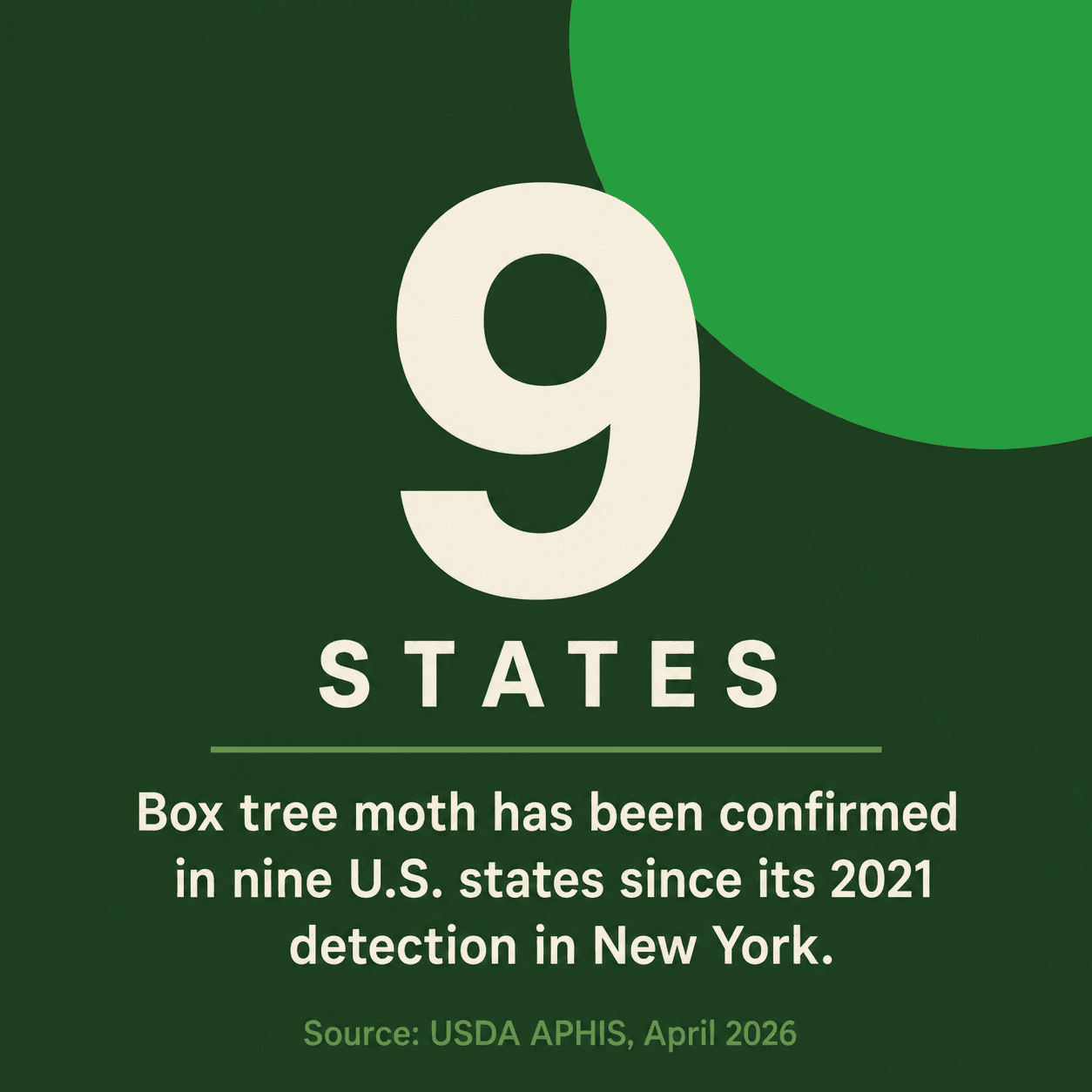
USDA APHIS reports that box tree moth caterpillars can completely defoliate boxwood and then feed on the bark, eventually killing the plant. The pest was detected in New York in 2021 and, as of the agency’s April 2026 update, has been confirmed in Delaware, Kentucky, Maryland, Massachusetts, Michigan, Ohio, Pennsylvania, Virginia, and West Virginia, with quarantines and movement controls in affected areas.
| Consideration | Live boxwood | Artificial hedging |
|---|---|---|
| Ongoing horticulture | Irrigation, feeding, pruning, pest and disease management | None |
| Biological risk | Boxwood blight, box tree moth, quarantine exposure in affected states | None |
| Performance in low light | Limited by the plant’s requirements | Unaffected |
| Appearance over a season | Varies with health, season, and management | Consistent |
| Fire documentation | Generally not applicable | Required, and product specific |
| Structural design | Usually minimal for planted hedging | Required for permanently attached and exterior work |
| Degradation mode | Disease, pest damage, dieback | UV fade, embrittlement, leaf loss, frame corrosion |
| End of life | Compostable green waste | Mixed-material assembly with limited recycling pathways |
The temptation is to turn that table into a payback period. We will not, because no independent benchmark exists for the ongoing cost of commercial interior plantscaping, and live-plant costs swing widely with climate, design, cultivar, irrigation, management, and disease pressure. Artificial systems also carry fabrication, documentation, structural, cleaning, replacement, and disposal costs that belong on the same page. If you need that comparison, build it from actual local proposals for both options rather than from a category average someone published.
Where artificial hedging is unambiguously the stronger answer is where live material simply cannot perform: interiors without adequate light, rooftops and podiums where irrigation and soil loading are impractical, high-traffic zones where plants get damaged, and venues where consistent appearance is a brand requirement rather than a preference.
Sustainability and Green Building Certification
The honest version of this section is short, so here it is.
LEED v5 does not award a credit for specifying artificial foliage. Relevant pathways may include integrated biophilic design, low-emitting materials, material disclosure, and life-cycle considerations, but whether an artificial hedge falls within a given product category and testing requirement depends on its use, adhesives, coatings, backing, and the LEED version in play. The WELL Building Standard’s biophilia feature refers to direct experience of nature or nature-derived patterns and calls for indoor elements reminiscent of the natural environment, so artificial botanical work may belong in a project’s biophilic narrative. Whether it satisfies a particular feature depends on the feature language, the project pathway, and the documentation. Neither framework hands you an automatic contribution.
The same caution applies to research. Peer-reviewed work associating workplace nature exposure with well-being was conducted with live plants, outdoor views, natural materials, and mixed biophilic environments. No study we could find isolated artificial hedging as the intervention for employee productivity, patient outcomes, hospitality dwell time, or retail spending. Anyone quoting you a percentage improvement attributable to artificial greenery is extrapolating.
End of life is the weakest point in the category’s sustainability case, and pretending otherwise helps nobody. An artificial hedge is a mixed assembly: molded foliage, pigments, UV stabilizers, flame-retardant additives, wire, steel or aluminum framing, mesh, adhesives, coatings, fasteners, planters, and fill. The EPA treats polymer waste as a life-cycle issue spanning production, use, waste management, and environmental release, and identifies no artificial botanical recycling stream. Even where an individual polymer is technically recyclable, mixed materials, contamination, bonded construction, and the absence of local collection can prevent it in practice.
The useful questions are documentary. Can the supplier provide a bill of materials with polymer identification, recycled-content evidence, chemical disclosure, design for disassembly, replaceable foliage modules separate from the frame, a take-back program, and an environmental product declaration? On the input side, we hold ourselves to the same standard: a recycled-content figure belongs to the component it describes, and the 75% recycled steel we publish is a NATUREMAKER® Steel Art Tree™ armature specification rather than a blanket number across every product line. What applies to any hedge we build is that it is fabricated and assembled at our own facilities in San Marcos, California, Las Vegas, Nevada, and Miami, Florida, which shortens the supply chain considerably against imported product.
Common Questions About Commercial Artificial Hedges
Are artificial hedges suitable for commercial use?
Yes, when the specific product carries fire documentation the AHJ accepts, weathering data appropriate to the exposure, and an engineered attachment. Commercial suitability belongs to the documented product and its assembly rather than to the category as a whole.
How does an artificial hedge attach to a wall?
Through a designed load path. A commercial hedge is supported by a frame or backing system fastened to a verified structural substrate, with anchor type, embedment, spacing, and edge distance selected for that substrate and for the project’s wind and seismic reactions. Gypsum board, thin cladding, and veneer do not qualify as structural substrates. On our projects, pre-fabricated components ship to the site and get assembled in place by our crews, anchored to structural elements, then seamed and finished.
How long do artificial hedges last outdoors?
No independent category answer exists, because no published field study correlates accelerated weathering hours with years of commercial service for artificial foliage. Longevity depends on polymer, stabilizer package, pigments, leaf thickness, and actual exposure. Our own products are engineered to last decades with minimal maintenance, and we would treat any supplier’s specific year figure as a warranty commitment to read closely rather than an industry fact.
Do commercial artificial hedges need to be fire rated?
Artificial decorative vegetation is expressly addressed by the International Fire Code, which requires compliance with NFPA 701 flame propagation criteria, documented and certified by the manufacturer in an approved manner. Depending on how a dense wall-mounted system is mounted, ASTM E84 interior finish data may also be required. Confirm the classification with your AHJ before selecting a product.
What is the difference between inherently fire-retardant and fire-treated foliage?
Inherently fire-retardant foliage has the fire-retardant chemistry compounded into the resin before molding, so nothing on the surface can wash off or wear away. Treated foliage carries a topical application whose service life varies with cleaning, exposure, humidity, and handling, and for which no universal retreatment interval exists. Neither term amounts to a code rating on its own. Both still require test evidence tied to the finished product.
Can artificial hedges be used on a rooftop or terrace?
Yes, and they are one of the few practical options where soil loading and irrigation rule out live material. Rooftop and terrace work adds requirements: the 2024 IFC addresses permanently installed exterior artificial vegetation on roofs and near buildings, wind design becomes central, waterproofing penetrations and floor loading have to be verified, and planter ballast has to be calculated rather than assumed.
Where can I buy commercial artificial hedges?
From a manufacturer that can produce the documentation. The qualifying test is whether a supplier can hand you an independent laboratory report matching the exact product, a weathering report with retained-property data, an attachment design for your substrate, and a warranty covering labor and access.
Getting Your Hedge Specification Right
The pattern is consistent. Hedging gets selected late, on appearance, from a catalog, and the fire, structural, and exposure questions then arrive as problems instead of criteria. Moving those questions forward by a single design phase costs nothing and removes most of the risk.
If you have a project in front of you now, we would rather see it early than late. Send us a sketch, a drawing set, or a photo of the space with a note about what needs screening, and we will work through the classification, exposure, and attachment questions with you. Our design work, from concept through renderings and samples, carries no charge until you approve an order, and you can put our work next to a retail panel and judge for yourself at our Las Vegas showroom, which takes walk-ins, or at San Marcos or Miami by appointment.