
Plan on using fire-retardant artificial plants in a cruise ship’s passenger spaces. Expect to show fire test evidence for the plants before they go aboard. SOLAS, the international safety convention for ships, limits how much combustible material can go into passenger spaces and requires exposed surfaces to resist the spread of flame. Those rules can apply to artificial plants, because the plants are made of combustible material. Fire-retardant plants count as combustible too, since the retardant helps a plant resist fire but the material itself can still burn.
At International Greenscapes, our TREESCAPES® team has fabricated palms and sculpted column wraps for pool decks and indoor lounges on our cruise ship projects.
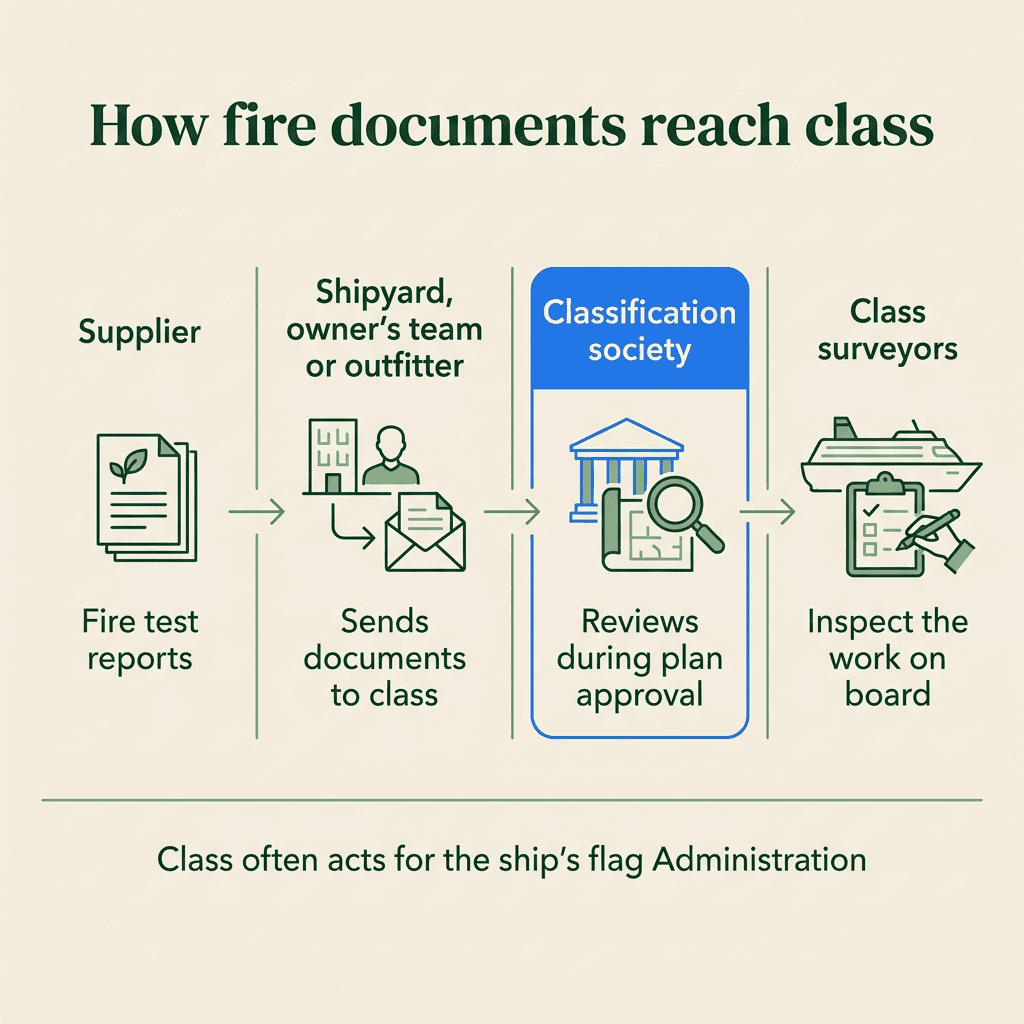
On a ship, fire evidence is reviewed by the ship’s flag Administration, meaning the government of the country where the ship is registered, or by a classification society acting for it. In the industry, the two are known as flag and class. The certificates you’ve probably seen on plant spec sheets, such as NFPA 701 and ASTM E84 Class A, were written for buildings, so the first thing to settle is whether class will accept them. After that, each piece has to suit the fire rules for the space it goes in, be secured against the ship’s motion and, on open decks, resist sun, salt air and wind.
What does SOLAS require for artificial plants?
SOLAS has no fire test or fire performance standard written for artificial plants, but that doesn’t make them exempt from its fire rules. What SOLAS asks of plants comes from Chapter II-2, the convention’s fire safety chapter, which limits combustible materials in passenger spaces. Chapter II-2 relies on the International Code for Application of Fire Test Procedures, known as the FTP Code (currently the 2010 edition), for its fire test methods. SOLAS has made the FTP Code mandatory for ships built since July 1998.
These are the Chapter II-2 rules most likely to affect artificial plants:
- A cap on combustible materials. SOLAS allows combustible “facings, moldings, decorations and veneers” in accommodation and service spaces, but their total volume is capped. The total can’t be more than the volume of a layer 2.5 mm thick (about a tenth of an inch) covering the combined area of the walls and ceiling. Public spaces where passengers gather, such as dining rooms, lounges and cafes, count as accommodation spaces.
- Low flame spread on exposed surfaces. Combustible materials used as exposed surfaces in corridors and stairways, and on bulkheads and ceilings in passenger accommodation, service and control areas, must have low flame spread. A green wall mounted on a bulkhead may be treated as one of these surfaces.
- Smoke and toxic gas. Regulation 6 of Chapter II-2 deals with the smoke and toxic gas that materials give off when they burn. The ship test for smoke and toxicity is FTP Code Part 2, so class can ask for Part 2 results as well as results for flame spread.
- Restricted fire risk furnishings. In stairways and some public spaces on passenger ships, furniture and furnishings must meet the “restricted fire risk” standard. That standard sets fire requirements for furniture, curtains, upholstery, bedding, floor coverings, and wall and ceiling surfaces. Plants aren’t on that list, so class decides whether a plant in one of these spaces has to meet the standard.
Whether a particular plant counts toward the combustible cap is up to flag or class, since they approve the ship’s plans. If class counts your plants, they share the room’s allowance with every other combustible finish in it, so raise the question early for rooms that already have a lot of wood veneer.
Do NFPA 701 or ASTM E84 Class A certificates count on a ship?
NFPA 701 certificates are real fire evidence for artificial plants, and ASTM E84 Class A results are real evidence for wall-mounted pieces such as green wall panels and column wraps. Both standards were written for buildings. On a ship, class decides whether to accept them or to require results under FTP Code Part 5 and Part 2, the ship tests for surface flammability and for smoke and toxicity.
| Standard | What it covers | Written for | What to do with it on a ship project |
|---|---|---|---|
| NFPA 701 | How fabrics, films and other listed materials resist the spread of flame. Its scope specifically includes artificial vegetation. | Buildings | Offer it as fire evidence for foliage and loose potted plants. Ask class whether it will accept NFPA 701 results or wants FTP Code results instead. |
| ASTM E84 Class A | How fast flame spreads across a surface and how much smoke develops. Class A is the best of three classes. | Buildings, mainly wall and ceiling surfaces | Use it as evidence for green wall panels and column wraps, since it rates surfaces such as walls. |
| FTP Code Part 5 | Surface flammability, meaning how easily a surface material catches fire and spreads flame | Ships | Plan on supplying it for any piece class treats as a wall finish, such as a green wall. It is also the test the Coast Guard requires when it approves wall and ceiling finishes for US-flagged SOLAS ships. |
| FTP Code Part 2 | How much smoke and toxic gas a material gives off when it burns | Ships | The Coast Guard requires it together with Part 5 when it approves wall and ceiling finishes for US-flagged SOLAS ships. Plan on supplying both results for the same material. |
Who approves artificial plants on a cruise ship?
The ship’s flag Administration approves the ship’s fire safety arrangements. A classification society often does that work for the flag, reviewing plans and carrying out surveys. Class usually reviews your fire documents during plan approval. Its surveyors then inspect the work on board. Your documents and questions normally reach class through the shipyard, the owner’s newbuild or refit team, or the turnkey outfitter. Find out at the start of the project which of them handles correspondence with class.
If the ship embarks passengers at US ports, or calls at US ports with US citizens among its passengers, the Coast Guard also examines it at least once a year.
What documentation should you ask a supplier for?
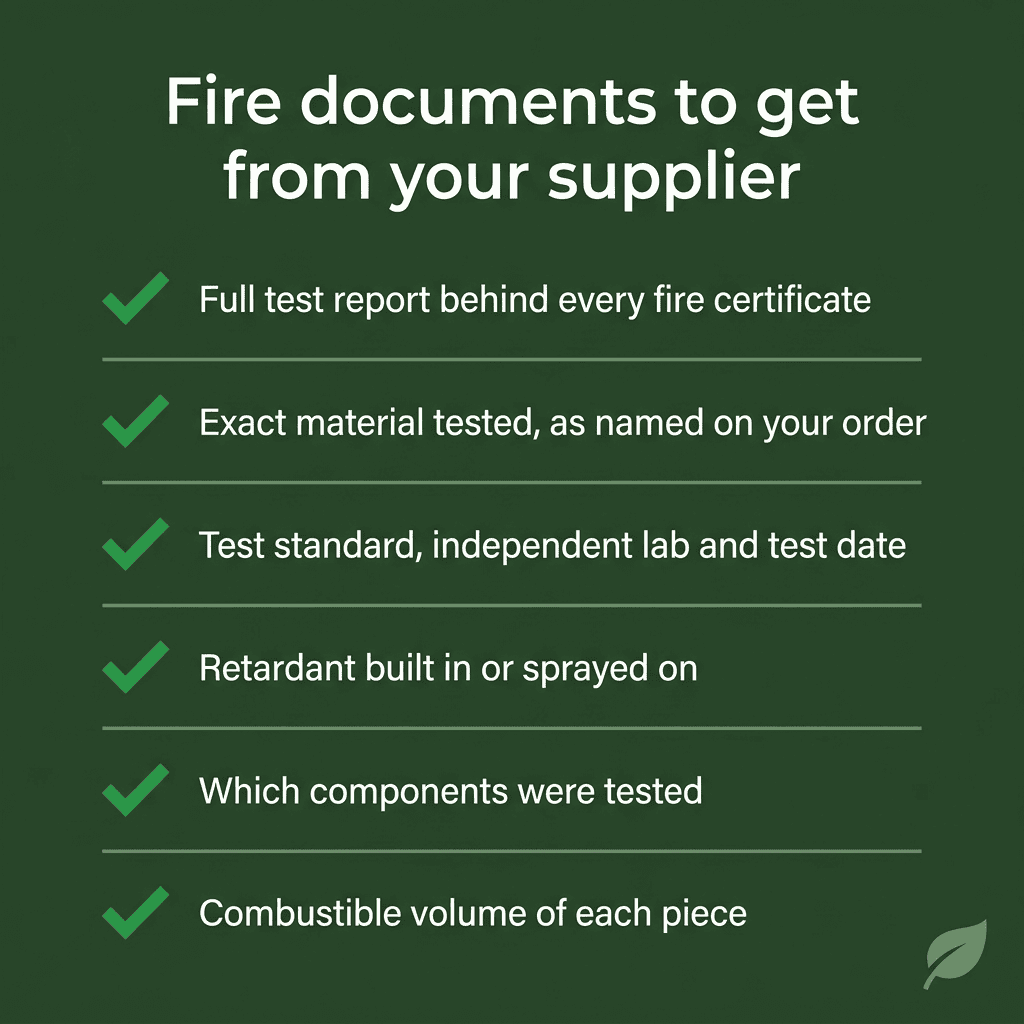
Get the full test report behind every fire certificate, because class needs to see that the material tested is the material going aboard. Each report should show:
- The exact material tested, named the way it appears on your order
- The standard it was tested to, such as NFPA 701, ASTM E84, or FTP Code Part 5 and Part 2
- The name of the independent lab that ran the test
- The date of the test
- Whether the retardant is built into the material or sprayed on afterward
- Which components were tested, such as the leaves, trunk, branches, moss, planter or backing panel
Along with the reports, get the volume of combustible material in each piece. You need that figure to check the room’s total against the combustible cap if class counts your plants toward it.
We provide stamped certifications and independent lab test reports for our projects. Our TREESCAPES® products are ASTM E84 Class A certified, NFPA 701 compliant and California Title 19 certified. California Title 19 contains the state fire marshal’s rules for flame-retardant materials, which include artificial plants used in buildings such as restaurants and schools.
Do I need to reapply fire retardant coating?
It depends on how the retardant got into the plant. A spray or coating applied to a finished plant can wash off or wear away over time, so it may need to be reapplied. Retardant mixed into the material before the plant is made stays part of the material, so there is nothing to reapply. Our UltraLeaf-IFR® foliage is inherently fire-retardant, because we mix the retardant into the liquid resin before the leaves are molded.
A spray-on treatment needs proof that it lasts if the plants will be wiped down or washed as part of the ship’s regular cleaning. When a supplier says its treatment holds up to cleaning or weather, get the test results taken after cleaning or weathering. Find out, too, how often the treatment has to be reapplied.
Does every part of the plant need to be fire retardant?
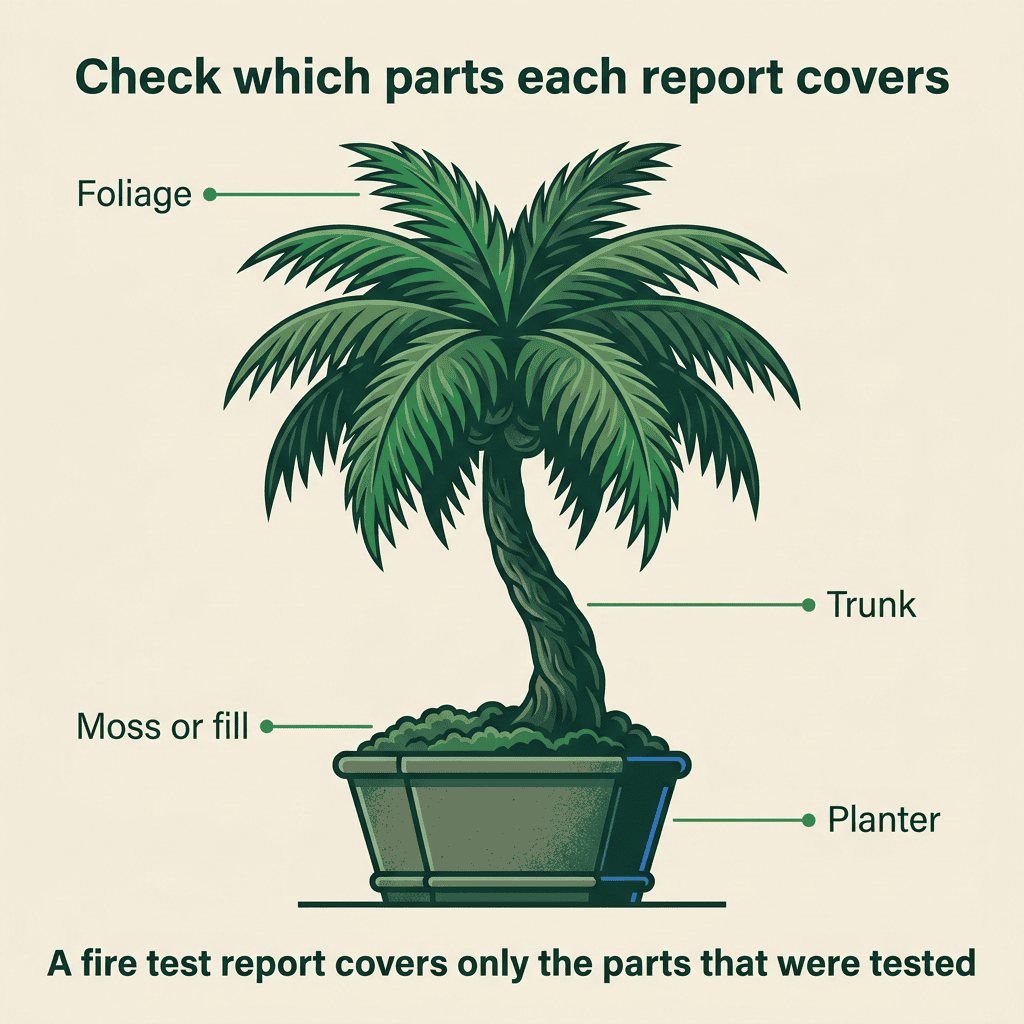
Yes, assume every part needs to be fire-retardant. Each part of a plant can be a different material, and a fire test report covers only the parts that were tested. A palm with fire-retardant leaves and an untreated trunk still puts untreated material into the space.
A large artificial palm can include foliage, a trunk, branches, moss or fill at the base, and a planter. A green wall adds a backing panel behind the foliage. Check which parts each report covers, and get a separate report for any part made from a different material.
Design considerations for artificial plants on cruise ships
Placement and the ship’s fire plan
Start with where each plant will go, because the fire rules change from space to space. SOLAS sorts a passenger ship’s spaces into numbered fire categories, and the furnishing rules depend on the category. Each space’s category is shown on the ship’s fire protection drawings, so check it there before you choose plants for the space. Class decides whether fixed pieces such as palm tree column wraps and green walls count as wall finishes or as furnishings. The classification sets which fire test results you’ll need, so submit drawings and fire test reports for those pieces early in the design. SOLAS allows decorative plant arrangements in corridors and stairways only if they are fixed in place and don’t narrow the escape route. Furniture and furnishings in stairways must meet the restricted fire risk standard, so check any placement in or near a stairway enclosure against it before the design is final.
Weight and securing against motion and vibration
A ship moves and vibrates at sea, so every large piece needs to be fixed to the ship’s structure. A loose planter can slide or tip over when the ship rolls. Get the weight of each large piece from the supplier early, along with its anchoring details and engineering calculations, so the yard’s engineers can plan where and how it will be fixed. Our anchoring uses heavy-gauge base plates secured to structural elements, and we can provide calculations stamped by licensed engineers. The shipyard or outfitting contractor is responsible for the deck or bulkhead structure those base plates attach to, so they need the anchoring details before their own drawings are final.
Sun, salt air and wind on open decks
Plants on an open deck face strong sun, salt air and wind, so they need materials made for outdoor use. Our UltraLeaf-X® / UVI foliage has UV stabilizers bonded into the resin, which helps it resist fading and turning brittle in the sun. Our TREESCAPES® finishes are made to resist salt air in coastal environments. For pieces on an open deck, ask for anchoring calculations that account for wind loads as well as the ship’s motion.
A foliage grade rated for sun is not automatically fire-retardant. Confirm that the exact outdoor grade you’re buying is also fire-retardant, and get the test report for that grade. The SOLAS cap on combustible “facings, moldings, decorations and veneers” is written for accommodation and service spaces, so find out from class how it treats plants on pool decks and other open decks.
How long does it take to have custom plants made for a ship?
Our custom trees take at least three months from the day you approve the design to the day they’re delivered, and complex or very large pieces can take longer. Plan the schedule around our lead time and the time class needs to review the fire documents. The documents should reach class well before the yard needs the pieces, because a question about a report late in the schedule can delay when the pieces go aboard. For a newbuild, gather the documents early in the interior design work. For a refit, gather them as soon as you’ve chosen the pieces.
FAQ
Can artificial plants go on cabin balconies?
Artificial plants can go on cabin balconies if they meet the fire rules for that ship’s balconies. Those rules depend on the ship’s age and how its balconies are protected. SOLAS rules that took effect in 2008 treat cabin balconies differently on new and existing ships. On new ships, the rules on combustible materials and smoke that apply indoors also apply to balconies. On both new and existing ships, furniture and furnishings on balconies must meet the restricted fire risk standard, unless the balcony has a fixed water spraying system and a fixed fire detection and alarm system. The restricted fire risk standard doesn’t name plants, so class decides whether balcony plants have to meet it.
What do you show a Coast Guard examiner for artificial plants added in a refit?
Show the fire test reports for the plants and any approval certificates that flag or class issued for them. Coast Guard examiners check material approval certificates when a foreign passenger ship has new furniture, curtains or other movable items aboard. On a foreign-flagged ship, those certificates come from flag or class, not from the Coast Guard. The Coast Guard also has no approval category for artificial plants, so no supplier can give you a “USCG-approved” plant certificate. Keep the plant documents with the ship’s records so they are ready for the next exam.
Planning artificial plants for a newbuild or refit
If you’re specifying greenery for a cruise ship, we’d be glad to talk through your spaces, the fire documents that flag and class are likely to want, and the timeline. Call our team at 760-631-6789 or send us a note. You can also set up a visit to one of our studios in San Marcos, California; Las Vegas, Nevada; or Miami, Florida, to see our artificial plants and finishes in person before you specify them.