
Global passenger traffic hit a record 9.4 billion in 2024, and the industry expects that number to nearly double by 2043. Airports are spending tens of billions on terminal renovations, and biophilic design has become a central differentiator in the passenger experience. Trees, palms, green walls, and botanical environments now show up in terminal master plans from Portland to Doha.
The problem: most airports cannot sustain live plants at scale. The light levels, HVAC conditions, water infrastructure, biosecurity rules, and fire codes in terminal environments make living plant programs enormously expensive and operationally fragile. That’s where engineered artificial and preserved botanicals come in.
At International Greenscapes, we’ve designed and fabricated artificial trees for more than ten U.S. airports, from Orlando International and Denver International to San Diego, Newark Liberty, and Fresno Yosemite. Through that work, and through more than four decades of experience in commercial biophilic design, we’ve developed a detailed understanding of what these projects require. This article covers the landscape: why airports are investing in botanical design, why live plants fail in most terminal environments, and what airport authorities, architects, and specifiers need to know about fire codes, total cost of ownership, and procurement.
Why Airports Are Investing in Botanical Design
Biophilic design (the incorporation of natural elements into built environments) has moved from a niche interest to a standard expectation in terminal architecture. The driving force is research showing that visible greenery reduces passenger stress.
The academic foundation rests on two theories: Stress Reduction Theory (SRT), which holds that visual contact with nature lowers sympathetic nervous system activity, and Attention Restoration Theory (ART), which demonstrates that natural environments restore the ability to focus after mental fatigue. Both are well documented in environmental psychology literature.
A 2012 study published in the Journal of Alternative and Complementary Medicine enrolled 457 patients in a Dutch hospital radiology department and found that patients exposed to real plants and patients exposed to posters of plants both reported lower stress levels than a control group. The implication is significant for airports: the visual presence of botanical elements, not their biological function, is what drives the stress reduction effect. High-quality artificial botanicals deliver this same visual benefit.
A 2025 study published in Buildings (MDPI) took the analysis further, finding that visibility of greenery matters more than total volume, and that placing botanical elements in passengers’ sightlines is the most effective strategy. The researchers recommended incorporating biophilic visibility metrics into existing frameworks like IATA Level of Service, WELL, and LEED.
Madrid-Barajas Airport’s Terminal 4 relaxation zone, which features 99 Mediterranean trees, reported a 20% improvement in passenger satisfaction according to the 2023 Aena Sustainability Report. Bill Browning of Terrapin Bright Green noted that Portland International Airport’s design team was explicit about the goal: reducing passenger stress through biophilic interventions targeted at high-anxiety zones.
The financial incentive is clear. Lower passenger stress leads to longer dwell times, and longer dwell times in terminal concourses correlate directly with higher non-aeronautical revenue from retail, dining, and services.
Why Live Plants Fail in Most Airport Environments
A few airports in the world have pulled off live botanical programs at scale. Singapore Changi and Doha’s Hamad International are the headline examples. But the resources they commit are extraordinary and unrealistic for most terminals.
Changi maintains over 600,000 plants with roughly 14 in-house horticulturists and approximately 120 outsourced contractors. The airport operates a 3-hectare nursery that produces about 3,000 replacement plants per month. Jewel Changi, the 1.46-million-square-foot retail and garden complex, was purpose-built with custom HVAC modeling, recirculated rainwater systems (handling up to 10,000 US gallons per minute during storms), and specialized lighting designed around plant heat and light needs.
For the vast majority of U.S. airports, that level of infrastructure and staffing is not on the table. The operational realities working against live plants in terminals include:
- Low light and aggressive HVAC. Terminal interiors are climate-controlled environments designed for human comfort, not plant survival. Industry data indicates most commercial indoor plants die within 2 to 3 years, and Planterra states plainly that “there is no such thing as a true low light plant.”
- Water infrastructure risk. Live planters require irrigation, drainage, and waterproofing in close proximity to terminal electrical systems, baggage handling, and IT infrastructure. Leaks near this equipment create service disruptions that airports cannot tolerate.
- Biosecurity friction. USDA APHIS prohibits plants in soil from entering the United States, and phytosanitary certificates are required for bare-rooted plants. Plants from Hawaii, Puerto Rico, and the U.S. Virgin Islands face additional restrictions. For airports, this complicates international sourcing and quarantine of replacement specimens.
- Ongoing cost. Published live interior plantscape service contracts range from $2 per plant per month for a tabletop plant to $12 per plant per month for a 6-foot floor plant, with minimum service contracts of $125 to $600+ per month. Replacement cost is typically built in as a 30% to 50% markup over plant retail, amortized over 12 months.
Artificial and preserved botanicals eliminate every one of these challenges. There is no irrigation to leak, no biosecurity paperwork, no replacement cycle, and no horticultural staff.
Fire Code Compliance for Airport Botanicals
Airport terminals are classified as assembly occupancies (typically A-3 under the International Building Code), and their large occupant loads make flame propagation control a non-negotiable requirement. Any decorative botanical material in a terminal must meet stringent fire testing standards.
The distinction that matters most in fire compliance is inherently fire-retardant (IFR) versus surface-treated. IFR products have flame-retardant compounds blended into the fabric and polymer during manufacture. The fire protection is permanent and does not degrade. Surface-sprayed treatments wash off over time and lose effectiveness, making them unsuitable for long-term commercial applications. Specification language should explicitly exclude surface-treated products.
| Standard | Authority | What It Covers |
|---|---|---|
| NFPA 701 | National Fire Protection Association | Fire tests for flame propagation of textiles and films. Char length under 6.5 inches; self-extinguish within 2 seconds. Most commonly cited spec for decorative artificial foliage in U.S. commercial settings. |
| ASTM E84 (Class A) | ASTM International | Surface burning characteristics of building materials. Frequently specified for trunk and structural elements in commercial sculpted trees. |
| California Title 19 | CA Office of the State Fire Marshal | Required for decorative materials including artificial trees and plants in public-occupancy spaces in California. |
| CAN/ULC S109 | Underwriters Laboratories of Canada | Canadian flame-spread test for decorative materials. |
| BS 476 Parts 6 & 7 | British Standards Institution | UK/EU equivalent for surface spread of flame. |
| IBC / NFPA 101 Life Safety Code | NFPA / ICC | Governs airport assembly occupancy classification and limits on combustible interior finishes. |
At International Greenscapes, all of our products are manufactured with inherently fire-retardant materials. Our NATUREMAKER™ steel-core trees, TREESCAPES™ preserved palms and fabricated trees, and PLANTWORKS™ green walls and foliage all meet or exceed ASTM E84 Class A, NFPA 701, and California Title 19 requirements. We provide full documentation for fire marshals, building departments, and architects.
Airport Botanical Projects Around the World
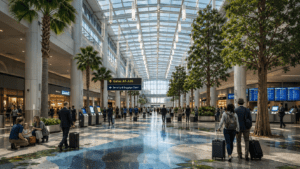
The following projects represent the current state of botanical design in airport and transit architecture. They range from live-plant-intensive programs with massive operational budgets to engineered botanical solutions that deliver biophilic impact without the maintenance tail.
| Airport | Project | Scale |
|---|---|---|
| Singapore Changi (Jewel) | Jewel Changi Airport (2019) | More than 2,000 trees and palms, over 100,000 shrubs covering 21,000+ m². 40-meter Rain Vortex. Purpose-built structure with custom HVAC and recirculated rainwater. |
| Hamad International, Doha | The Orchard (2022) | 6,000 m² indoor tropical garden. 300+ trees, 25,000+ plants. LEED Gold Central Concourse. |
| Portland International (PDX) | Main Terminal Expansion (2024) | 9-acre mass timber roof. 72 large trees up to 25 feet. 5,000+ understory plants. Designed with Terrapin Bright Green and PLACE landscape architects. 50% reduction in energy use per square foot. |
| Madrid-Barajas (Aena) | T4 Relaxation Zone (2022) | 99 Mediterranean trees. 20% improvement in passenger satisfaction per 2023 Aena Sustainability Report. |
| Pittsburgh International (PIT) | Gensler-designed new terminal (2025) | Native Western PA species. Rainwater harvesting. |
| Kempegowda International, Bengaluru | Terminal 2 (“Terminal in a Garden”) | Bamboo and reed-clad biophilic terminal. |
Each of these projects reflects a growing consensus among aviation architecture firms that biophilic design has become a baseline expectation in terminal projects, not an optional upgrade. ZGF Architects’ Sharron van der Meulen described the trend in a 2026 I+S Design outlook: biophilic design elements for comfort and well-being are now standard.
Artificial Botanicals in U.S. Airport Projects
We’ve had the opportunity to bring biophilic design to airports across the country, each with different design goals and species requirements. Our airport portfolio includes projects at San Diego International, Newark Liberty International, Fresno Yosemite International, Orlando International, Myrtle Beach International, John Wayne Airport, Denver International, San Francisco International, Tampa International, Ft. Lauderdale-Hollywood International, and Southwest Florida International.
These projects collectively demonstrate how our three brands work together to solve specific challenges in transit environments: NATUREMAKER™ for hand-sculpted, steel-core trees at monumental scale; TREESCAPES™ for preserved palms and fabricated trees; and PLANTWORKS™ for green walls, foliage, and integrated botanical environments.
Here’s a closer look at several of them.
Orlando International Airport (MCO)
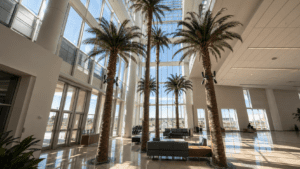
Towering fabricated palms welcome travelers entering Orlando International Airport, introducing the landscape of Florida directly into the terminal architecture. Designed at architectural scale, these botanical environments are integrated within the terminal’s glass atriums, creating a strong sense of arrival while performing reliably inside one of the busiest airports in the United States. The palms are engineered with durable materials built for the demands of a high-traffic international hub.
San Diego International Airport (SAN), Terminal 2 West
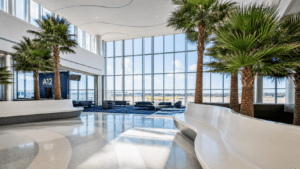
Six custom-crafted 30-foot Queen Palms rise through the glass atrium of Sunset Cove at San Diego International Airport. The HNTB-designed Terminal 2 West (Green Build) became the world’s first LEED Platinum commercial airport terminal. Crafted by our NATUREMAKER™ team, the palms feature ceramic trunks paired with preserved fronds, combining engineered structure with natural botanical materials. Positioned among circular leather seating pods, the palms soften the modern stainless-steel interiors and echo the coastal palms visible through the terminal windows.
Newark Liberty International Airport (EWR), Terminal A
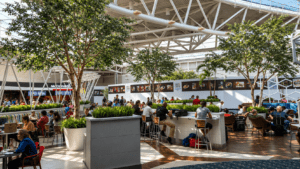
As part of the $2.7 billion Terminal A renovation, Newark Liberty reopened in January 2023 with a completely reimagined passenger experience. Inside the Kitchen Step restaurant, an 18-foot NATUREMAKER™ oak tree crowned with twinkle lights anchors the circular bar. Flanking 10-foot birch trees, sculptural planting walls, and trailing greenery transform the terminal restaurant into something closer to a neighborhood bistro than an airport concession. The design by Atelier NY Architecture used botanical elements to create a sense of place that makes travelers forget they’re dining airside.
Fresno Yosemite International Airport (FAT)
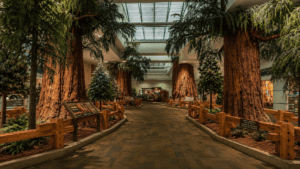
The “Sequoiascape” at Fresno Yosemite International features 25-foot column-clad sequoia trees custom-engineered by our NATUREMAKER™ team to wrap existing structural columns. The project won an ADEX Platinum Award in 2011 for design excellence. Passengers walk through a forest trail experience complete with sapling pine trees, boulders, native plantings, and interpretive signage. The sequoias reflect the airport’s role as the gateway to Yosemite, Sequoia, and Kings Canyon National Parks, giving the terminal a sense of regional identity that no generic interior finish could achieve.
Myrtle Beach International Airport (MYR)
The expansion of Concourse A at Myrtle Beach International Airport incorporates palm environments inspired by the coastal landscape of South Carolina. Integrated seating areas and botanical elements create a relaxed, welcoming environment for passengers moving through the terminal, with materials engineered for the demands of a public terminal environment.
John Wayne Airport (SNA)
At John Wayne Airport in Santa Ana, California, palm groupings and integrated plantings reflect the landscape and climate of Southern California. The botanical environments introduce texture, scale, and natural character into the terminal, with palm environments scaled to the architecture and durable materials suitable for public spaces.
Additional Airport Projects
Our work extends to several other major U.S. airports, including Denver International, San Francisco International, Tampa International, Ft. Lauderdale-Hollywood International, and Southwest Florida International. Each project is custom designed to complement the surrounding architecture while meeting the operational demands of modern terminals.
What to Specify When Procuring Airport Botanicals
If you’re an airport authority, architect, or procurement team specifying decorative botanicals for a terminal project, the following requirements should appear in your specification language:
- NFPA 701 certification (small or large scale), documented with independent lab test results.
- ASTM E84 Class A rating for structural components including trunks and armatures.
- State-specific fire marshal certification where applicable. California Title 19 is the most common additional requirement.
- Inherently fire-retardant (IFR) materials only. Specification language should explicitly exclude surface-sprayed flame-retardant treatments, which degrade over time.
- Manufacturer warranties covering foliage, structural integrity, and finish durability.
- Seismic engineering that meets or exceeds International Building Code requirements for the project’s seismic zone.
- Independent lab test documentation for material safety, including RoHS compliance (non-toxic, non-allergenic).
Getting these details right at the specification stage avoids costly substitutions and ensures the botanical elements perform as intended over the full lifecycle of the terminal renovation.
Artificial Trees and Smart Technology in Terminals
One area where engineered trees offer a capability that live plants simply cannot match is technology integration. The cell-tower concealment industry has been disguising wireless infrastructure inside artificial trees since 1992, when the first “monopine” was built in Denver. Today, more than 10,000 concealed cellular sites across the U.S. use tree-form enclosures, according to Valmont Concealment Structures.
The rollout of 5G mmWave technology has accelerated this trend. Because mmWave signals must be set up every couple hundred feet, the number of indoor antenna locations in large public buildings is multiplying. Engineered trees with steel-core construction, like our NATUREMAKER™ Steel Art Trees™, can readily integrate Wi-Fi access points, distributed antenna system (DAS) nodes, cameras, sensors, and small-cell radios within their trunk and canopy structures.
For airports and transit hubs that need to expand wireless coverage without adding visible infrastructure to architecturally sensitive spaces, this is a practical advantage that no living tree can offer.
Total Cost of Ownership: Artificial vs. Live Plants
For terminals without the budget or operational infrastructure for a Changi-scale horticulture program, the financial case for engineered botanicals is straightforward.
| Cost Factor | Live Interior Plants | Artificial / Preserved Botanicals |
|---|---|---|
| Ongoing service contract | $2 to $12 per plant per month, with $125 to $600+ monthly minimums. | None. Periodic light cleaning only. |
| Replacement cycle | 2 to 3 years typical lifespan in commercial indoor settings. | Engineered to maintain their appearance for decades. NATUREMAKER® steel-core trees are built on structural armatures designed for permanent placement. |
| Water and irrigation | Required. Increases risk of leaks near terminal electrical and IT infrastructure. | None. |
| Lighting and HVAC load | High. Plants require supplemental lighting and HVAC adjustments. | None. |
| Biosecurity | USDA APHIS phytosanitary certificates required. Soil prohibited from entry to the U.S. | None. |
| Fire compliance | Soil-borne combustibles. Some species require additional treatment. | Inherently fire-retardant at manufacture. Meets NFPA 701 and California Title 19. |
| Pest, pollen, and mold exposure | Ongoing concern in enclosed terminal environments. | None. |
When amortized over a 10- to 15-year terminal renovation cycle, the break-even point for engineered botanicals versus live plant programs is typically reached within 3 to 5 years. After that, it’s ongoing savings with no loss of visual impact.
The Biophilic Opportunity in Transit Beyond Airports
The same dynamics apply to other transportation environments. Cruise terminals in Miami, Port Everglades, and Galveston increasingly use preserved palm trees and fabricated trees to evoke destination identity in pre-cruise check-in halls. Bus and intermodal hubs, including Denver Union Station and Salesforce Transit Center in San Francisco, have used live planters that frequently require costly replacement.
Train stations and transit halls represent an underdeveloped opportunity. Moynihan Train Hall in New York, the $1.6 billion SOM-designed Amtrak/LIRR hall, emphasizes daylight and material warmth through its 31,000-square-foot skylight and Tennessee marble flooring, but incorporates minimal vegetation. Custom green walls, preserved palms, and sculptural trees could add biophilic depth to these spaces without the operational burden that live plants would create.
Bring Biophilic Design to Your Terminal
Airports and transit hubs face a clear opportunity: billions of passengers moving through spaces that can either feel sterile and stressful or calm and connected to nature. The research supports the investment. The fire codes are navigable. And for most terminals, engineered and preserved botanicals are the practical path to biophilic design at scale.
If you’re planning a terminal renovation, concession redesign, or transit hub project and want to discuss how artificial and preserved botanical elements can fit your design and compliance requirements, contact our team to start the conversation.