
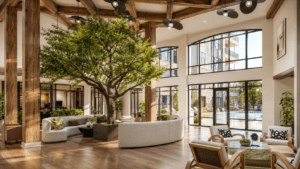
Artificial plants for apartment buildings belong in the shared spaces that shape a property’s first impression: lobbies, leasing centers, fitness rooms, pool decks, rooftop lounges, co-working areas, corridors, and parking structures. These are the exact zones where live plants tend to fail, brought down by low light, heavy foot traffic, and the absence of dedicated horticultural staff, while irrigation introduces water-damage risk near finishes and electrical systems. Building-grade artificial greenery holds its appearance for decades without watering, replacement, or pruning. At International Greenscapes, we have fabricated botanical elements for commercial environments since 1983, and our inherently fire-retardant (IFR) foliage meets or exceeds ASTM E84 Class A, NFPA 701, and California Title 19, the standards a fire marshal applies to multi-tenant residential corridors and assembly areas.
This guide is written for the people choosing greenery for the building, not for a renter decorating a single unit: developers, owners, operators, property managers, and the architects and interior designers who specify on their behalf. The decision is a leasing and operations decision before it is a design choice, so the sections below are organized two ways at once: by where greenery goes in the building, and by the building-level factors that actually move the numbers.
Why greenery in an apartment building is a leasing decision, not decor
The way renters use a building has changed, and that change runs straight through the common areas. According to the 2024 NMHC and Grace Hill Renter Preferences Survey, which captured responses from more than 172,000 renters, 52% of renters now work remotely to some degree. Amenity lounges, lobbies, and co-working spaces are daytime habitats now, not rooms residents pass through on the way to the elevator.
That shift raises the stakes on how those spaces look. According to the same survey, roughly 30% of surveyed renters previously owned a home, and 60% cite maintenance-free living as the single most valuable benefit of renting. This is the lifestyle renter: someone who could buy but chooses to rent, expecting an environment that matches high-end ownership without the upkeep. Wilting or pest-ridden live plants in a lobby quietly contradict the maintenance-free promise the entire lease is built on.
Leasing also starts long before a tour. Sixty percent of renters seriously evaluate between three and seven communities, and 54% say property and amenity photos are the most valuable content when comparing options. Greenery that looks flawless in a photo and identical in person, 365 days a year, keeps the digital first impression and the physical walkthrough aligned. That consistency is the practical reason developers specify engineered botanical elements for the spaces that sell the building.
The ROI case for biophilic design in multifamily
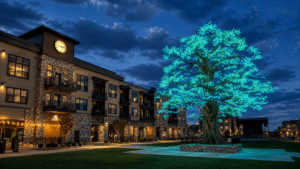
The financial argument for greenery ties directly to biophilic design: the documented human response to natural elements. People exposed to nature, or to convincing representations of it, show measurable benefits, and in a commercial context those benefits translate into perceived value. Research compiled in Terrapin Bright Green’s Economics of Biophilia connects natural design elements to higher productivity, stronger well-being, and concrete real estate premiums.
| Economic Indicator | Demonstrated Impact | Relevance to Multifamily |
|---|---|---|
| Property sale value | +7% to +16% at sale | Asset valuation for owners and investors |
| Rent premiums | 5% to 6% for high daylight; 10% to 15% for access to natural spaces | Amenity decks, lounges, and co-working areas |
| Occupant well-being | 6% higher productivity, 15% higher creativity, 15% higher well-being | Remote-working residents using building amenities |
| Lobby spending behavior | Guests spend 36% more in biophilic lobbies | Mixed-use ground floors and retail |
The CREW Network ties biophilic integration to faster lease-ups, stronger lease rates, and lower vacancy. There is a catch built into that data: the premiums only hold if the greenery stays in a state of visual perfection. Neglected or dying plants erase the effect. That requirement for permanent consistency is what pushes multifamily teams toward building-grade artificial fabrications, which deliver the visual and psychological payoff of biophilia without exposing the operator to biological failure.
Why live plants fail in apartment common areas
Specifying live plants for shared spaces means asking a climate-controlled building engineered for people to also function as a greenhouse. The mismatch shows up as a series of operational liabilities.
Light and traffic. Windowless elevator banks, deep corridors, and amenity rooms rarely provide the light spectrum plants need. Plants drop leaves and decline quickly in these conditions, and high foot traffic accelerates the damage.
No horticultural staff. Property and facility teams are not horticulturists. Plant care gets outsourced to landscape vendors or handed to janitorial staff, turning a design feature into a recurring, volatile line item on the operating budget.
Water damage and mold. Living walls and planters need irrigation, and irrigation sits next to millwork, carpet, and electrical. The EPA is direct that moisture control is the key to mold control, and damp soil also draws fungus gnats and other pests that generate tenant complaints.
Structural load. A fully saturated living green wall can exert significant dead load per square foot, often requiring steel backing and engineering review. Commercial artificial green wall panels weigh a fraction of that and integrate into standard partitions without triggering structural redesign.
The air-purification myth. The belief that potted plants clean indoor air traces to a 1989 NASA chamber experiment. A Drexel University meta-analysis of 12 studies spanning 30 years found that ordinary building ventilation removes airborne compounds far faster than plants can, and that matching that rate biologically would require somewhere between 10 and 1,000 plants per square meter of floor. Once you accept that indoor greenery is valued for how it looks and feels rather than for measurable air quality, the case for absorbing all of the liabilities above gets much harder to make.
Here is how the two approaches compare across the factors that matter most in a building.
| Factor | Live Plants in Common Areas | Building-Grade Artificial Greenery |
|---|---|---|
| Low-light and high-traffic zones | Decline and need replacement | Look identical regardless of light |
| Maintenance | Recurring labor, irrigation, vendor contracts | No watering, pruning, or replacement |
| Water and mold risk | Irrigation near finishes and electrical | Operates completely dry |
| Structural load | Heavy when saturated; may need reinforcement | Lightweight; mounts on standard partitions |
| Fire compliance | Not a finish-rated material | Inherently fire-retardant options rated to ASTM E84 Class A |
| Budget treatment | Volatile operating expense | One-time capital expense |
Where artificial plants belong in an apartment building, zone by zone
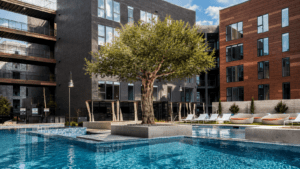
Each space in a building imposes its own constraints. The right specification depends on scale, light, traffic, and whether the zone is indoors or exposed to weather.
Lobby and leasing center statement trees
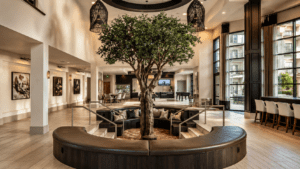
The lobby sets the property’s positioning and carries the first impression every prospect forms. These are often double-height spaces that need a focal point at architectural scale. A live tree of that size is rarely feasible indoors: it demands a large root pit, heavy floor loads, and overhead grow lighting that disrupts the interior design.
Steel-core sculptural trees are built for these spaces. Our NATUREMAKER® trees are hand-sculpted onto welded steel armatures, can reach well past 50 feet, and are engineered to seismic categories D, E, and F with ADA sightline clearances in mind. Because the core is structural, these trees can be designed to clad an existing column, wrapping a concrete support or concealing ductwork and cabling so an architectural constraint becomes the centerpiece. For lobby columns and parking-structure piers that do not call for a full tree, Tree Trunks and Column Wraps by TREESCAPES® turn structural elements into a biophilic feature.
At the Datran Center, a twin-tower commercial complex in Miami, our team transformed the 10,000-square-foot atrium and common areas with trailing green walls, architectural-grade planters, and fabricated treeforms using UV-resistant materials suited to a high-traffic, climate-controlled interior. The scope covered ground-level and mezzanine lobbies across both towers, and the result is a useful analog for how a multifamily lobby and ground floor can read when greenery is layered across both vertical and horizontal sightlines.
Fitness centers and amenity lounges
Fitness rooms and resident lounges get close, sustained visual inspection and usually cannot give up floor space. Vertical greenery answers both of those constraints. A custom green wall delivers strong visual impact behind a leasing desk, a lounge banquette, or a fitness mirror wall while occupying effectively zero floor area. For floor-standing pieces in lounges, natural wood trunk trees from PLANTWORKS® pair a real, fumigated hardwood trunk with inherently fire-retardant foliage, giving residents authentic bark texture at eye level while the canopy stays pristine without sunlight or pruning.
Pool decks, rooftop lounges, and exterior amenity spaces
Rooftop and pool-deck amenities are among the most valuable leasing assets, and the harshest environments for greenery. Live landscaping on a roof means deep planters, irrigation, and the risk of penetrating a roof membrane. Outdoors, the failure mode shifts from lack of water to UV degradation: ordinary faux plants fade, turn brittle, and shatter in wind.
Exterior amenity spaces call for fully fabricated, exterior-grade trees and artificial palm trees built with UV-stabilized polymers, rust-resistant steel cores, and stainless hardware for salt-air locations. Our TREESCAPES® line engineers these pieces specifically for sustained sun, wind, and weather, with replacement cycles an operator can plan for and budget around. At CityPlace in West Palm Beach, our preserved and fabricated palms anchor an outdoor plaza and shade high-traffic pedestrian corridors in the South Florida heat, mitigating the kind of heat-island effect that a rooftop pool deck imposes on greenery.
Co-working lounges
Co-working areas have become a core amenity for the remote-working majority, and they reward greenery that holds up to all-day close viewing. A statement tree gives the room an anchor and a sense of place. At Ledger in Bentonville, billed as the world’s first bikeable building, our NATUREMAKER® team crafted a 22-foot olive tree with a matching 22-foot canopy as the central gathering point of a collaborative workspace ringed by glass and tiered seating. That is a direct template for how a multifamily co-working lounge can use a single, well-placed tree to define the character of the space.
Corridors, elevator lobbies, and parking structures
These transition zones get the least natural light and the most need for relief from a flat, enclosed feeling. Live plants are guaranteed to die in a windowless elevator bank or a subterranean garage. Because artificial foliage looks the same at any light level, these are the spaces where it makes the biggest difference: low-profile foliage, fire-rated green walls, and column wraps that lift the resident’s walk from the lobby to the unit door. Fire rating matters most here because corridors are egress paths, which leads to the next section.
| Building Zone | Main Constraint | Recommended Specification |
|---|---|---|
| Lobby and Leasing Center | Scale, floor load, structural columns | Steel-core statement trees and column wraps |
| Fitness and Lounges | Close viewing, limited floor space | Green walls and natural wood trunk trees |
| Pool Deck and Rooftop | UV, wind, roof membrane, weight | UV-stabilized exterior palms and trees |
| Co-Working Lounge | All-day viewing, sense of place | Statement tree as central anchor |
| Corridors and Parking | Zero light, egress fire codes | Fire-rated green walls and low-profile foliage |
Fire code is the strongest building-level reason to go building-grade
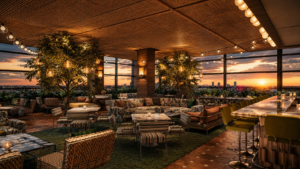
In multi-tenant residential buildings, the Authority Having Jurisdiction (usually the local fire marshal) can withhold a certificate of occupancy if interior materials pose a flame-spread risk. Consumer-grade faux plants are an unrated fuel load. Building codes treat artificial vegetation differently depending on how it is used, and the distinction is worth understanding before you specify.
Freestanding pieces such as floor trees and standalone planters are regulated as decorative materials, and the governing test is NFPA 701, which checks that a material self-extinguishes when the ignition source is removed and does not produce flaming drips. When foliage is affixed to a wall and covers enough of it, as with a green wall, the AHJ commonly reclassifies it as an interior wall finish. That triggers the far stricter ASTM E84 Steiner Tunnel Test. To be legal in egress corridors, exit stairways, and assembly areas, foliage must achieve Class A.
| ASTM E84 Class | Flame Spread Index | Typical Legal Application |
|---|---|---|
| Class A | 0 to 25 | Exit stairways, egress corridors, assembly areas |
| Class B | 26 to 75 | General corridors, certain residential spaces |
| Class C | 76 to 200 | Limited, generally fully sprinklered rooms |
There are two ways foliage reaches these ratings, and only one holds up in a permanent building. Topical treatments spray fire retardant onto standard foliage after assembly. The coating can leave a tacky film, attracts dust, and degrades over time, after which the material reverts to a combustible state. Inherently fire-retardant (IFR) foliage works the other way: retardant chemistry is fused into the raw resins before molding, so the protection is permanent and cannot wash off during routine cleaning. The vast majority of artificial plants on the market are not rated for commercial fire standards, which is exactly why specifying from a commercial fabricator matters. Our IFR foliage carries ASTM E84 Class A, NFPA 701, and California Title 19 ratings, and we provide the stamped engineering and fire documentation building departments and fire marshals require.
What separates a building-grade solution from a catalog purchase
A retail faux plant and a building-grade botanical element answer to entirely different requirements. For an apartment building, these are the differences that protect the asset and pass inspection.
- In-house fabrication, not resale. We manufacture at our own facilities in San Marcos, California; Las Vegas, Nevada; and Miami, Florida, with combined heritage of more than 40 years.
- Permanent fire compliance. Inherently fire-retardant foliage rated to ASTM E84 Class A, NFPA 701, and California Title 19, with documentation for the AHJ.
- Engineering for the building. Steel-core trees engineered to seismic categories and anchored to structure, dismantled into labeled sections for delivery and on-site assembly.
- Custom to the architecture. Pieces built to the space rather than pulled from a fixed catalog, with 87% botanical accuracy in the foliage.
- Documentation and support. Stamped calculations, fire certifications, and material testing for general contractors, building departments, and fire marshals.
Sustainability and green building certifications
Artificial greenery and sustainable building practice are not at odds when you look at the full lifecycle. The steel armatures in large sculptural trees use a high share of recycled steel, a meaningful portion of components are recyclable, and because the pieces use no irrigation, they support water-efficiency goals that carry weight in arid markets. Depending on the product line, artificial trees and green walls can contribute toward LEED categories including recycled content, regional materials, and water efficiency.
One honest caveat for teams pursuing the WELL Building Standard: WELL’s biophilia provisions show a prescriptive preference for living plant material to earn certain points, and artificial elements cannot always satisfy that requirement even though they meet the psychological intent. The common industry answer is a hybrid layout: a manageable number of live plants placed at ground level near large windows where they can actually survive, paired with artificial trees and green walls everywhere live plants would impose structural or operational risk. That approach protects both the certification scorecard and the operating budget.
Frequently asked questions
Are artificial plants allowed in apartment building common areas under fire code?
Yes, when they carry the right rating. Freestanding pieces must meet NFPA 701, and wall-mounted greenery in egress corridors and assembly areas generally must meet ASTM E84 Class A. Inherently fire-retardant foliage holds those ratings permanently.
Do artificial green walls damage apartment building walls or finishes?
No. Artificial green walls operate completely dry, so they carry none of the irrigation, water-damage, or mold risk of living walls. They are light enough to mount on standard partitions without structural reinforcement.
How long do commercial artificial plants last in an apartment building?
Interior steel-core trees and preserved elements are built to hold their appearance for decades in a climate-controlled space. Exterior pieces are engineered with UV-stabilized materials for sustained sun, wind, and weather, with predictable replacement cycles an operator can budget around.
Can artificial plants help an apartment building earn LEED credits?
They can contribute. Depending on the product, artificial trees and green walls support LEED categories such as recycled content, regional materials, and water efficiency because they require no irrigation and use a high share of recycled steel.
What is the difference between building-grade artificial plants and store-bought faux plants?
Building-grade pieces are custom-fabricated, carry permanent fire ratings with documentation for inspectors, and are engineered and anchored to structure. Store-bought faux plants are unrated, mass-produced, and not built to withstand high-traffic commercial use.
Plan the greenery for your building
Greenery in an apartment building works best when it is specified zone by zone, with the lobby, amenity decks, corridors, and rooftop each getting the piece engineered for its light, traffic, and code requirements. If you are planning a new development or repositioning an existing property, our team can review your common-area plans, recommend the right elements for each space, and provide the fire and engineering documentation your building department needs. Reach out through our artificial plants for commercial spaces page to start the conversation, and see our large-scale green walls guide for more on vertical greenery in commercial interiors.