Healthcare spaces have the strongest case for biophilic design and the hardest constraints against living plants. Infection control prohibits soil and standing water in immunocompromised zones, allergens are a liability, atrium light rarely sustains specimen trees, and irrigation retrofits invite water damage and mold. Artisan-crafted artificial trees resolve that tension when they are engineered and certified for clinical environments. At International Greenscapes, the parent company of NATUREMAKER®, PLANTWORKS®, and TREESCAPES®, we have built hand-sculpted trees for hospital lobbies, surgery center atriums, rooftop healing gardens, and memory care streetscapes, each one documented for fire marshal and building department review. This article covers the safety, compliance, and design requirements that actually matter when you specify botanical elements for healthcare, and what separates a code-ready piece from a permitting problem.
Why healthcare is the strongest case for biophilic design
The research connecting nature to patient outcomes begins with a single influential study. In 1984, Roger Ulrich published findings in Science showing that surgical patients with a window view of trees had shorter postoperative stays and required fewer strong painkillers than matched patients facing a brick wall. The effect is real but should be understood honestly: it traces to one retrospective study of 46 patients, and Ulrich himself cautioned that the conclusions could not be extended to all views or all patient groups.
The most defensible current statement of the effect comes from a 2024 scoping review in the Health Environments Research & Design Journal, which screened nearly 13,000 citations and concluded that exposure to nature during a hospital stay has a real but small therapeutic effect, mostly on psychological measures like anxiety, pain, and patient satisfaction. The broader evidence-based design literature, summarized in Ulrich’s 2008 review for the same journal, links the physical environment to patient stress, sleep, and staff effectiveness.
One distinction matters for specification. Nearly all of this research concerns views of nature, daylight, gardens, and live plants. There is no rigorous evidence that artificial foliage reproduces the measured recovery effects. The honest framing is this: artificial botanicals deliver the visual and aesthetic biophilic cue in spaces where live plants are precluded by infection control, light, or maintenance, and they remove the clinical risks that come with soil and water. We position our work on that basis, not on borrowed outcome statistics.
Infection control and indoor air quality in clinical settings
Living plants are restricted in the most vulnerable hospital zones for specific, documented reasons. The CDC’s environmental infection control guidelines advise against fresh or dried flowers and potted plants in patient-care areas for immunosuppressed patients, and prohibit them outright in protective environment rooms for transplant and severely immunocompromised patients. The reasons are biological. Potted plants and flower arrangements can act as a reservoir for Aspergillus and other fungi, and vase water harbors high concentrations of gram-negative bacteria, with Pseudomonas aeruginosa the most frequently isolated organism. These restrictions are risk-targeted to oncology, transplant, neutropenic, and ICU areas rather than a hospital-wide ban.
Artificial botanicals remove the soil, standing water, and fungal-spore reservoir that drive those restrictions. They carry no pests, no mold, and no allergens. The caveat is that an artificial trees and plants that cannot be cleaned become a dust-harboring surface, so the material has to be non-porous and wipeable and included in environmental cleaning protocols. Our foliage and trunks are built to be dusted and wiped down, which keeps them inside, not outside, your housekeeping plan.
Air quality is the second clinical concern, because healthcare occupants include respiratory, pediatric, elderly, and immunocompromised patients along with staff exposed for full shifts. The EPA notes that many volatile organic compounds run consistently higher indoors than outdoors. Lower-quality artificial trees and plants made from untreated plastics with topical coatings can be a VOC source. Our materials are RoHS compliant, non-toxic, and non-allergenic, with low-VOC emissions suitable for healthcare and educational facilities. When you evaluate any provider, ask for a named test method rather than an unqualified “low-VOC” claim, because without a threshold the phrase is not verifiable.
| Clinical Concern | Live Interior Plants | Artisan-Crafted Artificial Trees |
|---|---|---|
| Fungal and bacterial reservoir | Soil and vase water harbor Aspergillus and Pseudomonas | No soil, no standing water, no reservoir |
| Allergens | Pollen and mold exposure | Non-allergenic materials |
| Cleaning | Pruning, leaf litter, pest control | Dusted and wiped within housekeeping protocols |
| Water damage and mold | Irrigation retrofit, membrane, and leak liability | No irrigation, no drainage risk |
| Indoor air quality | Generally neutral | RoHS-compliant, low-VOC materials |
Fire code and structural compliance you need to document
Decorative botanical elements in a hospital fall under fire and life-safety review, and the documentation is what gets a project through permitting. A few points are worth getting right.
ASTM E84, the surface burning test that produces a Class A rating, is designed for flat building-material surfaces like walls and ceilings. It is not the right test for three-dimensional objects like trees. Artificial foliage is properly evaluated under NFPA 701 for flame propagation and, in California, under Title 19. For the NFPA 101 decorative-materials pathway, heat-release testing under NFPA 289 may apply. When you review any certificate, confirm what was actually tested, because some products carry an E84 rating on the backing material only.
NFPA 101, the Life Safety Code, is the controlling code nationwide because CMS adopts the 2012 edition for all Medicare and Medicaid participating hospitals, nursing homes, and surgery centers. Its healthcare chapters prohibit combustible decorations unless they are flame-retardant treated, meet NFPA 701, or pass NFPA 289 heat-release testing, and state life-safety guidance explicitly defines “decorative material” to include artificial vegetation. California adds an independent and more stringent regime: the Office of the State Fire Marshal names artificial trees and plants directly and requires Title 19 registration with a Certificate of Flame Resistance. Title 19 is not satisfied by NFPA 701 passage alone, and topically treated materials typically need retreatment after about a year.
This is where inherently fire-retardant materials matter. Our foliage uses IFR polymers, where the fire-retardant chemistry is bonded into the resin or polyethylene before the foliage is molded. The protection is integral and permanent: it cannot wash off, wear away, or expire the way a topical spray does, so the rating does not lapse on a maintenance cycle. Our products meet or exceed ASTM E84 Class A on applicable materials, NFPA 701, California Title 19, and the federal SIN-494-4 flammability code, and we provide stamped certifications and independent laboratory reports for fire marshal review.
Structural safety carries equal weight in high-traffic public health spaces. Large sculptural trees in lobbies and atriums need engineering, not just artistry. Every large piece is backed by calculations stamped by licensed engineers, with seismic design for high-risk categories, wind load calculations for outdoor work, and anchoring specifications, all built by certified welders with documentation for the building department. ADA clearances are part of the design from the start. A tall tree with a spreading canopy is the classic accessibility hazard, since branches projecting into a corridor between 27 and 80 inches above the floor must not protrude more than four inches into the path, and a wide canopy over a walkway is an undetectable head-height hazard for people with vision impairments. We design clearances and sight lines so a feature reads as a wayfinding landmark without narrowing the accessible route.
Design for healing environments
The clinical requirements set the floor. Design is what makes a piece worth specifying. Healthcare botanical work tends to live in four kinds of space, and each asks something different.
- Lobbies and entries set the tone before check-in. A sculptural grove can soften a glass-lined clinical entrance into something that feels like arrival rather than admission.
- Atrium healing gardens pair daylight with greenery to create a place to pause. Atrium light that would slowly starve a live ficus is no constraint for a fabricated tree, so the canopy stays full at height where real specimens decline.
- Rooftop and exterior gardens extend the healing-garden idea outdoors, where UV, wind, and weather rule out most interior plantings. Outdoor-rated foliage and engineered anchoring make permanent exterior pieces possible.
- Memory care streetscapes use trees as landmarks. In dementia design, strong, familiar focal points support wayfinding and reminiscence, and a recognizable oak at the center of an indoor courtyard becomes a reference point residents return to.
Two design notes specific to memory care are worth flagging. Realism and dust-cleanability matter more here than anywhere, and pieces should avoid small detachable parts or berries that could be ingested. Artificial botanicals serve the passive, sensory, and wayfinding role in these settings; they do not replace the active horticultural therapy, the planting and watering and harvesting, that some programs are built around. Specify them for what they do well.
How International Greenscapes meets healthcare requirements
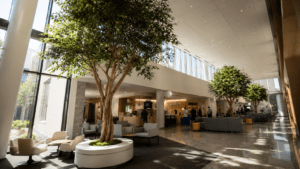
We have built for clinical environments across the country, and the projects show the range of what code-ready botanical art looks like in healthcare.
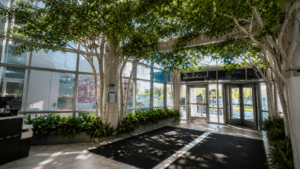
At the Richard and Lois Nicotra Heart Institute at Staten Island University Hospital, NATUREMAKER® created a grove of six multi-trunk birch trees just inside the main entrance. Each birch was individually designed to fit the geometry of the architectural columns while holding a natural grove rhythm, with fern ground cover and integrated lighting turning a clinical lobby into a calm, restorative threshold. The piece was part of the largest single donation in the hospital’s history, aimed at elevating the patient experience through hospitality-style design.
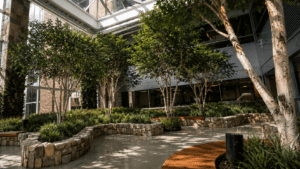
At the Bellin Health and Surgery Center in Green Bay, Wisconsin, three 20-foot ficus trees anchor a light-filled lobby atrium designed as a healing garden. Positioned among curved seating, the trees soften the expansive interior and invite patients, families, and staff to pause, each one custom-engineered to meet the safety and maintenance standards a high-traffic healthcare space demands.
At Scripps Memorial Hospital in La Jolla, California, NATUREMAKER® fabricated outdoor olive trees between 12 and 14 feet tall with broad canopy spans for a rooftop healing garden. Built for long-term exterior use, they bring shade and Mediterranean serenity to a terrace designed for reflection and wellness breaks, with no water or maintenance demands at elevation.
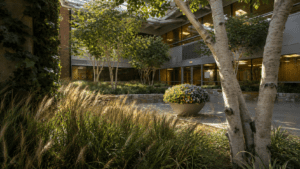
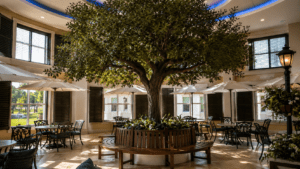
At the Watercrest Senior Living Memory Care Centers across the Southeastern United States, NATUREMAKER® designed 20-foot signature oaks, each with a 20-foot canopy, as central landmarks within indoor streetscapes. Placed in courtyards beside bistro seating and warm lighting, the oaks create European-style town squares that support reminiscence, social interaction, and wayfinding for memory care residents.
Across all four, the pattern is the same: a custom design built to the architecture, engineered and certified for the environment, and documented for the people who sign off on the building. That combination, hand-sculpted realism with stamped engineering and full code compliance, is what we bring to healthcare projects.
Frequently asked questions
Are artificial trees and plants safe for hospitals and infection control?
Yes. Artificial botanicals carry no soil, standing water, pests, mold, or pollen, which removes the fungal and bacterial reservoirs that lead the CDC to restrict live plants in immunocompromised and transplant zones. The material should be non-porous and wipeable so it can be cleaned as part of environmental protocols. Our healthcare pieces are built from RoHS-compliant, non-allergenic, low-VOC materials.
Do artificial trees meet hospital fire codes?
They can, when they are built and certified correctly. Artificial foliage is properly tested under NFPA 701 and, in California, California Title 19, with NFPA 289 heat-release testing for the NFPA 101 decorative-materials pathway. Our foliage uses inherently fire-retardant materials and meets or exceeds ASTM E84 Class A on applicable materials, NFPA 701, Title 19, and federal SIN-494-4, with stamped documentation for fire marshal review.
Can artificial trees go in outdoor healing gardens?
Yes. Outdoor-rated trees are fabricated with UV-inhibited foliage and weather-resistant construction, with wind load engineering and anchoring for exterior placement. Our olive trees on the rooftop healing garden at Scripps Memorial Hospital were built specifically for long-term outdoor use.
Who makes custom fabricated trees for healthcare facilities?
International Greenscapes, through NATUREMAKER®, PLANTWORKS®, and TREESCAPES®, designs and builds custom hand-sculpted trees and botanical pieces for hospitals, surgery centers, senior living, and memory care, with engineering and code documentation for clinical environments. Named healthcare projects include Staten Island University Hospital, Bellin Health, Scripps Memorial Hospital, and Watercrest Senior Living.
Are the materials allergen-free and non-toxic?
Yes. Our materials are RoHS compliant, non-toxic, and non-allergenic, with low-VOC emissions suitable for healthcare and educational facilities. There is no pollen, no mold, and no off-gassing concern, which is why these materials work in spaces with respiratory, pediatric, elderly, and immunocompromised occupants.
Specifying botanical art for your healthcare project
The right botanical piece earns its place in a healthcare space by clearing infection control, fire and life-safety codes, ADA clearances, and air quality requirements, then delivering the design vision on top of all of it. If you are specifying trees or foliage for a hospital, surgery center, or senior living project, our team can review your drawings, design to your architectural constraints, and provide the stamped engineering and certification documentation your building department and fire marshal will need. Contact us or call 760-631-6789 to start the conversation about your healthcare environment.