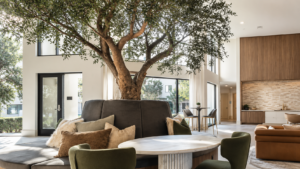
Biophilic design in multifamily housing is the practice of bringing nature, or recognizable representations of nature, into apartment communities to make shared spaces feel calmer and more welcoming. In lobbies, amenity lounges, co-working areas, and corridors, that connection to nature is what residents respond to on a tour and what keeps a building feeling like a place worth coming home to. artificial trees and plants fit this picture because the interior spaces where biophilic design matters most are also the spaces where living plants struggle: low light, dry HVAC air, no built-in irrigation, and a maintenance burden that lands on already-stretched property management. At International Greenscapes, residential amenity spaces are one of our core markets, and we have spent four decades crafting botanical elements for the lobbies, courtyards, and gathering spaces of buildings that owners operate for decades.
The framework most designers point to, Terrapin Bright Green’s 14 Patterns of Biophilic Design, counts representations and analogues of nature alongside living plants. Its first pattern, a visual connection with nature, can be met with natural or manufactured materials. That distinction is the practical opening for multifamily: you can deliver the visual and atmospheric experience residents want in spaces that would kill a real ficus in a season.
What biophilic design means in an apartment community
Biophilic design is the deliberate use of nature in the built environment to support how people feel and function inside it. In a single-family home it might mean a garden window or a courtyard. In multifamily housing, it shows up in the spaces everyone shares: the arrival sequence through the lobby, the amenity lounge where residents work and socialize, the fitness room, the corridors, even the package room.
The trend is no longer niche. Trade coverage in Multi-Housing News treats biophilic design as a standard part of the amenity conversation, and designers increasingly specify “real or synthetic” plantings as interchangeable options depending on the space. For owners and developers, the takeaway is simple. Residents have come to expect some version of nature in the buildings they choose, and the communities that plan for it at the design stage tend to do it better than the ones that bolt it on later.
The wellbeing research behind the trend is worth reading precisely. The strongest stress, mood, and attention studies measure living plants and real views of nature. A separate body of work, including a 2024 peer-reviewed meta-analysis, found that simulated and visual nature produced stress recovery comparable to real-nature exposure. So the honest version of the claim is this: artisan artificial greenery delivers the visual connection with nature and the calming atmosphere that biophilic design is built around. We frame the benefit as the look and feel of nature, available year-round, in spaces where keeping a living plant alive is the exception rather than the rule.
Why living plants struggle in shared resident spaces
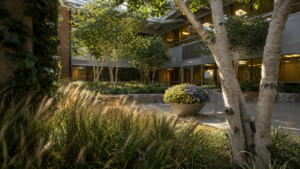
Shared interior spaces are the hardest environment in the entire building to keep greenery alive, and every failure mode carries a cost that lands on the operator.
- Light falls below survival minimums. Most interior plants need a baseline of usable light to hold their appearance. Corridors, package rooms, and deep amenity lounges set back from the glazing routinely fall under that threshold. The plant does not die dramatically. It thins, yellows, and looks tired, which is worse for a leasing space than no plant at all.
- HVAC dries the air and swings the temperature. Commercial HVAC pulls humidity out of the air and cycles back at night and on weekends. Vents blowing directly on foliage stress it further. Plants that would be fine in a greenhouse decline steadily in a climate-controlled lobby.
- Irrigation creates water risk above occupied units. A live plant program in a multi-story residential building means introducing water on floors that sit directly above people’s apartments. Overwatering, a cracked saucer, or a leaking planter can seep into flooring and drywall. Water damage and the mold remediation that follows are expensive problems, and they are entirely avoidable.
- Occupied buildings raise pest and mold concerns. Soil harbors pests and fungal spores. In a building full of residents, that is a liability nobody wants near amenity spaces, fitness rooms, or anywhere people gather.
- Maintenance becomes a recurring contract. Keeping live interior plants presentable means a horticultural service on a regular visit schedule, plus a built-in replacement cycle for the specimens that inevitably fail. That is a recurring operating cost and a recurring coordination task for a management team that already has enough to manage.
Artisan artificial greenery removes every item on that list. There is no irrigation, so there is no water risk to the units below. There is no soil, so there are no pests or mold. There is no replacement cycle, because the foliage holds its appearance for decades. The space looks the same in February as it does in June.
Where biophilic elements pay off in multifamily buildings
Not every square foot needs greenery. The spaces where biophilic elements earn their place are the ones that shape a resident’s impression of the building or carry heavy daily traffic.
| Space | What it does for the community | Product forms that fit |
|---|---|---|
| Lobby and leasing/arrival area | Sets the first impression on every tour and every homecoming | Statement trees, green walls, natural-trunk trees |
| Amenity lounge and clubroom | The room residents show off and actually use | Green walls, natural-trunk trees, sculpted foliage |
| Co-working space | A leasing differentiator that keeps residents on-site | Anchor trees, moss walls for acoustic softening |
| Fitness room | Softens an otherwise hard, utilitarian space | Green walls, foliage panels |
| Corridors and elevator lobbies | Turns dead transitional space into something considered | Foliage groupings, column wraps |
| Package and mail room | A high-traffic space residents pass through constantly | Compact greenery, wall-mounted foliage |
| Indoor lounges adjacent to rooftops and terraces | Carries the outdoor-garden feeling indoors year-round | Trees, green walls, mixed foliage |
The Datran Center in Miami is the closest analog we have to this kind of work. It is a twin-tower complex where PLANTWORKS® and TREESCAPES® transformed the lobbies and common spaces with trailing green walls, balcony-edge greenery, layered planters, and fabricated trees. The design team’s brief was to soften a lot of stone, glass, and steel. The greenery turned the lobby from a corridor you pass through into a calming arrival experience, and it did so with UV-resistant materials chosen specifically to hold up in a high-traffic, climate-controlled interior.
Product forms that work in resident spaces
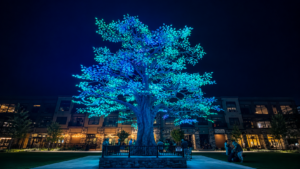
The right product depends on the space, the ceiling height, and what the room is for. A few forms do most of the work in multifamily.
Green walls and moss walls
A green wall turns a blank vertical surface into the visual centerpiece of a lounge, lobby, or fitness room. Our custom green walls are built to fit any wall dimension and need no irrigation, which means no water-damage risk to the building and no plumbing to run. Preserved moss walls add a soft, tactile texture that also helps absorb sound, useful in co-working rooms and amenity lounges where acoustics matter. For larger feature walls, we cover the specification details in our guide to large-scale artificial green walls for commercial interiors.
Statement trees as anchors and wayfinding
A single well-placed tree gives a space a center of gravity. In memory care communities for Watercrest Senior Living, NATUREMAKER® designed 20-foot oak trees, each with a 20-foot canopy, set in central indoor courtyards. They anchor the room as a natural gathering point and double as a wayfinding landmark, helping residents orient inside what reads like a walkable town square. The same principle applies to a multifamily lobby or amenity floor: a statement tree tells people where the heart of the space is. Our artificial trees for commercial spaces range from full sculpted steel-core pieces to natural-trunk trees for human-scale lounge areas.
Natural-trunk trees for lounge scale
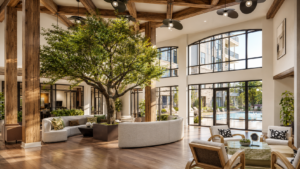
Where a monumental tree would overwhelm the room, a natural-trunk tree at human scale fits better. These pair genuine preserved wood trunks with artisan-crafted foliage, giving a lounge or seating cluster authentic bark texture without the footprint of a full atrium piece.
Column wraps that turn structure into a feature
Multifamily buildings, especially those with structured or podium parking, are full of structural columns. Our column wraps turn those columns into sculpted tree trunks, so a piece of necessary structure in a lobby or parking-adjacent space becomes part of the design rather than something to work around.
For a broader view of what fits a given space, our overview of artificial trees and plants for commercial spaces walks through the full range.
The leasing and retention argument
Biophilic amenity spaces do real work on the two numbers that matter most to an owner: how quickly units lease and how often residents renew.
On leasing, shared spaces are what prospects photograph and remember. A green wall in the lounge or a sculpted tree in the lobby is the kind of feature that ends up on a community’s social feed and in a prospect’s camera roll after a tour. That visual moment is a low-cost way to make a building feel distinct in a market where floor plans and finishes often look alike.
On retention, the sense of place that greenery creates is part of why residents stay. Health-focused multifamily certifications have been among the fastest-growing in the industry, and operators with wellness-positioned portfolios report that residents will pay for those communities and renew in them at higher rates. Greenery in shared spaces is one of the most visible, daily-encountered expressions of that positioning.
The practical advantage of artisan artificial greenery here is consistency. The lobby that sold a prospect on the building looks identical when their lease comes up for renewal two years later. There is no off-season, no thinning specimen waiting to be replaced, no week when the amenity lounge looks neglected because the plant service missed a visit.
Operations and cost of ownership
For an asset you plan to hold and operate for decades, the operating profile of your greenery matters as much as its appearance.
A live interior plant program is a recurring line item: a horticultural maintenance contract, regular service visits, and a built-in replacement allowance for the specimens that fail. Artisan artificial greenery turns that ongoing operating cost into a one-time capital investment. After the initial project, the recurring spend is close to zero. Maintenance amounts to occasional dusting and a visual inspection. No irrigation, no fertilizer, no pruning, no pest control, no horticultural staff, and no grow lighting.
The durability is the part owners tend to underestimate. A restaurant once contacted us about relocating a NATUREMAKER® tree that had been in place for 20 years. They sent photos before the move, and the tree looked as good as the day it was assembled, just in need of a dusting. That is the operating reality of a well-built piece: it holds its appearance for decades, not seasons. We keep the cost discussion conceptual here, but for owners who want to see how the numbers work over a project’s life, our breakdown of custom artificial tree costs for commercial projects is a useful starting point.
There is a sustainability dimension as well. Artisan artificial greenery requires no water, fertilizer, or pesticides, which removes irrigation demand from a building’s water budget. Our foliage is RoHS-compliant and non-allergenic, with no soil, pest, or mold concerns in occupied spaces, and it can contribute to LEED goals through water efficiency and related criteria.
Fire codes for apartment common areas
Multi-unit residential common areas are governed by fire codes, and decorative vegetation has to meet them. This is one area where getting the detail right protects your project from a permitting delay.
The governing standard for artificial decorative vegetation is NFPA 701, a flame-propagation test that the manufacturer documents and certifies. In apartment and condominium common areas, NFPA 701-certified artificial vegetation is the compliant path. Our foliage is available in inherently fire-retardant (IFR) specifications, meaning the fire-retardant chemistry is bonded into the material itself rather than sprayed on as a topical coating that can wear off or wash away over time. That distinction matters in a building you operate for the long term: an IFR specification holds its compliance, while a topical treatment degrades and may need reapplication.
One technical point is worth clearing up, because it comes up often. ASTM E84 Class A is a surface-burning test for flat materials like wall and ceiling finishes. It is not the right test for a three-dimensional sculpted tree, which cannot be mounted as a flat specimen. For decorative vegetation, NFPA 701 is the applicable standard. Large wall-mounted green walls that cover significant wall area may be treated as interior finish in some jurisdictions, which is a separate conversation with your authority having jurisdiction. The local fire marshal always has the final say, so the practical approach is to specify NFPA 701-certified IFR foliage and confirm requirements with your AHJ. We provide stamped certifications and independent lab reports for fire marshal review on every project.
Frequently asked questions
Do artificial trees and plants meet fire codes for apartment common areas?
Yes, when they are specified correctly. Artificial decorative vegetation in multi-unit residential common areas must meet NFPA 701 flame-propagation criteria, documented by the manufacturer. We supply foliage in inherently fire-retardant specifications that meet NFPA 701, along with stamped certifications for fire marshal review. Confirm the specific requirements with your local authority having jurisdiction, since some areas add their own rules.
How long do artificial trees and plants last in a lobby?
A well-built artisan piece holds its appearance for decades, not years. We once relocated a NATUREMAKER® tree that had been in continuous service for 20 years and still looked as good as the day it was assembled. Unlike living plants, there is no replacement cycle to budget for.
Are artificial green walls good for apartment amenity spaces?
Yes. Artificial green walls give amenity lounges, co-working rooms, and fitness areas a strong visual centerpiece with none of the operational load of a living wall. They need no irrigation, carry no water-damage risk to the building, and hold a consistent appearance year-round. Moss walls add an acoustic-softening benefit that suits shared work and lounge spaces.
Do artificial trees and plants help an apartment community lease faster?
They contribute to it. Shared spaces are what prospects photograph and remember, and a distinctive green wall or statement tree gives a community a recognizable visual moment on tours and social media. Greenery also supports the sense of place that influences renewals, and artisan artificial elements keep that impression consistent from the first tour through every lease renewal.
What maintenance do artificial trees and plants in common areas require?
Very little. Occasional dusting with compressed air and a periodic visual inspection cover it. There is no watering, fertilizing, pruning, pest control, or specialized horticultural staff required, which is the main reason these elements suit buildings owners operate for the long term.
Planning biophilic design into your next community
Biophilic design has become a real differentiator in multifamily, and the shared spaces where it matters most are exactly where it is hardest to keep living greenery alive. Artisan-crafted botanical elements give you the look and the calming atmosphere residents respond to, year-round, with no irrigation, no water risk to the units below, no pest or mold concerns, and a lifespan measured in decades. They can be specified to meet the fire codes that govern residential common areas, and they hold up across a portfolio of communities with consistent results.
If you are planning a new community or renovating the shared spaces in an existing one, our team can work from your drawings and design intent to specify the right elements for each space. Contact us to start the conversation.