
Search “artificial trees companies” and you get a list of businesses that have almost nothing in common beyond the words. Some are overseas factories shipping standard units by the container. Some are catalog retailers with a photo and an add-to-cart button. A few actually fabricate trees to order. For a six-foot tree in a quiet corner, most of them will do. For a 30-foot atrium centerpiece that has to pass fire and structural code, survive years of public traffic, and read as a real species from ten feet away, the type of company you choose decides whether the project works.
This guide is built for buyers assembling a shortlist: architects, interior designers, hospitality developers, and facility decision-makers specifying a commercial tree. Rather than rank named brands, it walks through the kinds of companies in this market, what each is built for, and the criteria to vet any of them. At International Greenscapes, we have completed more than 20,000 tree and botanical projects across 40 years, and we fabricate the steel cores and custom-assemble every tree at our US facilities, so the questions below are the same ones we help clients answer before a single tree is built.
Why “Artificial Trees Company” Can Mean Five Different Businesses
The most useful way to compare vendors is by business model, not by whether the word “custom” appears on the homepage. A US sales office may import the finished tree. An installer may subcontract the fabrication. A “custom” supplier may only change the pot size. Sorting the market into a few honest categories tells you far more about what a company can actually deliver.
| Company type | Built for | Typical strengths | Typical limits for a high-stakes commercial tree |
|---|---|---|---|
| Overseas factory or wholesale importer | Standard models, repeat units, container-scale orders | Low unit price, broad standard catalogs | Freight, tariffs and customs, remote mock-up review, uncertain middle layers, test reports that may not match the final tree, limited local engineering support |
| Domestic custom manufacturer | Site-specific statement, atrium, and monumental trees tied to architecture | Direct design iteration, shop drawings and mock-ups, structural coordination, factory visits, clear accountability | Higher initial price, real fabrication takes design and approval time, capacity still needs to be verified |
| Catalog retailer or ornamental tree distributor | Small to mid-size freestanding trees and repeatable decor | Fast ordering, transparent stock items | Limited monumental capability, “custom” may mean assembling catalog parts, often no control over testing or engineering |
| Seasonal or event-tree supplier | Temporary displays, themed decor, lighting packages | Quick deployment, event logistics | Products built for temporary duty, not permanent architectural use; fire, electrical, and structural requirements need separate review |
| Interiorscape or design-build installer | Local surveying, planting design, and service | One local contact, field coordination | May be a reseller rather than the legal manufacturer, so responsibility for fire reports and warranty can fragment |
Most projects only get into trouble when a company built for one column of this table is hired to do the work in another. A catalog distributor can be a fine choice for a potted lobby tree. It is the wrong choice for a monumental atrium piece that needs engineered support and code submittals. The first decision, then, is matching the company to the stakes of the tree, not to the lowest quote. If you want a fuller look at the finished pieces this can produce, our commercial artificial trees page shows the range.
Buyers choose statement trees for a reason. A large sculpted tree supports a biophilic design strategy, bringing scale, natural form, and a strong focal point to a commercial interior. Most of the solid research on measured benefits looks at living plants and whole biophilic environments, so treat an artificial tree as a visual and spatial contribution rather than a stand-in for every function of a live tree.
Manufacturer or Distributor? Why It Matters for a Commercial Tree
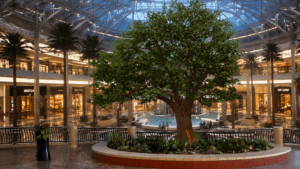
For a permanent tree in a public space, accountability follows the actual product and the documents that come with it. The International Fire Code requires that fire compliance for artificial decorative vegetation be documented and certified by the manufacturer in a form the local authority accepts. That makes the identity of the real manufacturer an operational question, not a branding preference.
Before you sign, you want to know who fabricated the structural core, who specified or applied any flame-retardant treatment, who chose the tested foliage, and who will stand behind the finished tree. When those answers point to four different parties, a single problem can turn into a finger-pointing exercise. When they point to one manufacturer, correction is faster and the warranty means more.
“Made in USA” deserves the same scrutiny. Under Federal Trade Commission guidance, an unqualified US-origin claim requires final assembly and virtually all significant processing to happen in the United States. A US headquarters, a warehouse, or a final potting step does not by itself support that claim. Ask a vendor to be specific about which processes actually happen where.
We built International Greenscapes as the manufacturer, not a reseller. Steel cores, preserved trunk trees, and preserved palms are fabricated at our own facilities in San Marcos, California; Las Vegas, Nevada; and Miami, Florida, and trees are custom-assembled to each project’s specifications at those studios. That control is what lets us adjust a canopy silhouette, respond to a fire marshal’s comment, or repair a piece years later without routing the request through an overseas factory.
Fire Compliance: NFPA 701, ASTM E84, and California Title 19
Fire documentation is where commercial tree projects most often go sideways, usually because three different standards get treated as interchangeable. They are not.
| Standard | What it measures | What it does not mean |
|---|---|---|
| NFPA 701 | Flame propagation of textiles and films under specified test conditions; the standard the International Fire Code cites for artificial decorative vegetation | A blanket NFPA approval of a whole finished tree |
| ASTM E84 | Surface-burning behavior of a material, reported as flame-spread and smoke-developed indices; “Class A” is the top index band | That the complete tree meets the decorative-vegetation provisions, or that it is non-combustible |
| California Title 19 | A state regulatory program covering approved materials, treatments, registrations, and certificates | Another name for a single fire test |
A “Class A” rating on a trunk coating does not prove the foliage meets the decorative-vegetation requirement. An NFPA 701 report on foliage does not automatically cover every adhesive, coating, or trunk finish. And California’s Title 19 program can call for registration and a certificate of flame resistance that a generic report does not satisfy. Compliance cannot be inferred from appearance or a “commercial grade” label. Ask for the full lab report, confirm the tested specimen matches the exact materials being supplied, and get your local fire authority involved before fabrication is locked, because the authority having jurisdiction has the final say.
This is one reason we keep documentation in-house. International Greenscapes provides ASTM E84 Class A ratings, NFPA 701 compliance, and California Title 19 certification, with stamped certifications prepared for fire marshal review and test reports that trace to the materials actually used on your tree.
Structural Engineering and Monumental Trees
A vendor’s ability to make something tall is not proof it can engineer, ship, and anchor a permanent tree in a public space. Permanently attached components and their supports can require seismic resistance, and ASCE/SEI 7 is the US standard the building code leans on for those loads. For a statement or monumental tree, ask for engineering and execution evidence, not a maximum-height number.
Useful questions for any company quoting a large tree:
- Have you completed trees of comparable height, canopy spread, and weight, and can you show them?
- Is there a defined internal structural system, or does the design lean on the visible trunk shell?
- Can you provide base-plate, anchor, and slab loads, plus seismic and wind assumptions where they apply?
- Will the structural calculations be sealed by an engineer licensed in the project’s state? A stamp from an engineer licensed elsewhere may not be accepted.
- How does the tree coordinate with sprinklers, lighting, ceilings, and maintenance access?
Accessibility belongs on the same list. Branches and canopies that project into circulation paths have to respect ADA clearances, and the US Access Board’s protruding-object guidance is the reference your design team will check. A serious vendor supplies coordinated shop drawings rather than a vague claim that a tree is “ADA certified.”
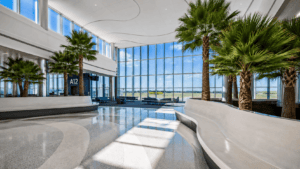
Our monumental work is the evidence behind these answers. NATUREMAKER® built the 25-foot column-clad Sequoia environment at Fresno Yosemite International Airport, which won an ADEX Platinum Award, the 40-foot LED-lit oak at Creekside Development outside Kansas City, and a 36-foot birch anchoring the Walton Family Whole Health and Fitness campus. We engineer trees to 50 feet and beyond, and our licensed engineers produce the calculations and seismic analysis in-house.
What “Custom” Should Actually Mean
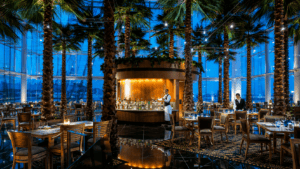
No standard defines “custom artificial tree,” so the word ranges from a new pot on a catalog trunk to a one-off sculptural and structural piece. Test the label against the vendor’s design-control process. Genuine custom capability shows up as concept sketches that become dimensioned shop drawings, physical finish and foliage samples, a scaled or full-size mock-up, and defined revision rounds before anything is finalized. If foliage or trunks are imported, ask which design changes the vendor controls directly and which require sign-off from an upstream factory.
Realism is the other half of custom, and it is why the showroom matters. Our trees are 87% botanically accurate, hand-sculpted by artisans with backgrounds in fine art and scenic work, with inherently fire-retardant (IFR) polymers and ultraviolet-inhibited (UVI) options for exterior pieces. Species drive the details, whether it is an artificial olive tree with a knotted Mediterranean trunk, an oak with a broad canopy, a sprawling banyan, or a preserved palm. Photos only go so far with a five- or six-figure piece, which is why clients who visit one of our showrooms and see the craftsmanship up close rarely have doubts afterward. If you are still weighing which species or style fits your space, our guide to the best artificial trees for commercial projects covers that question; this guide is about choosing the company.
Comparing the Cost of an Artificial Tree to a Live Tree
Artificial and live trees carry different cost profiles, and the honest comparison is project-specific rather than a fixed percentage or payback window. Artificial trees concentrate spending in design, fabrication, and assembly. Live trees concentrate it in ongoing biological support.
| Cost category | Live tree | Artificial tree |
|---|---|---|
| Initial object | Tree, root system, soil, and planter | Sculpted tree, frame, foliage, finish, and base |
| Design and engineering | Structural planter, waterproofing, drainage, horticultural design | Structural frame, anchorage, seismic and wind calculations, shop drawings |
| Water | Irrigation, drainage, leak management | None for the tree itself |
| Lighting | Natural-light study and possibly grow lighting and electricity | Display lighting only if desired |
| Routine service | Watering, pruning, fertilizing, pest and plant-health management | Dust removal, appearance cleaning, attachment inspection |
| Replacement | Mortality, decline, acclimatization failure | Faded or damaged foliage, finish repair, refoliation |
| End of service life | Plant and growing-medium removal | Disassembly, reuse, or disposal of mixed materials |
An artificial tree removes the biological demands of a live tree, including watering, pruning, fertilizing, and grow-lighting, which indoor plants need where natural light is short. It is low horticultural maintenance, not maintenance-free. An atrium piece still needs periodic dusting and inspection, sometimes with a lift. The case for artificial is strongest where light, irrigation, or access make a healthy live tree impractical, or where the design calls for scale and a sculptural form a live tree cannot hold.
One caution on sustainability claims. LEED certifies buildings, not products, so no tree “earns LEED points” on its own. USGBC’s guidance for product manufacturers is clear that a product can contribute to a project’s credits with the right documentation, but eligibility depends on the rating system and the project team’s calculations. We can supply the material documentation; your LEED professional confirms how it counts. For a deeper look at the numbers, see our breakdown of how much custom artificial trees cost for commercial projects, and we are glad to model total cost of ownership for your specific space.
The Artificial Trees Company Vetting Checklist
Use this as a short pre-award request to compare unlike companies on the same terms:
- Manufacturer declaration: the legal manufacturer, fabrication location, any subcontractors, and precise country-of-origin wording.
- Relevant experience: completed trees of comparable height, spread, weight, and setting.
- Shop drawings: overall dimensions, modules, branch extents, base, and maintenance clearances.
- Material schedule: foliage, trunk shell, structural core, adhesives, coatings, and any substitutions.
- Fire documentation: the full report with standard, edition, method, specimen, date, lab, and a statement tying it to the supplied materials, plus California registrations where they apply.
- Structural package: dead, seismic, and wind loads as applicable, with drawings sealed by an engineer licensed for the jurisdiction when required.
- Assembly and rigging plan: module weights, access, sequence, and field tolerances for on-site assembly.
- Warranty: what it covers, including labor, lifts, and access, not just parts, and how fast matching foliage can be replaced.
- Operations and maintenance: cleaning, inspection, and how repairs preserve the fire documentation.
A company that answers these readily is showing you its process. One that deflects is telling you something too.
One Company, Three Tree Specialties
Different trees call for different fabrication methods, which is why we keep three specialized tree brands under one roof and one point of contact:
- NATUREMAKER® originated the hand-sculpted Steel Art Tree™ in 1983 and builds steel-core statement and monumental trees, from the High Line’s “Old Tree” in New York to the 22-foot olive at Ledger Bentonville.
- TREESCAPES® focuses on preserved palms and engineered fabricated trees built for durability in demanding, high-traffic settings.
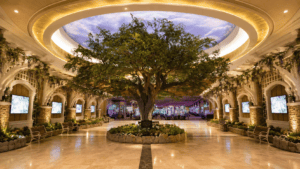
- PLANTWORKS® handles natural-trunk trees and foliage, including the custom olive trees inside CATCH Las Vegas at ARIA.
That structure means a project needing a steel-core sculpture, a preserved palm grove, and natural-trunk accents does not have to coordinate three vendors, three warranties, and three sets of paperwork.
Frequently Asked Questions About Artificial Trees Companies
Are commercial artificial trees fire rated? They can be, but a fire rating is never automatic. Verify NFPA 701 or California Title 19 documentation for the exact foliage, coatings, and trunk finish being supplied, and confirm requirements with your local fire authority. International Greenscapes provides ASTM E84 Class A, NFPA 701, and California Title 19 documentation with stamped certifications.
How tall can a custom artificial tree be? Custom trees can be engineered well past 50 feet. We have built monumental pieces such as the 40-foot LED oak at Creekside Development and the 25-foot Sequoia environment at Fresno Yosemite International Airport, each with its own structural and anchoring package.
Do artificial trees qualify for LEED credits? LEED certifies buildings, not individual products, so a tree does not earn points on its own. An artificial or preserved tree may contribute to a project’s LEED goals with the right documentation, which the project’s LEED professional confirms against the chosen rating system.
How long does a custom commercial tree take to build? Our custom trees start at a three-month minimum from design approval, and monumental or highly detailed pieces can take longer. When you compare vendors, ask for a full milestone schedule covering approval, engineering, fabrication, freight, and on-site assembly rather than a single quoted number.
Choosing the Right Partner for Your Commercial Tree
The right artificial trees company for a commercial project is the one whose business model, engineering, documentation, and craftsmanship match the stakes of the tree you are specifying. If that tree has to pass code, hold up in public for decades, and look right the day it opens, you want a domestic manufacturer that controls the whole process and can put its name on every document.
If you would like to talk through a specific space, send us the details and we will walk you through the options, or visit one of our showrooms to see the craftsmanship in person. Reach out to our team and we will help you get it right.