For a hotel atrium, a corporate lobby, an airport concourse, or a restaurant dining room, the choice between artificial trees and live trees is a specification decision, not a matter of taste. The right answer depends on how much daylight reaches the tree, how the building manages its air and temperature, how tall the tree needs to be, and what the space can support year after year. This guide compares the two options across the factors a commercial buyer actually weighs, so you can match the tree to the space instead of starting from a preference.
We build custom trees at International Greenscapes, the parent company of NATUREMAKER®, PLANTWORKS®, and TREESCAPES®, and our artisan-crafted trees are 87% botanically accurate. We will still tell you plainly where a live tree is the better answer. In a daylit atrium that already carries a horticulture budget and a team to run it, a living tree can be exactly right. This comparison is about the many commercial interiors where that is not the case, and where a custom artificial tree for a commercial space tends to win.
What actually decides the choice in a commercial interior
A live commercial tree is a horticultural system, not a finished object. Its long-term success depends on the light measured at the canopy, the species chosen, the humidity and temperature around it, access for pruning and cleaning, and a maintenance budget that continues every year. An artificial tree removes the biological side of that equation. Once it is assembled, it needs no light, water, or feeding, and it holds the same appearance in conditions where a living tree would decline.
How live trees perform in commercial interiors
Live trees do best when the building already gives them what they need, which is mostly light. In a bright, daylit space with room for a planting bed and a crew to tend it, a living tree can thrive and is worth considering. Many large commercial interiors do not offer those conditions at the exact spot where the tree has to stand, and that is where the difficulty begins.
Light and distance from windows
Interior light that looks bright to people is often too dim for a tree. Even foliage plants sold for low light have real light requirements, and natural light drops off quickly as you move away from the glass, according to Purdue University Extension. A lobby can have a dramatic glass facade while a tree placed thirty or forty feet into the floor plate receives a small fraction of that light. When light runs short, the signs show up fast. Leaves pale and yellow, growth gets thin and leggy, and foliage starts to drop. The usual fix is supplemental grow lighting, which adds fixtures, wiring, and a recurring power bill.
Dry indoor air and temperature
Conditioned commercial interiors are often drier than plants prefer, especially in winter. During the heating season, indoor humidity can fall below the level many plants like, per Penn State Extension. Air near the top of a tall space can also run hotter and drier than air at floor level, which is hard on the upper canopy of a large tree. These conditions are manageable for a living tree, but managing them takes attention and money.
Pests and ongoing plant care
Indoor plants bring a pest-management obligation that does not end. Outdoors, predators and weather keep pests in check. Indoors they do not, so common pests such as spider mites, mealybugs, scale, and fungus gnats can take hold, according to the University of Minnesota Extension. In restaurants, hotels, and healthcare interiors, treating plants around guests and patients is inconvenient and sometimes restricted.
A live commercial tree also keeps costing money for as long as it stays in the building. A current City of Austin contract for interior plant care lists the routine work it takes to keep interior plants healthy, including watering, feeding, pruning, cleaning leaves, managing pests and disease, rotating plants toward light, and replacing any that cannot be revived, on a weekly or every-other-week schedule (City of Austin). That work does not stop while the tree is in place.
Height and access for tall trees
The taller the tree, the more its care turns into an access problem. Pruning, cleaning, and inspecting a canopy well above the floor means lifts or ladders and the planning that comes with elevated work. Federal rules require fall protection for many general-industry tasks at four feet and above (OSHA). None of this makes a tall live tree impossible. It does add time, equipment, and safety planning to care that would be simple at floor level.
How artificial trees perform in the same conditions
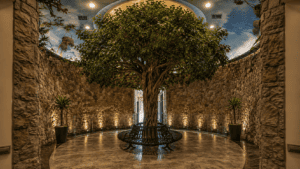
Artificial trees are built for the conditions that give live trees trouble. Because a custom-fabricated tree has no biological needs, low light, dry air, and hard-to-reach canopies stop being problems. The tree holds its shape and color in a deep lobby, on a casino floor, or in an interior restaurant zone where a living tree would slowly fade. Much of our work sits in exactly those spaces.
The common objection is that an artificial tree won’t look real, and that is a fair thing to check. Our NATUREMAKER® steel-core trees are hand-sculpted from molds taken from real specimens, with bark texture and leaf placement that follow how the species actually grows. That craftsmanship is what gets them to 87% botanically accurate. Realism is easiest to judge in person, which is why we encourage buyers to see the work up close at a showroom before deciding.
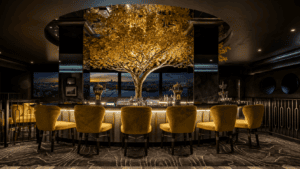
The projects where live trees would struggle are the ones we point to most. At the Datran Center in Miami, a high-traffic, climate-controlled atrium with a forty-foot ceiling, we used fabricated treeforms to bring scale and greenery into a lobby where keeping living trees healthy at that height would have been a constant project (Datran Center). A trio of 20-foot custom oaks anchors the hotel lobby at the Fairmont in Austin, and a 22-foot olive tree anchors the coworking floor at Ledger in Bentonville. Inside Terminal A at Newark Liberty, an 18-foot oak centers the bar at the Kitchen Step restaurant, a spot where a living tree would face weak light, dry air, and heavy traffic all at once. We see the same pattern across airport and transit interiors.
Artificial trees also hold up for decades. A restaurant that had a NATUREMAKER® tree for twenty years contacted us when they were relocating and sent photos. After two decades of continuous use, the tree looked as good as the day it was assembled, just a little dustier. That is the kind of service life a custom tree is built to give.
Artificial does not mean maintenance-free, and we do not claim it does. The trees still need occasional dusting and a periodic look for damage, with the interval depending on the space. What they do not need is watering, feeding, pruning, pest control, or replacement, and that is where the cost difference comes from.
Cost of ownership: artificial trees vs live trees
The purchase price is only part of the comparison. A live tree spreads its cost across years of service, energy, and eventual replacement, while a custom artificial tree concentrates its cost up front and then largely stops. Laying the two side by side is the honest way to compare them.
| Cost driver | Live commercial tree | Custom artificial tree |
|---|---|---|
| Upfront cost | Specimen tree, planter, and delivery | Custom fabrication and delivery |
| Water | Irrigation system or ongoing hand-watering labor | None for the tree |
| Light | Supplemental grow lighting and its power use where daylight is short | None |
| Routine care | Weekly or every-other-week horticultural service | Occasional dusting and inspection |
| Pest control | Ongoing monitoring and treatment | None |
| Replacement | Budgeted for plants that decline | None under normal use |
| Tall-canopy access | Lifts or ladders for elevated care | Minimal |
Each of those live-tree lines is a real, recurring cost. Interior plant-care contracts run on a weekly or every-other-week schedule (City of Austin). Even using a conservative labor figure, the U.S. median wage for grounds maintenance workers was $18.50 an hour in 2024 (BLS), so a single service hour each week is roughly $960 a year in wages alone, before travel, supervision, materials, and profit are added to an actual invoice. Where a tree needs supplemental light, the energy adds up too. At the 2025 U.S. commercial average of about 13.4 cents per kilowatt-hour (EIA), a modest grow-light setup running through the day can cost a few hundred dollars a year in electricity for a single tree.
In our own cost-of-ownership analysis, most commercial projects reach break-even against a comparable live-tree program within three to five years, and then keep saving for decades after that. The exact timeline depends on the space, so the number is only as good as the assumptions behind it. The way to test it is to put your own live-plant maintenance quote, expected lighting load, and replacement allowance against the one-time cost of a custom tree. We work through that math in detail in our guide to custom artificial tree cost for commercial projects.
Maintenance and safety differences

Beyond upkeep, fire code and healthcare environments are the two safety topics that come up in almost every commercial spec.
Fire code and artificial trees
Large artificial trees are regulated by fire code, and no material is immune to fire. The 2024 International Fire Code specifically addresses artificial decorative vegetation, and its limited exception for sprinklered spaces caps free-standing pieces at three feet in any dimension, which does not cover the large trees used in commercial interiors (International Code Council). The controlling authority is always the locally adopted code and the authority having jurisdiction, so large projects should be reviewed at the project level. Our materials are inherently fire-retardant, and the meaningful thing to ask for is the actual flame-propagation test documentation for the specific materials used, tested to a standard such as NFPA 701, rather than a generic label.
Trees in healthcare interiors
In most healthcare settings either kind of tree can work, but the highest-risk areas have a specific rule. The CDC directs that no fresh or dried flowers and no potted plants be kept in the protective-environment rooms used for certain transplant patients (CDC). That is a narrow rule for a specialized environment, not a general hospital ban. Where it applies, an artificial tree brings greenery in without soil, standing water, or the pest and moisture management a living plant needs, which is why we see steady demand for artificial trees in clinics, senior living, and hospital public areas. We go deeper on this in our guide to artificial trees and plants for healthcare facilities.
Sustainability: which is the greener choice?
There is no honest universal winner here, and the answer depends on documentation rather than on the word artificial. A living tree program uses water and, where daylight is short, electricity for grow lights, and it replaces plants over time. An artificial tree removes the water and much of that energy and replacement, which is a real operational advantage. On the other side, synthetic foliage carries manufacturing and end-of-life impacts that a living plant does not.
For LEED, credit comes from documented product attributes. LEED v5 rewards things like verified recycled content and environmental product declarations (USGBC), so an artificial tree helps a project team only when it can show that kind of documentation. Our steel cores use 75% recycled steel, which is exactly the sort of attribute a project team can put toward a rating. Only the steel and structural components are made in America, at our facilities in San Marcos, Las Vegas, and Miami, and we do not claim the foliage is entirely domestic.
How to choose between artificial and live trees
Here is how we frame the decision, space by space.
- Deep lobbies, casino floors, airport concourses, and interior zones with weak daylight: artificial has a clear advantage, because a live tree would need supplemental light and constant care to survive there.
- Tall trees whose canopy cannot be reached from the floor: the advantage grows with the access problem, since every routine live-tree task becomes elevated work.
- Daylit atriums and perimeter spaces that already have a horticulture budget and staff: a live tree can be the better specification, and we will say so.
- High-risk healthcare areas covered by protective-environment rules: live potted plants are not appropriate, so an artificial tree is the way to add greenery.
- Sustainability-led projects: the winner depends on the documentation each option can produce, not on the category.
If you are still weighing it, our guide to choosing artificial trees for a lobby works through the same questions for a single space, and our overview of artificial trees and botanical design for commercial spaces shows the range of what is possible. When a project needs more than trees, PLANTWORKS® handles natural-trunk trees and foliage, and TREESCAPES® handles preserved palms and engineered exterior trees, all from one team.
Frequently asked questions
Do artificial trees look real up close?
A well-made custom tree holds up to close inspection. Ours are hand-sculpted from real-specimen molds and finished by scenic artists, which is how they reach 87% botanically accurate. The best test is to see one in person, and you can do that at any of our showrooms.
How long do commercial artificial trees last?
Decades. A custom tree is built around a steel core with colorfast, UV-resistant finishes, and we have trees still looking their best after twenty years of daily use. They need occasional dusting, not replacement.
Do artificial trees have to meet fire code?
Yes. Large artificial trees fall under fire codes such as the 2024 International Fire Code, and compliance is set by the locally adopted code and the authority having jurisdiction. Ask for the specific flame-propagation test documentation for the materials used, and be skeptical of any material marketed as immune to fire, because none truly is. You can find more in our FAQ.
Talk to us about your space
Every space is different, and the right tree depends on yours. Tell us about your project and the conditions the tree has to live in, and we will help you decide honestly between artificial and live, then design and build the piece if artificial is the right call. You can reach our team through our contact page, or visit a showroom in San Diego, Las Vegas, or Miami to see the craftsmanship for yourself.