
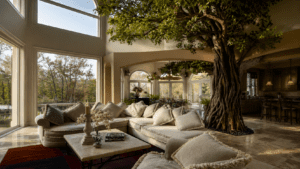
A custom artificial tree for a high-end home is a made-to-order botanical sculpture, scaled to the room and built to look like a mature specimen of a real species. It is a different category from anything sold at retail. At International Greenscapes, the parent of NATUREMAKER®, PLANTWORKS®, and TREESCAPES®, we hand-build trees that are 87% botanically accurate, with bark textures carved from molds of real trees and foliage placed the way it grows in nature. For a private estate, a penthouse, or a major renovation, that level of craft is the difference between an object that fills a corner and an architectural feature the room is designed around.
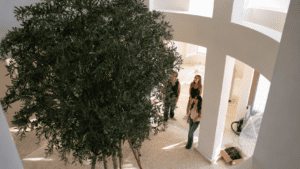
We have spent more than 40 years building trees for luxury hotels, museums, airports, and corporate headquarters. The same engineering and artistry behind those landmark spaces is available to a private home. One recent example: a 14.5-foot custom olive tree we built from a real olive trunk for a Las Vegas residence, featured on HGTV’s Sin City Rehab with designer Alison Victoria. It anchors the room without crowding it, with enough walk-under clearance to keep sightlines open. That is what a custom artificial tree can do for a serious home.
What separates a custom artisan tree from a retail faux tree
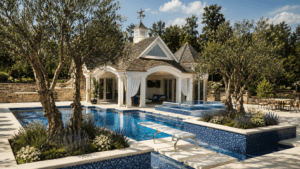
The faux trees sold through home retailers are mass-produced to a fixed size, with molded trunks and generic foliage. They work as filler. They do not hold up as the focal point of a designed room, and they do not survive close inspection in good light. A custom artisan tree is built the opposite way: to spec, at the scale the architecture calls for, with realism that reads as natural even up close.
In a home where the rest of the space is custom, a stock tree is the one element that gives the whole room away. A made-to-order tree belongs there.
Why designers choose artificial over live trees indoors
A mature live tree indoors is harder to keep alive than most people expect, and the failure is public when it dies in the middle of a beautiful room. The practical problems we hear about most often:
- Light. Most interior spots a designer wants a tree (a stair landing, a windowless entry, a deep great room) do not get the sustained direct light a real tree needs.
- Humidity and climate. Conditioned indoor air is dry, and the temperature swings of a home that empties out for part of the year are hard on living specimens.
- Pests and mess. Live trees drop leaves, attract insects, and bring soil and watering into a finished interior.
- Replacement. When a live tree declines, it has to be removed and replaced, which means disruption and cost on a recurring basis.
A custom artificial tree removes all of that. It looks the same in January and July, in a bright atrium or a dim corner, in a primary home or a place that sits empty for months. There is no watering, no pruning, and no replacement cycle. That reliability is why most luxury residential trees we build run through professional design teams: the designer gets the look they specified, and the client never has to manage it.
What you can customize
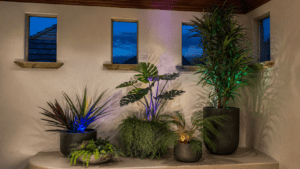
Because each tree is built to order, nearly every element is a design decision rather than a constraint. The main variables:
- Species. Olive, ficus, cherry blossom, birch, oak, Italian cypress, and effectively any species you can show us.
- Height and canopy width. Sized to your ceiling and the volume of the room, with walk-under clearance set wherever you want it.
- Trunk character. A real preserved wood trunk for authentic grain and bark, or a sculpted steel core for larger and more dramatic forms.
- Branch density and foliage. Full and lush, or open and sculptural, with seasonal variation in the foliage where the species allows it.
- Planter integration. The base and planter are designed to match the room’s materials, whether that is matte black, stone, or a custom finish.
A useful rule of thumb on scale: a tree should read as generous without fighting the ceiling. In a room with standard residential ceilings, a natural wood trunk tree in the 6-to-16-foot range usually fits beautifully. Double-height great rooms and atriums open the door to far larger statement pieces. We work all of this out with you before anything is built. If you want to understand how scale and complexity drive the investment, our overview of custom artificial tree cost walks through the factors involved.
Two ways we build trees for the home
There are two construction paths, and the right one depends on the scale and the look you are after.
For most residential interiors, a natural wood trunk tree from PLANTWORKS® hits the sweet spot: the trunk is a real preserved specimen, so the bark and grain are authentic, and the height range fits the ceilings most homes actually have. The Las Vegas olive tree on Sin City Rehab was built this way. When a room can take something monumental, a steel-core tree from NATUREMAKER® gives us almost unlimited freedom on scale and form.
Best tree species for luxury interiors
Some species simply photograph and live better indoors than others. The ones we build most often for high-end homes:
- Mediterranean olive. Our number one species. Gnarled trunk, silvery foliage, and a wide, sculptural canopy that suits both modern and classical interiors. Our artificial olive trees are the most-requested tree we make, for homes and commercial spaces alike.
- Ficus. Dense, lush, and timeless, the classic indoor tree silhouette.
- Cherry blossom. A soft, romantic statement that brings color and movement to an entry or stair.
- Birch. Clean white bark and a light, airy canopy that works well in single or multi-trunk groupings.
- Oak. Substantial and grounding, with a majestic branching habit.
- Italian cypress. Tall and narrow, ideal for framing a doorway or flanking a fireplace where floor space is tight.
Olive’s mix of drama and restraint is why it leads, but the right species ultimately follows the room.
How the design process works for a private home
We do not sell trees off a shelf, so the process starts with a conversation, not a transaction. There is no charge to design with us, and we iterate as many times as it takes to get it right before any order is confirmed. A typical path:
- Consultation. We learn the room, the ceiling height, the light, the materials, and the look you are after.
- Species and concept. We recommend species and a construction approach, and develop renderings so you can see the tree in the space.
- Refinement. We revise the design until it is right. The team behind that Las Vegas olive tree staged it in our showroom and fine-tuned it with the designer before it ever reached the home.
- Collaboration with your team. We work directly with your architect or interior designer, integrate with CAD drawings, and provide engineering documentation when a building department needs it.
- Fabrication and assembly. The tree is built by our artisans and assembled on site by our crew.
If you are working with a designer, this slots cleanly into their workflow. They specify, we build, and the tree arrives engineered and ready. Our residential work sits alongside projects in the luxury home-furnishings world, including the custom olive trees in the Three Arts Club atrium at RH Chicago, which is exactly the aesthetic many high-end homes are reaching for.
The showroom is where most of this becomes real. Photographs and renderings only go so far with work this tactile. In our Las Vegas, Miami, and San Diego showrooms, you can stand under the canopy, run a hand along the bark, and see the realism up close. Clients who visit a showroom stop wondering whether a custom tree will look right in their home.
Where custom artificial trees make the most sense
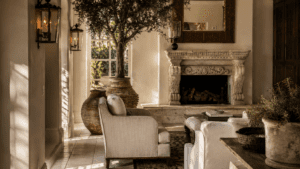
The case is strongest exactly where live trees struggle.
- Second homes and vacation properties that sit empty for stretches, where no one is there to water or watch a living tree.
- Rooms with difficult light, including interior spaces with no real daylight, where a live tree would slowly fail.
- Finished, high-stakes interiors where soil, dropped leaves, and pests are not acceptable.
- Tall volumes where the tree needs to be far larger than any potted live specimen could safely be.
In each of these, the artificial tree is the only version that actually holds up over time.
The calm of nature, without the upkeep
Part of what a tree does in a home is psychological. Bringing the form of nature indoors is the core idea behind biophilic design, and the visual presence of a large tree changes how a room feels: softer, calmer, more grounded. A custom artificial tree delivers that sensory cue reliably, in places and seasons where a living tree could not survive to provide it. We are careful here, because most published wellness research studies live plants and real views of nature, so we frame our trees as delivering the look and feeling of nature rather than claiming the same measured health outcomes.
Frequently asked questions
How realistic do custom artificial trees look?
Very. Our trees are 87% botanically accurate, with bark textures hand-carved from molds of real specimens and foliage placed to follow natural growth patterns. Up close, most people cannot tell, which is the entire reason we encourage a showroom visit.
What is the most popular indoor tree species?
Mediterranean olive is our best-selling species. Its gnarled trunk and wide, silvery canopy work in modern and traditional interiors alike. Ficus, cherry blossom, birch, and oak are also frequent choices for homes.
How tall can an indoor artificial tree be?
It depends on construction. Natural wood trunk trees typically run about 6 to 16 feet, which fits most home ceilings. Steel-core trees can be built much larger for double-height rooms and atriums, scaled to the architecture.
Do custom artificial trees need any maintenance?
Almost none. There is no watering, pruning, feeding, or pest control. An occasional light dusting keeps the foliage looking its best, and the tree is built to last decades.
Can a tree be made to match a specific room?
Yes. Every tree is made to order. We size the height and canopy to your ceiling and floor plan, select the species and trunk type, tune the branch density, and design the planter to match your materials.
Design a tree for your space
If you are planning a custom build, a major renovation, or a statement piece for a private home, we would like to design it with you. Bring us a sketch, a photo, or a set of CAD drawings, and our team will recommend a species, develop renderings, and refine the design until it is right. Better yet, visit one of our showrooms in Las Vegas, Miami, or San Diego to see the craftsmanship in person. Start a project conversation with us and we will take it from there.