
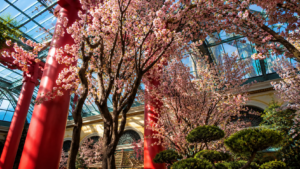
Choosing an artificial tree for a commercial lobby comes down to five decisions: scaling the tree to the ceiling height, picking a species that suits the architecture, confirming the foliage meets fire code, keeping the piece clear of accessible routes, and buying from the company that actually fabricates the tree rather than a reseller. Get those right, and the tree reads as a sculptural centerpiece. Get them wrong, and even an expensive piece looks like filler in exactly the space where filler is most visible. At International Greenscapes, we have fabricated and assembled more than 20,000 commercial botanical projects across our three brands since 1983, and our trees are 87% botanically accurate, the level of realism that full lobby lighting demands.
The conditions that make a lobby comfortable for people are hostile to living trees. Energy-efficient glazing filters out the light spectrum large trees need for photosynthesis. Climate-controlled air pushes humidity well below what tropical species require. And when a living tree inevitably attracts pests indoors, the EPA notes that pesticide treatments linger far longer in enclosed commercial spaces than they would outdoors, creating air quality and liability concerns for building occupants. A living ficus or olive in these conditions tends to decline within a few years and becomes a recurring replacement cost. An artificial tree built with commercial-grade materials delivers the same biophilic presence with routine dusting as the only maintenance. Research from Terrapin Bright Green shows that commercial properties with strong biophilic elements can command rent premiums and measurably improve occupant productivity, which means the lobby tree is working as an economic asset alongside a visual one.
Five factors that make or break a lobby tree
Most lobby tree mistakes trace back to one of these. Work through them in order, because scale and code compliance constrain everything else.
- Ceiling height and proportion: how tall the tree should be relative to the room
- Species and form: what matches the architecture and the footprint you have
- Fire code compliance: the testing standards your fire marshal will require
- Accessible routes: keeping branches out of ADA-protected circulation paths
- Materials and sourcing: steel-core engineering, foliage quality, and who stands behind it
Match the Tree to Your Lobby’s Ceiling Height
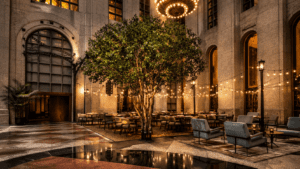
Scale is the single factor that decides whether a tree commands a room or disappears in it. The working rule among interior designers is that a feature tree should fill roughly two-thirds to three-quarters of the floor-to-ceiling height. A tree shorter than that leaves a visual vacuum above it and makes the whole room feel smaller.
In practice, that means:
- A reception area with a 15-foot ceiling calls for a tree around 10 to 11 feet
- A double-height lobby at 20 feet, wants a tree in the 14 to 16 foot range
- A grand atrium at 30 feet or more needs a custom tree of 20 feet or taller to hold the space
Leave breathing room at the top. We recommend keeping 12 to 20 inches of clearance between the highest foliage and the ceiling. When a canopy crowds or touches the ceiling, the eye reads it as forced into a space too small for it, and that breaks the illusion of a naturally grown tree. We break down the full sizing mechanics, including canopy spread, floor load, and structural requirements, in our guide to choosing the right scale and structure for large artificial trees.
The planter follows the same logic. A top-heavy tree on a small base looks unstable, so the planter width should run at least a third of the tree’s height. For monumental trees, the base is usually a custom architectural enclosure or a recessed floor pit that hides the steel baseplate and anchoring, finished at eye level with river stone, preserved moss, or natural bark.
Choose a Species That Fits the Architecture
Once the height is set, the species choice is about matching the building’s character and your floor footprint. Some forms read formal, some Mediterranean, some regional. Here is how we typically guide clients by scale and style.
| Lobby Type | Typical Ceiling | Species and Forms That Work | Why |
|---|---|---|---|
| Boutique reception, warm or Mediterranean feel | 10 to 16 ft | Multi-trunk olive, smaller sculptural trees | Soft silvery foliage, intimate scale, classic hospitality look |
| Mid-height hotel or corporate lobby | 15 to 25 ft | Live oak, larger olive, ficus | Broad sculptural canopies that frame seating and soften architecture |
| Grand atrium or rotunda | 25 ft and up | Birch, monumental oak, custom sculptural trees | Tall, light-filled forms that draw the eye up the full volume |
| Narrow footprint or flanking an entrance | Any | Italian cypress, columnar forms | Vertical presence without a wide canopy eating floor space |
| Resort, pool-adjacent, or tropical interiors | Any | Preserved palms, fabricated palms | Tropical character engineered for high-traffic, climate-controlled rooms |
At the Fairmont Austin, a trio of custom live oak trees stands 20 feet tall to echo the iconic oaks of Central Texas and frame the open lobby’s communal seating. At VOCO Laguna Hills, a 16-foot multi-trunk olive tree anchors the lobby with a sculpted slate-inspired base and Mediterranean ease. At Bellin Health and Surgery Center in Green Bay, three 20-foot ficus trees fill a light-filled lobby atrium, softening the clinical architecture. And at the Walton Family Whole Health and Fitness facility in Bentonville, a 36-foot birch with a 24-foot canopy carries a soaring glass rotunda that a smaller tree could never hold. At the Datran Center in Miami, layered botanical elements fill a 10,000-square-foot atrium lobby with a 40-foot ceiling, transforming a transitional corridor into a calming arrival experience.
One lesson we return to often: bigger is not always right. On an HGTV project, the client originally specified a large custom steel-core tree for an atrium. When our team assessed the space, a natural-trunk tree from inventory actually fit better because the custom piece would have over-dominated the room. The point is not to default to the largest option. It is to match the tree to what the space actually needs.
If your design also calls for vertical greenery, a tree often pairs with a green wall to layer the space. We cover how those two elements complement each other in our guide to large-scale artificial green walls for commercial interiors.
Confirm Fire Code Compliance Before You Commit
This is the factor that gets trees rejected at inspection. A lobby is a public assembly space and a primary path of egress, so any tree in it is regulated by fire code under IFC Chapter 8. A consumer-grade piece without proper certification can be pulled by the fire marshal, delay your certificate of occupancy, and create liability exposure. The standards below are the ones that come up most often.
| Standard | What It Covers | Why It Matters for a Lobby Tree |
|---|---|---|
| NFPA 701 (Test Method 2) | Freestanding decorative materials, including dense synthetic foliage | The correct test for heavy polymer trees verifies that the foliage resists flame spread and does not produce flaming drips |
| ASTM E84 (Class A) | Materials classified as interior finishes, such as wall-mounted greenery | Applies when foliage is anchored to a wall or covers a large share of its surface; Class A is the top rating |
| California Title 19 | California State Fire Code for high-occupancy public spaces | The strictest tier requires testing and product registration with the California State Fire Marshal |
One detail catches buyers off guard. NFPA 701 has two test methods, and lightweight Test Method 1 is meant for thin fabrics. A dense artificial tree should be certified under Test Method 2, which is built for heavier synthetic materials. A Test Method 1 certificate on a heavy tree is a compliance gap waiting to surface at inspection.
The bigger distinction is how the fire retardancy is achieved. Cheaper trees are dipped or sprayed with a topical flame retardant after manufacturing. That coating leaves a tacky film, attracts dust, and wears off over a few years, which puts a recurring recertification burden on your facility team. Commercial-grade trees use inherently fire-retardant (IFR) materials, where the fire-safe chemistry is fused into the polymer during molding. It is permanent, leaves no residue, and never needs reapplication. Our foliage is engineered to meet ASTM E84 Class A, NFPA 701, and California Title 19, and we provide stamped certifications for fire marshal review. We go deeper on this topic in our breakdown of fire-rated artificial trees and code compliance.
Keep Branches Clear of Accessible Routes
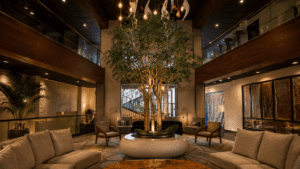
A lobby is a circulation path, so a freestanding tree has to respect the Americans with Disabilities Act. The relevant rules are in ADA Section 307 on protruding objects, and they exist to protect people who navigate with a cane.
- Branches and foliage cannot hang below 80 inches in any active walkway
- Between 27 and 80 inches above the floor, nothing can protrude more than 4 inches into the path
- The planter or base must stay wider than the overhanging branches and stand at least 27 inches tall, so a cane detects it before anyone reaches the canopy
- The tree and planter cannot pinch the accessible route below its required 36-inch minimum width
This is a placement and base-design problem, and it is easy to solve when considered early. The fix is usually a cane-detectable planter or a low architectural barrier that sits under the widest part of the canopy. The US Access Board publishes the full technical details in its accessibility guidelines.
How to Judge Construction Quality Under Lobby Lighting
Under full lobby lighting, cheap materials announce themselves. Glossy leaves, visible seams, and a faded canopy all read as artificial from across the room. The quality markers worth confirming:
- Foliage molded from high-grade polyethylene with a natural matte finish rather than a glossy sheen
- UV stabilizers are built into the material, so the color holds under skylights and glass facades for years
- Hand-sculpted bark or preserved natural wood trunks rather than a uniform molded texture
- A reinforced steel core on any tree over roughly 10 to 15 feet
That steel core is not optional at scale. A monumental tree carries a heavy canopy spanning 10 to 20 feet, and only an internal steel armature can support it and meet seismic and wind-load requirements for an open atrium. Our NATUREMAKER® steel-core trees are built around welded steel armatures by certified welders and ship with stamped structural calculations and seismic documentation. Steel baseplates are engineered to bolt into the building’s foundation. For preserved palms and fabricated trees built for durability in high-traffic and outdoor-adjacent settings, TREESCAPES® handles the engineering.
Buy from the Manufacturer, Not a Distributor
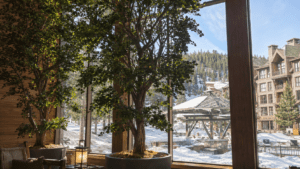
A distributor resells imported stock. That limits customization, slows the timeline, and leaves no one accountable for engineering or code documentation. A manufacturer controls the materials, the fabrication, and the certifications.
We are the manufacturer. Every tree is fabricated in-house at our facilities in San Marcos, California; Las Vegas, Nevada; and Miami, Florida, by certified welders, sculptors, and scenic artists. That means we can match a custom height, finish, or form to your space, provide the engineering stamps your building department needs, and stand behind the piece for the decades it stays in place. It also means one point of contact can deliver the lobby tree, PLANTWORKS® green walls, and the preserved palms for the pool deck on a single coordinated timeline, instead of you managing three vendors who have never worked together.
What to Look for in a Vendor Partner
When you evaluate a supplier for a lobby tree, the checklist is short but telling:
- They fabricate the trees themselves and can prove it
- They provide stamped fire and structural certifications, not just a generic flame-retardant claim
- They use inherently fire-retardant materials rather than topical sprays
- They engineer a steel core for any large tree and supply seismic and wind documentation
- They will customize species, height, and finish to your design rather than offer stock units
- They handle delivery and on-site assembly with their own crews
- They have a portfolio of comparable commercial projects you can reference
Frequently Asked Questions
How tall should an artificial tree be for a lobby?
Plan for roughly two-thirds to three-quarters of your floor-to-ceiling height, then leave 12 to 20 inches of clearance at the top. A 15-foot ceiling suits a tree near 10 to 11 feet; a 30-foot atrium needs 20 feet or more.
What fire rating does a lobby tree need?
Most commercial lobbies require foliage that meets NFPA 701 Test Method 2 and, depending on placement, ASTM E84 Class A. California projects also require California Title 19 registration. Ask for stamped certifications and confirm the materials are inherently fire-retardant rather than topically treated.
How long do commercial artificial trees last?
Built with commercial-grade materials and UV stabilizers, they hold their appearance for decades with only routine dusting. That durability is what makes them more economical than cycling through declining live trees. We cover the cost comparison in our guide to custom artificial tree cost for commercial projects.
Get Your Lobby Tree Specified Right
A lobby tree is a long-term architectural element, and the specification details decide whether it elevates the space or undercuts it. If you are planning a project, reach out to our team, and we will help you scale the tree to your space, select the right species, and deliver the fire and structural documentation your building department needs. We have been doing this for over 40 years and more than 20,000 projects, and we would be glad to do it for yours.